
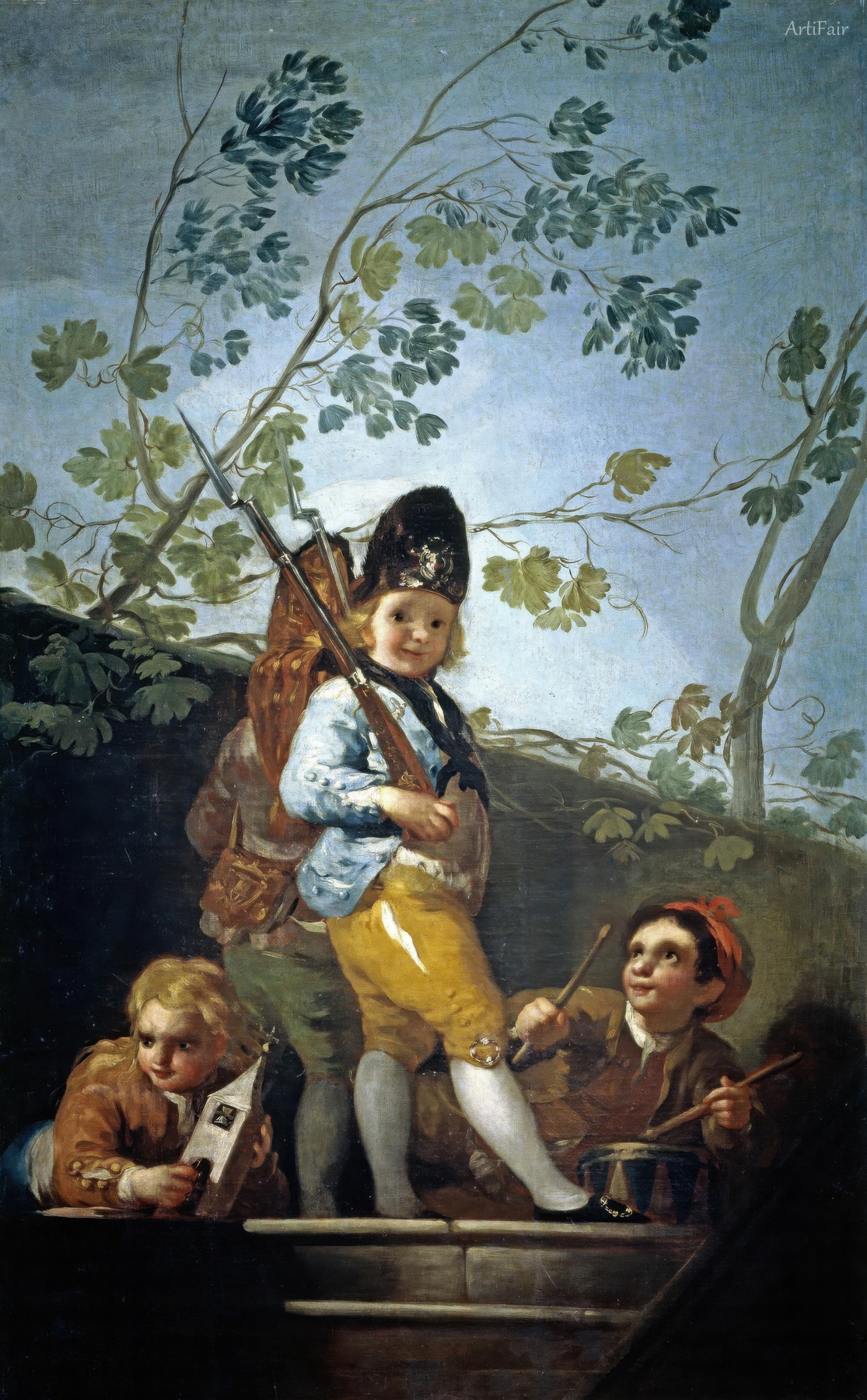
Boys Playing Soldiers
Category:
Created:
1779
Likes:
0
Dimensions:
Download:
New users get 4 free credits. 2K costs 1 credit; 4K and Ultra HD are priced by resolution. Public domain artworks can be used commercially.
Dominant colors
Public domain download summary
This artwork is provided as a public domain image resource. The 2K file costs 1 credit for everyday creative work, while 4K and Ultra HD files are priced by resolution.
Art Appreciation
Boys Playing Soldiers (Muchachos jugando a soldados) is an oil-on-canvas cartoon by Francisco Goya, a full-size design for a woven wall hanging in the royal palace of El Pardo near Madrid, dated 1779 by the Museo del Prado, which owns it.
In the late 1770s the young Goya worked for the Royal Factory of Santa Bárbara in Madrid, painting full-size models from which weavers produced hangings for the royal residences. This cartoon belongs to a set of seven on varied subjects, dated 1778–1779, for the bedroom of the Princes of Asturias, the future Charles IV and María Luisa of Parma, at El Pardo; six of the seven are in the Prado. Its tall, narrow format reflects its purpose as an overdoor. Children were a favourite subject for such places, and Goya had already used them over the doors of the palace dining room as a counterpoint to the adult scenes; the related cartoons include Children with a Cart and Boys Picking Fruit. Following Tomlinson, the Fundación Goya en Aragón links the children's make-believe to the brief joy of childhood and the folly of the adult spectacle shown in the neighbouring scenes.
Four children play at war. Two march with rifles on their shoulders, one beats a drum and another carries a miniature church tower from a fair, set on a rise so that the low viewpoint makes them loom against the sky. The Prado singles out the little soldier at the front, facing the viewer with martial air and comic pride, as one of the finest images of childhood in Goya's work. Yellowish and bluish tones keep the mood light, and the brushwork and lighting have been seen as anticipating Impressionism. The weavers had to change parts of the composition to suit the taste of the time.
The cartoon, 146 × 94 cm, was delivered to the Santa Bárbara factory on 6 January 1779, moved to the Royal Palace in Madrid in 1856–1857 and entered the Prado in 1870. An oil sketch for it is in the Yanduri collection in Seville.