
The Red Kerchief
Category:
Created:
1873
Likes:
2
Dimensions:
Download:
New users get 4 free credits. 2K costs 1 credit; 4K and Ultra HD are priced by resolution. Public domain artworks can be used commercially.
Dominant colors
Public domain download summary
This artwork is provided as a public domain image resource. The 2K file costs 1 credit for everyday creative work, while 4K and Ultra HD files are priced by resolution.
Art Appreciation
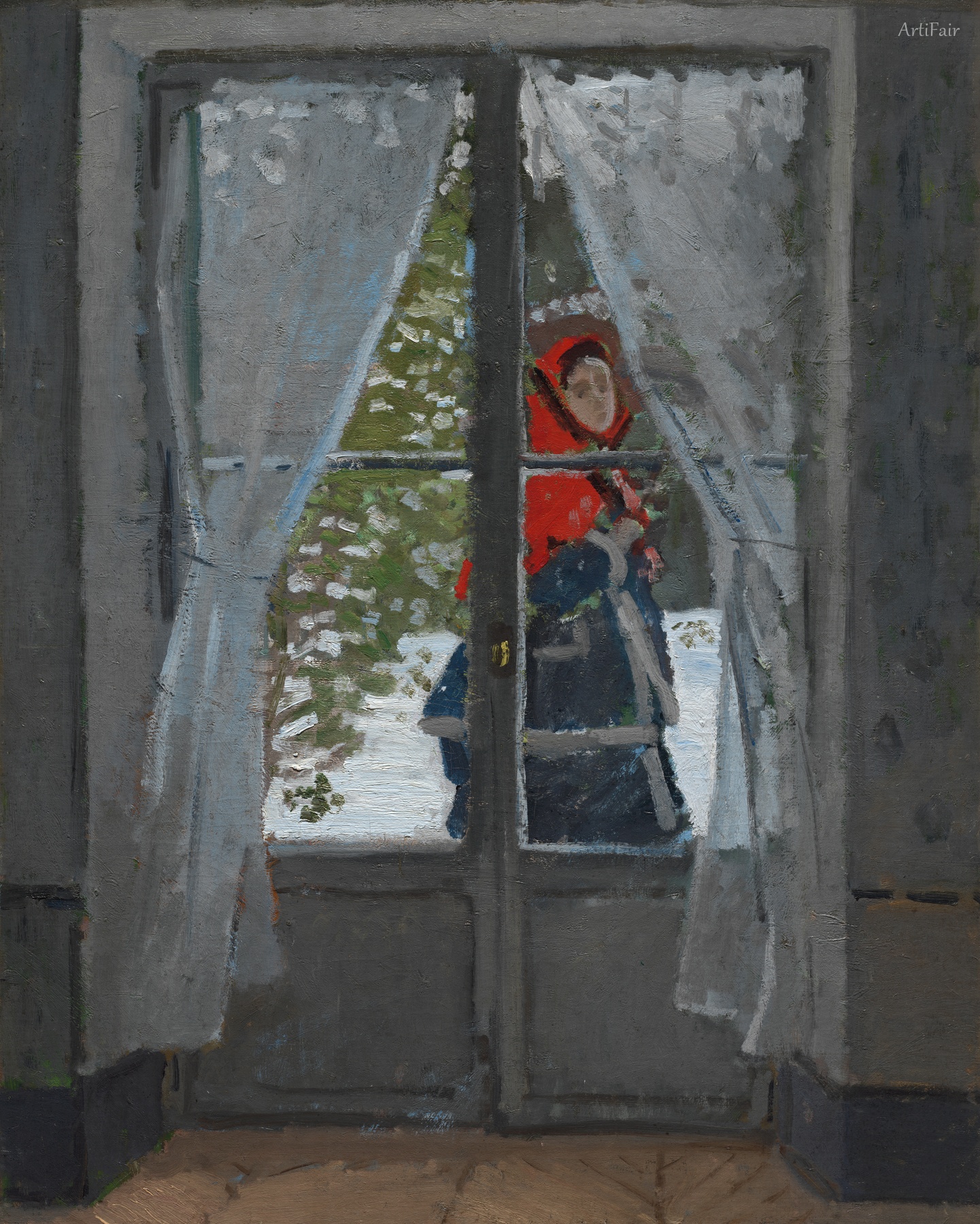
The Red Kerchief (Femme à la capeline rouge), also known as The Red Cape or Madame Monet, is an oil painting by Claude Monet dated about 1868–73, showing his first wife Camille passing in the snow outside the French doors of their home in Argenteuil; it belongs to the Cleveland Museum of Art.
Monet painted it while living at Argenteuil, the town on the Seine near Paris where the quiet of his home let him work undisturbed and spend time with his family. The canvas measures 99 by 79.8 cm. It is his only known snow scene that includes Camille Doncieux, whom he had married in 1870.
The composition is built as a view from inside a room: the dark wall, the floorboards and two pale curtains tied back on either side frame the glazed doors, and through the glass Camille appears in a bright red hood, glancing towards the house as she walks past. The Cleveland Museum describes her face as rendered with bold daubs of paint applied quickly, while the snow and the trees are made of broad, broken strokes of pure white and green. The patch of red draws the eye beyond the glass and fixes a passing moment.
According to the museum, the painting was especially dear to Monet and he kept it all his life. After his death it passed to his son Michel Monet, then from 1939 belonged to Edouard Molyneux in Paris. In 1948 the Carroll Carstairs Gallery in New York sold it to the Cleveland collector Leonard C. Hanna Jr., who bequeathed it to the museum in 1958. It has since been lent to exhibitions including Claude Monet: Seasons and Moments at the Museum of Modern Art in 1960 and Impressionists in Winter: Effets de Neige at the Phillips Collection in 1998–99.