
I Am Half-Sick of Shadows, Said the Lady of Shalott
Category:
Created:
1915
Likes:
4
Dimensions:
Download:
New users get 4 free credits. 2K costs 1 credit; 4K and Ultra HD are priced by resolution. Public domain artworks can be used commercially.
Dominant colors
Public domain download summary
This artwork is provided as a public domain image resource. The 2K file costs 1 credit for everyday creative work, while 4K and Ultra HD files are priced by resolution.
Art Appreciation
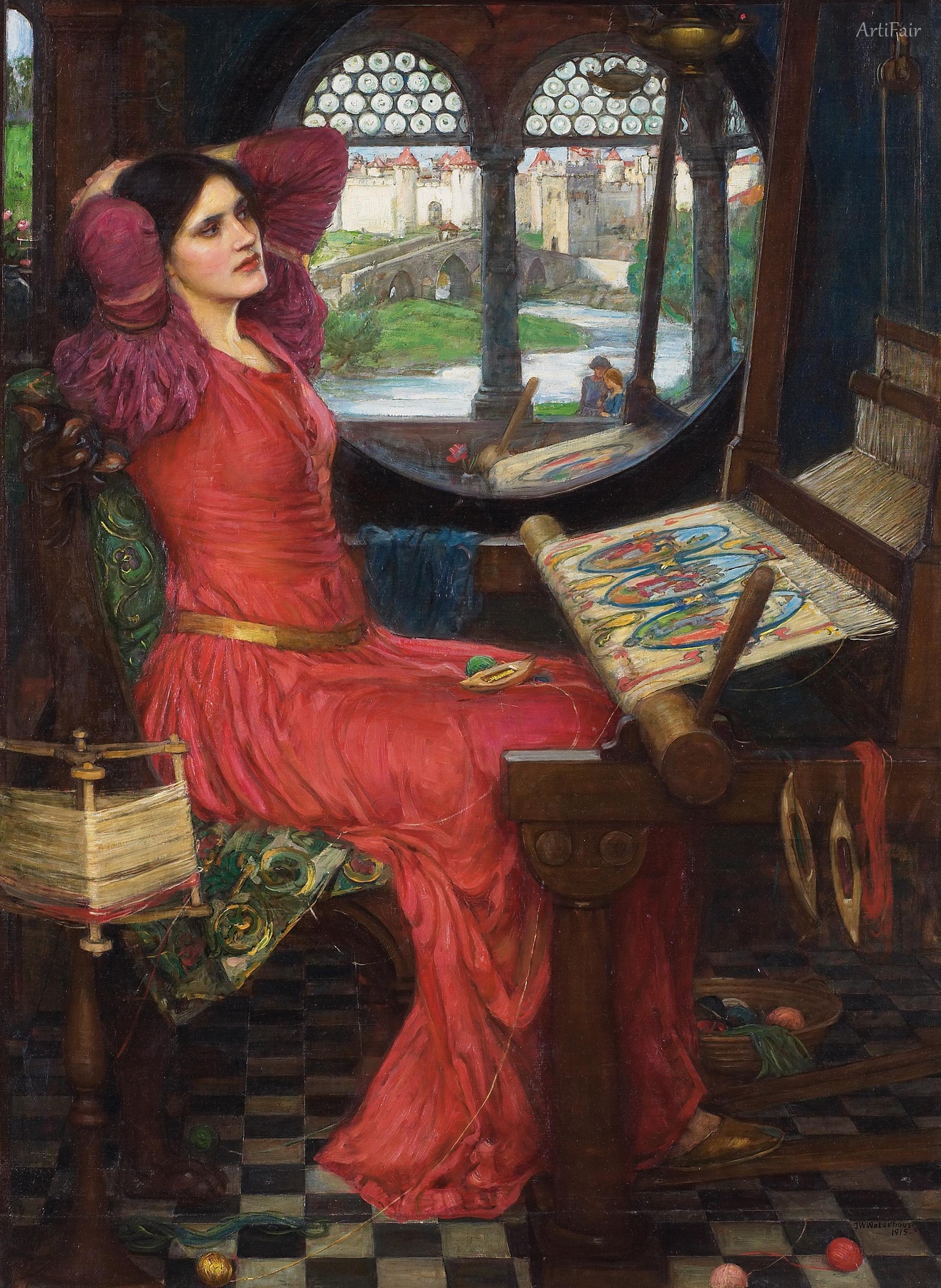
I Am Half-Sick of Shadows, Said the Lady of Shalott is an oil painting on canvas by John William Waterhouse, signed and dated 1915, in the collection of the Art Gallery of Ontario, Toronto.
It was Waterhouse's third picture from Tennyson's poem The Lady of Shalott, and its title quotes the closing lines of the poem's second part. The Lady lives under a curse in a tower near Camelot: she must weave without looking directly out of the window, seeing the world only as reflections in a mirror. Waterhouse's earlier versions showed later moments, her departure for Camelot by boat in 1888 (Tate) and the instant she sees Lancelot and turns to the window in 1894 (Leeds). Here the story is at an earlier point. Resting from her weaving, the Lady leans back in her chair with her hands behind her head, while the large round mirror behind her shows a bridge over a river leading to the walls and towers of Camelot and a man and woman nearby, perhaps the two young lovers lately wed of Tennyson's verse whose sight makes her weary of shadows.
She wears a red dress in a room whose Romanesque columns hold up the arches of the window reflected in the mirror. The frame of the loom and the geometric floor tiles lead the eye back into the room, where reds, yellows and blues echo the brighter colours outside. A single poppy appears in the mirror, and the shuttles of the loom are shaped like boats, foreshadowing her death on the river.
The painting, 100.3 by 73.7 cm, was exhibited at the Royal Academy Summer Exhibition in 1916, the year before Waterhouse died. It was sold from the estate of the accountant John George Griffiths at Hampton's in 1923 for 300 guineas, passed through the dealer Arthur de Casseres and belonged to Mr and Mrs Frederick Cowan. Their great-niece, the wife of the Canadian engineer Philip Berney Jackson, gave it to the Art Gallery of Ontario in 1971.