
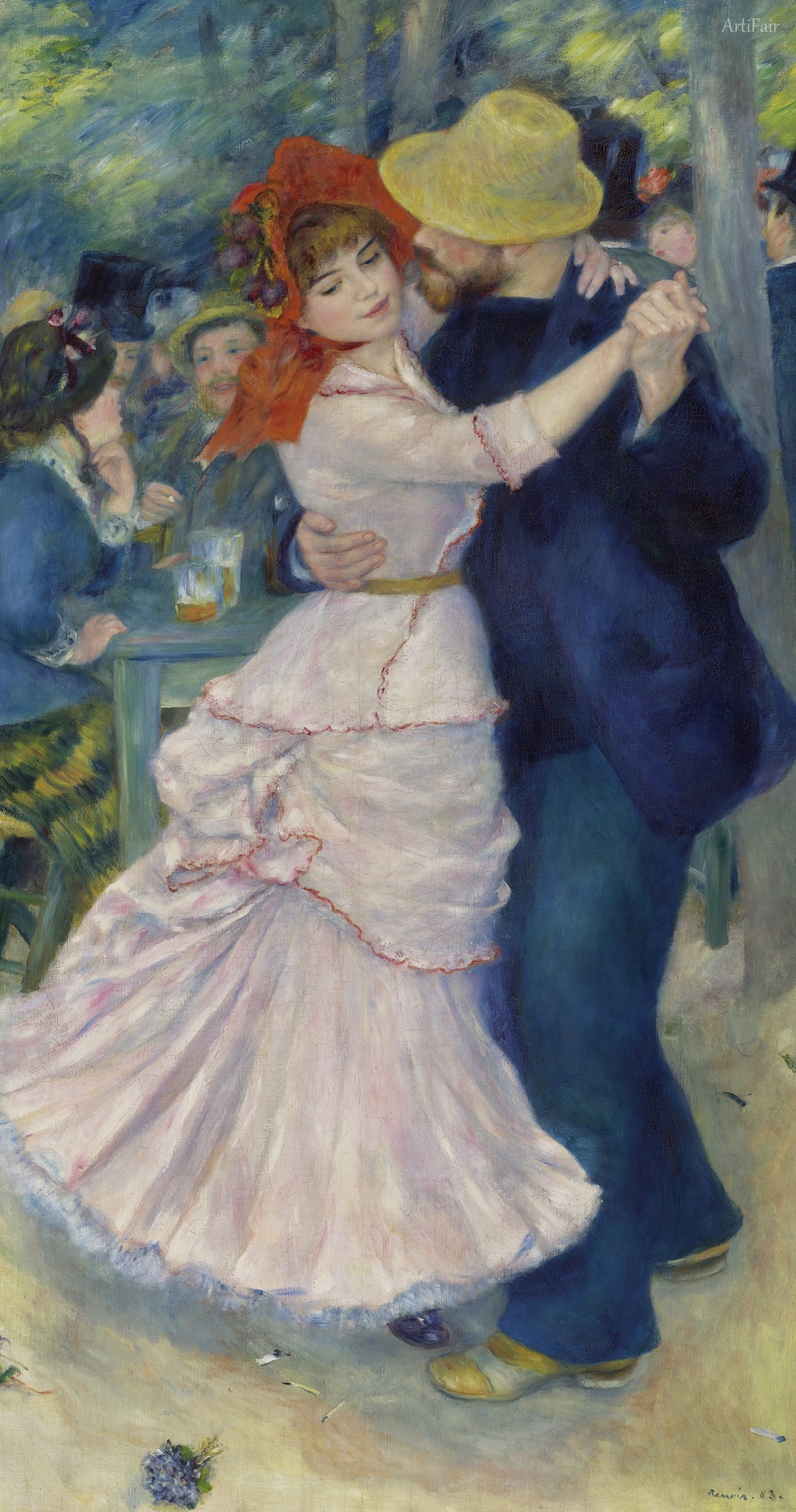
Dance at Bougival
Category:
Created:
1883
Likes:
0
Dimensions:
Download:
New users get 4 free credits. 2K costs 1 credit; 4K and Ultra HD are priced by resolution. Public domain artworks can be used commercially.
Dominant colors
Public domain download summary
This artwork is provided as a public domain image resource. The 2K file costs 1 credit for everyday creative work, while 4K and Ultra HD files are priced by resolution.
Art Appreciation
Dance at Bougival (La Danse à Bougival) is an oil-on-canvas painting by Pierre-Auguste Renoir, signed and dated 1883, in the Museum of Fine Arts, Boston. It measures 181.9 by 98.1 cm and shows a couple dancing, almost life size, at an outdoor café in Bougival, a village on the Seine about 15 km from central Paris also painted by Monet, Sisley and Berthe Morisot.
It is one of three dance pictures produced for the dealer Paul Durand-Ruel, together with Dance in the City and Dance in the Country, now in the Musée d'Orsay. The curator Colin B. Bailey has dated all three to January to April 1883, which he called among the most productive three months of Renoir's career. The group is often described as Renoir's last foray into Impressionism, painted as he turned towards a more classical manner after his time in Italy while keeping a bright range of colour. The models are debated. The usual view is that they are Suzanne Valadon and Renoir's friend Paul Lhote, but Bailey has suggested the man may be Alphonse Fournaise, son of the Chatou restaurant owner, and some historians see in the woman features of both Valadon and Aline Charigot.
The woman's pale pink dress and red bonnet set off the man's deep blue suit and straw hat, while drinkers sit at a table on the left and a posy of flowers lies on the trampled ground. X-rays show that Renoir first gave the woman a different hat, closer to that of the dancer in Dance in the Country, and in a letter to the Bernheim brothers he recalled that he had first painted his dancer with a white jacket and then changed it to blue, regretting that he had not waited a month.
Renoir deposited the canvas with Durand-Ruel in April 1883. It reached a London exhibition late, prompting The Academy to lament the absence of this great and audacious masterpiece, and in 1886 it was shipped to New York. After passing through Mme Hiltbrunner, it returned to Durand-Ruel, who sold it in 1894 to Félix-François Depeaux of Rouen. At the Depeaux sale of 1906 it went to his brother-in-law Edmond Décap, and in April 1937 Jacques Seligmann and Co. sold it to the Boston museum for $150,000.