
The Flower Girls or Spring
Category:
Created:
1786
Likes:
0
Dimensions:
Download:
New users get 4 free credits. 2K costs 1 credit; 4K and Ultra HD are priced by resolution. Public domain artworks can be used commercially.
Dominant colors
Public domain download summary
This artwork is provided as a public domain image resource. The 2K file costs 1 credit for everyday creative work, while 4K and Ultra HD files are priced by resolution.
Art Appreciation
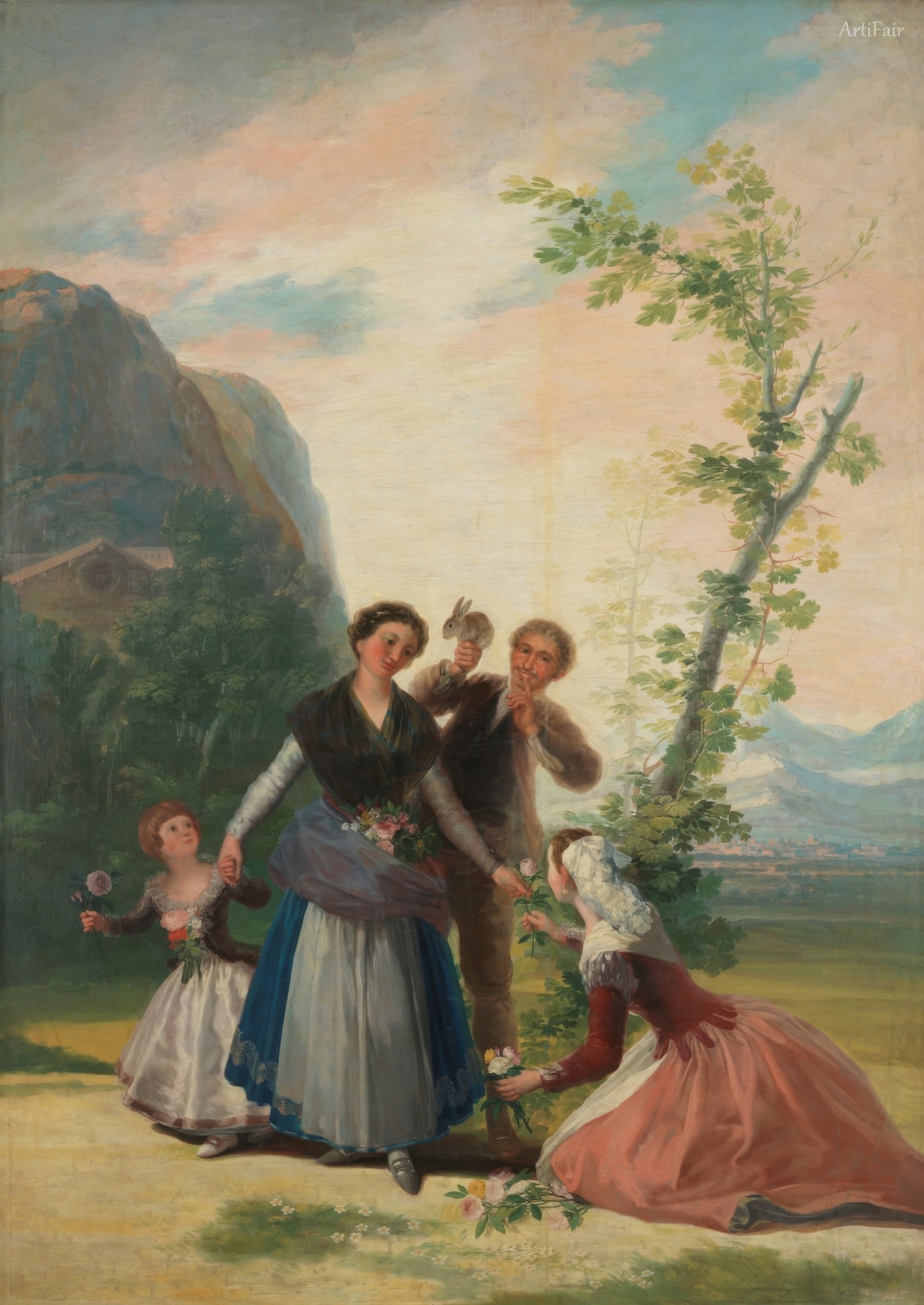
The Flower Girls or Spring (Las floreras o La Primavera) is an oil-on-canvas cartoon painted by Francisco Goya in the autumn of 1786; it measures 277 × 192 cm and belongs to the Museo del Prado, Madrid (P000793).
Goya painted it as the full-size model for a woven wall hanging in a set ordered in 1786–1787 for a room of the Prince and Princess of Asturias, the future Charles IV and Maria Luisa of Parma, at the palace of El Pardo; the Prado describes it as probably their dining room. The set of thirteen pieces on the Four Seasons and other country scenes, described at the time as subjects that were light-hearted and agreeable, was Goya's first work for the Real Fábrica de Tapices de Santa Bárbara after six years and his first after being named painter to the king. Its seasons were Spring, The Threshing Floor (Summer), The Grape Harvest (Autumn) and The Snowstorm (Winter). Because Charles III died in December 1788, the hangings never reached their intended room.
Rather than the traditional goddess Flora, Goya shows a contemporary offering of flowers in a sunny landscape. A young woman dressed as a maja kneels to hand a flower to a lady walking with her small daughter, while a countryman behind them raises a live hare and puts a finger to his lips, about to surprise her. The figures form a pyramid, and the flower sits at the centre where the diagonals cross; the hare too can be read as a sign of spring and fertility. The Prado suggests the mountains behind recall the Sierra de Gredos near Arenas de San Pedro, where Goya had spent two summers working for the Infante Don Luis, or the Guadarrama range near Madrid. The Fundación Goya en Aragón calls it the most traditional and Rococo of the El Pardo cartoons.
With its format, the hanging was meant for a side wall as the pair to The Grape Harvest. The cartoon stayed with the royal factory, was moved to the Royal Palace in Madrid in 1856–1857 and entered the Prado by royal orders of 1870. The Prado keeps eleven cartoons from the set and one of six known preparatory sketches.