
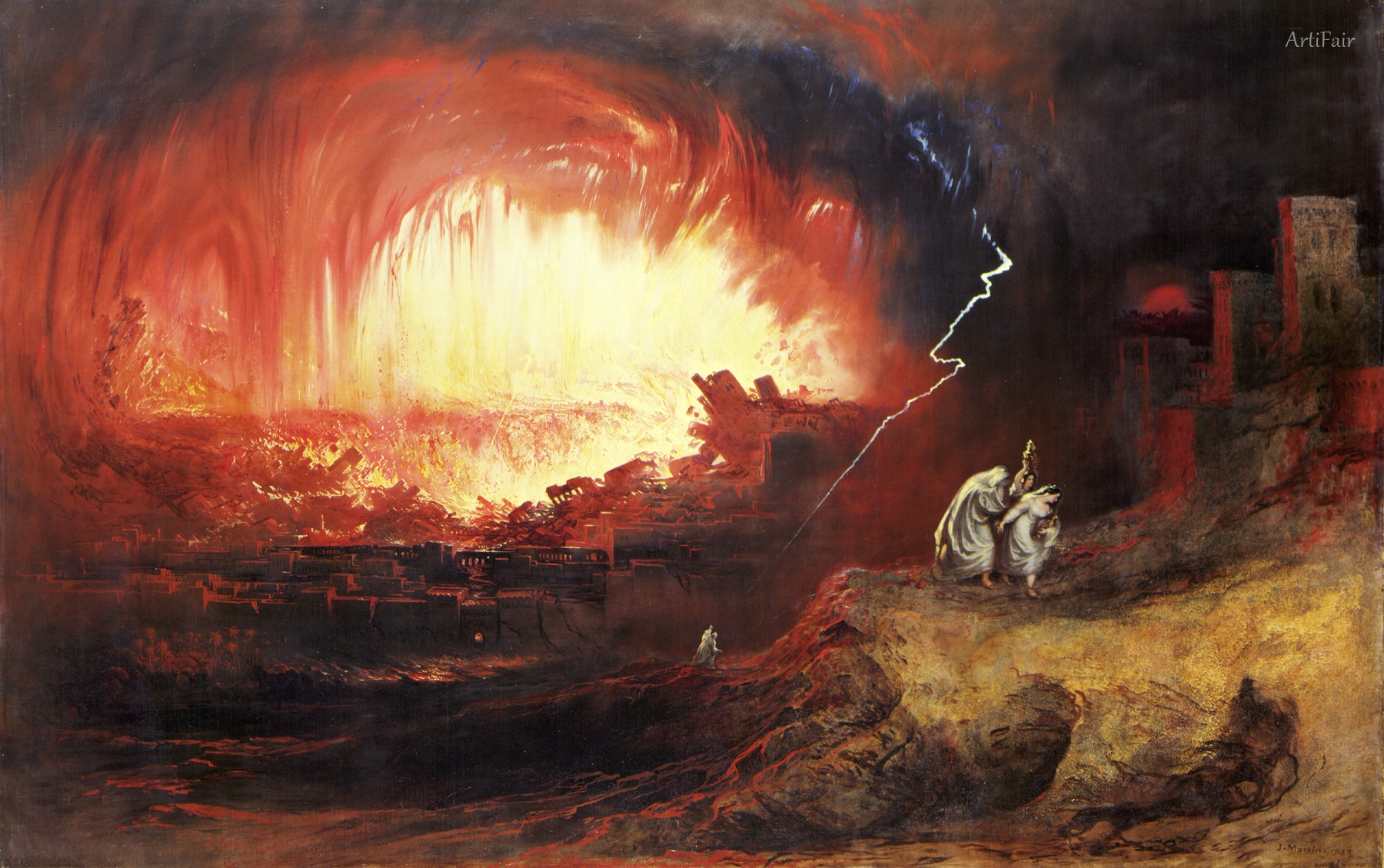
The Destruction of Sodom and Gomorrah
Category:
Created:
1852
Likes:
3
Dimensions:
Download:
New users get 4 free credits. 2K costs 1 credit; 4K and Ultra HD are priced by resolution. Public domain artworks can be used commercially.
Dominant colors
Public domain download summary
This artwork is provided as a public domain image resource. The 2K file costs 1 credit for everyday creative work, while 4K and Ultra HD files are priced by resolution.
Art Appreciation
The Destruction of Sodom and Gomorrah is an oil painting on canvas by John Martin, signed and dated 1852 and held by the Laing Art Gallery in Newcastle upon Tyne, part of Tyne & Wear Archives & Museums.
Martin was born in Northumberland and studied art in Newcastle before moving to London at the age of 17. He made his name with huge, theatrical canvases of catastrophe drawn from the Bible and ancient history, among them The Fall of Babylon (1831), The Fall of Nineveh, Pandemonium (1841) and The Eve of the Deluge (1840). In his lifetime many ranked him among the leading British painters, a rival of J. M. W. Turner for public recognition, though his reputation fell sharply after his death in 1854. This late picture was shown at the Royal Academy exhibition of 1852.
The subject comes from Genesis 19. God destroyed the two cities of the plain for the wickedness of their people, sparing only Lot and his family, who were told not to look back. Lot's wife disobeyed and was turned into a pillar of salt. Martin sets the burning cities beneath a vast arch of yellow and red flame that curls up into a whirling storm, with a fork of lightning striking towards the rocks. At the right, Lot and his two daughters hurry away along a narrow ledge, while a small pale figure stands behind them nearer the destruction: Lot's wife, already transformed. The fiery red colouring and the swirling sky are features found throughout Martin's scenes of divine vengeance.
In 1929 the painting arrived at the Laing as a long-term loan from the Newcastle shipowner and alderman J. F. Weidner, and its arrival prompted fresh local interest in the artist at a time when his work was widely neglected. Tyne & Wear Museums describes it as an outstanding example of his style, and his dramatic pictures as the source of his international fame in his own lifetime. The canvas measures 136.3 by 212.3 cm.