
Wheatfield with Crows
Category:
Created:
1890
Likes:
1
Dimensions:
Download:
New users get 4 free credits. 2K costs 1 credit; 4K and Ultra HD are priced by resolution. Public domain artworks can be used commercially.
Dominant colors
Public domain download summary
This artwork is provided as a public domain image resource. The 2K file costs 1 credit for everyday creative work, while 4K and Ultra HD files are priced by resolution.
Art Appreciation
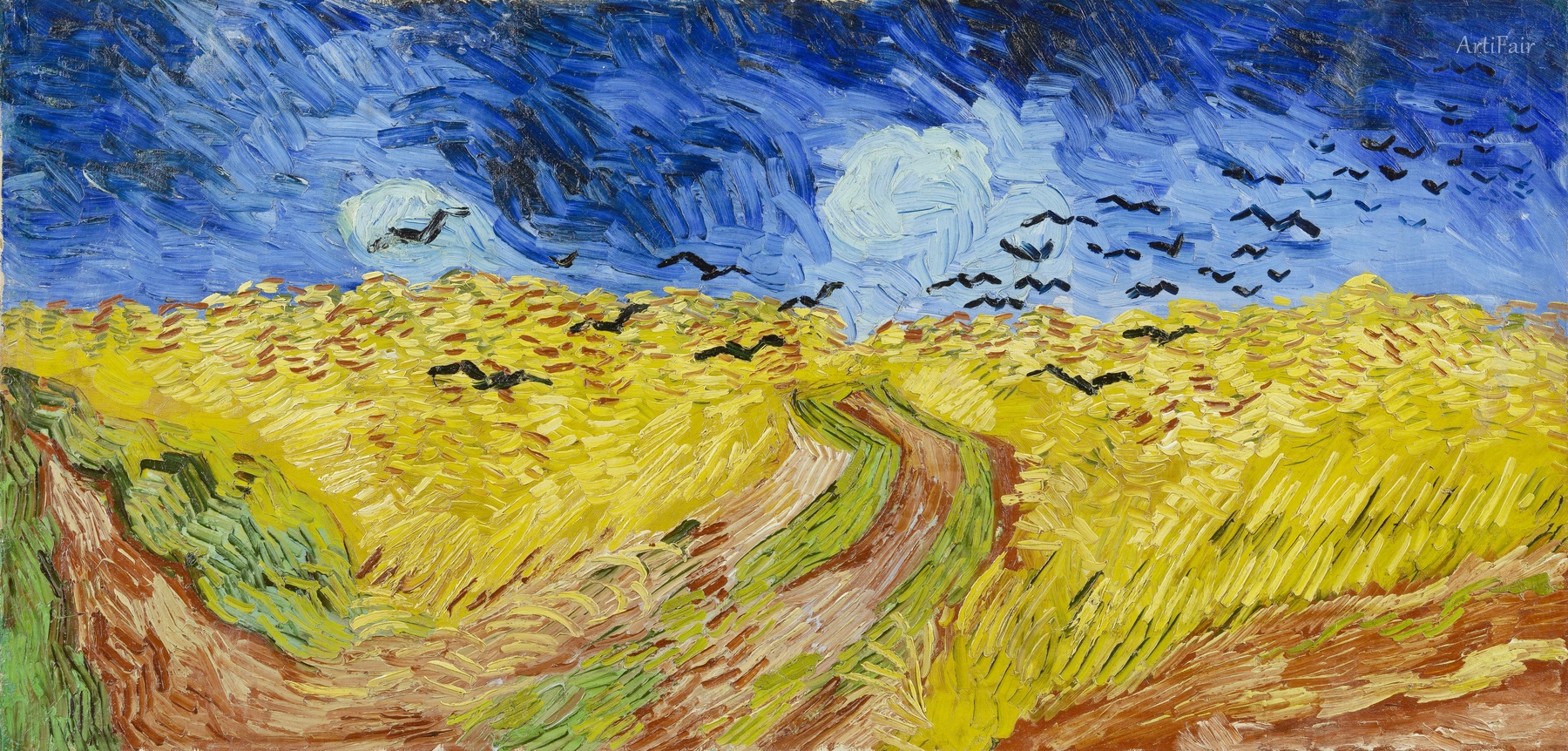
Wheatfield with Crows is an oil painting on canvas by Vincent van Gogh, made at Auvers-sur-Oise in July 1890 and now in the Van Gogh Museum, Amsterdam (Vincent van Gogh Foundation). It measures 50.5 × 103 cm.
Van Gogh spent the last weeks of his life at Auvers, north of Paris. On 6 July he visited his brother Theo in Paris, and in a letter written around 10 July to Theo and his wife Jo he reported three large new canvases: two immense stretches of wheat under troubled skies, generally identified as this picture and Wheatfield under Clouded Sky, and a view of Daubigny's garden. He said he had deliberately set out to express sadness and extreme loneliness, but that he believed the canvases also showed what he found healthy and fortifying about the countryside. The elongated double-square format is one he used only in June and July 1890.
A turbulent dark blue sky with two pale clouds hangs over a windswept field of ripe wheat that fills about two thirds of the canvas. Black crows scatter in uncertain directions, and a red-brown path bordered by green grass runs into the wheat and stops. Van Gogh pushed the complementary contrasts hard: blue against yellow-orange, red against green.
It is often said to be his last painting, an idea popularised by Vincente Minnelli's 1956 film Lust for Life, and the threatening sky, crows and dead-end path are read as signs of approaching death. The museum calls this a persistent myth: the letters show that he painted several other works afterwards, and Tree Roots is generally considered his final canvas. After his death the painting stayed with Theo and then Jo van Gogh-Bonger and their son; it passed to the Vincent van Gogh Foundation in 1962. In 1991 it was among the twenty paintings stolen from the museum and quickly recovered, though it was severely damaged.