
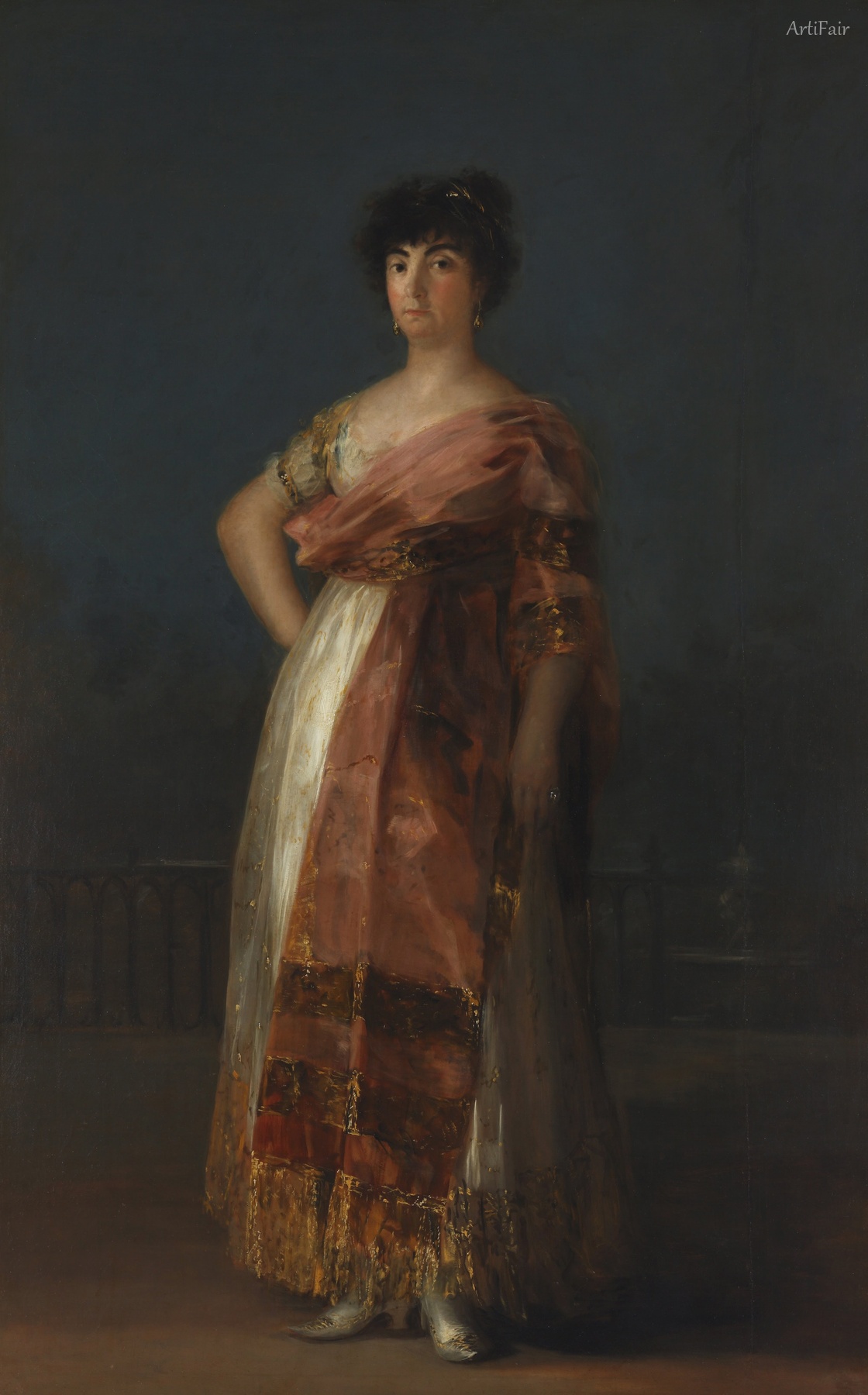
La Tirana
Category:
Created:
1792
Likes:
0
Dimensions:
Download:
New users get 4 free credits. 2K costs 1 credit; 4K and Ultra HD are priced by resolution. Public domain artworks can be used commercially.
Dominant colors
Public domain download summary
This artwork is provided as a public domain image resource. The 2K file costs 1 credit for everyday creative work, while 4K and Ultra HD files are priced by resolution.
Art Appreciation
La Tirana is a full-length oil-on-canvas portrait by Francisco Goya of the actress María del Rosario Fernández, painted around 1790–1792 and kept in the Real Academia de Bellas Artes de San Fernando, Madrid (inventory 677); the museum records its size as 206 × 130 cm.
Rosario Fernández (1755–1803), born in Seville, was the leading lady of Manuel Martínez's company and had great success at the Cruz and Príncipe theatres in Madrid. Her nickname came from her husband, the actor Francisco Castellanos, called el Tirano because he played tyrants. The dramatist Leandro Fernández de Moratín and the English playwright Richard Cumberland wrote in her praise. Goya, a keen theatregoer, portrayed her twice: this is the first of the two portraits, and the second, of 1794, belongs to the March family collection. She left the stage in 1794, ill with consumption, and the Academia's catalogue places its picture shortly before that date.
An inscription at the lower left, 'La Tirana / por Goya. a 1799', long led to the portrait being dated 1799, but the Goya scholars José Gudiol and José Manuel Pita Andrade regard it as a later addition and date the work to 1790–1792. The actress stands against a plain dark ground with a balustrade, one hand on her hip, in a white dress with a gold band, white satin high-heeled shoes and a strong pink shawl edged with gold fringe. The museum's description stresses the contrast between the precisely modelled face, which conveys her assurance, and the dress and fringe, painted in quick, light-filled strokes; the background serves only to create space.
Teresa Ramos, a cousin of the sitter, gave the portrait to the Academia in 1816, making it the second painting by Goya to enter its collection. It was among the works reproduced in the Academia's series of Cuadros selectos, completed in 1885.