
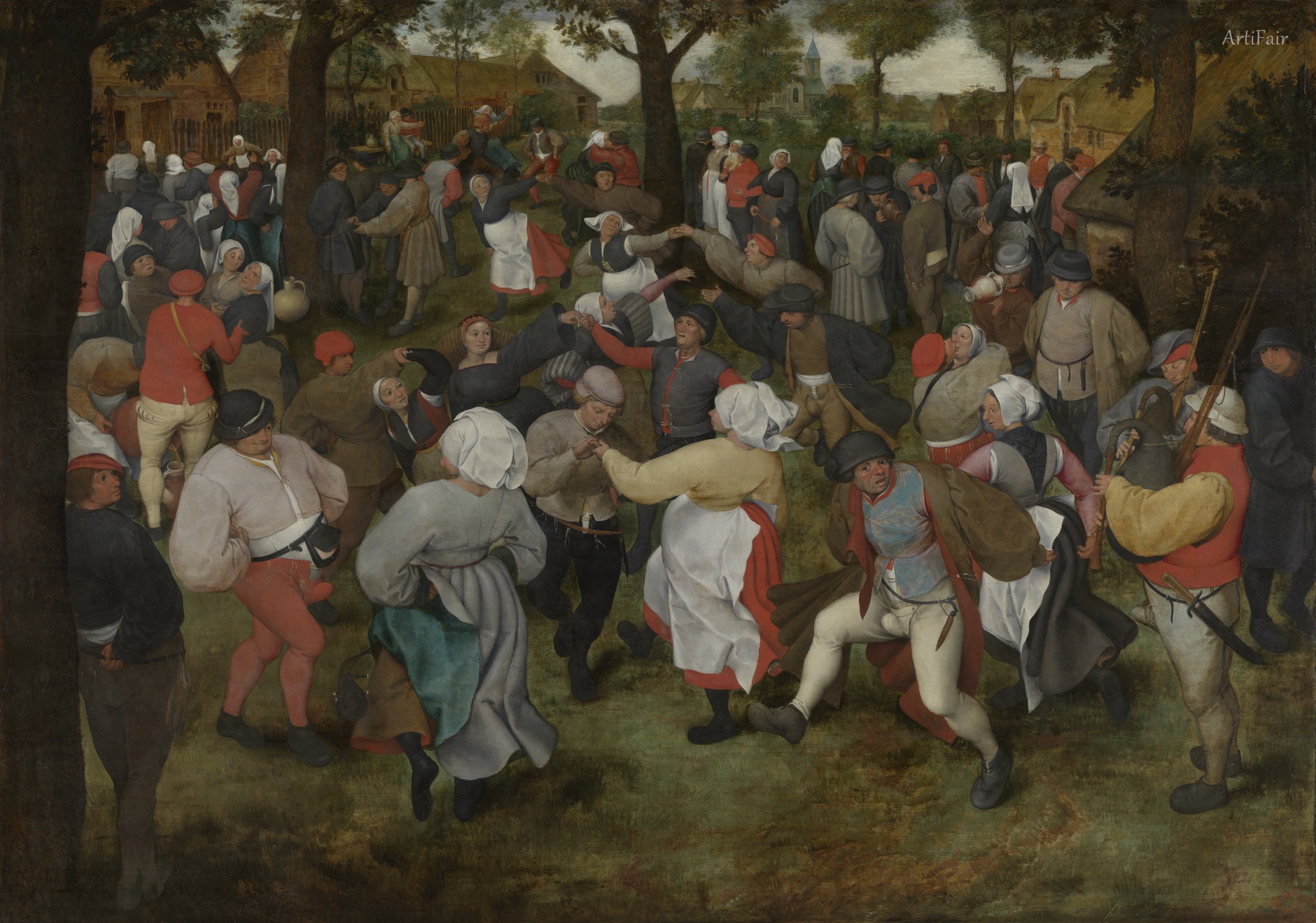
The Dance of the Bride (copy after The Wedding Dance)
Category:
Created:
Date unknown
Likes:
0
Dimensions:
Download:
New users get 4 free credits. 2K costs 1 credit; 4K and Ultra HD are priced by resolution. Public domain artworks can be used commercially.
Dominant colors
Public domain download summary
This artwork is provided as a public domain image resource. The 2K file costs 1 credit for everyday creative work, while 4K and Ultra HD files are priced by resolution.
Art Appreciation
The Dance of the Bride is a 16th-century oil painting on panel by an anonymous copyist after Pieter Bruegel the Elder's The Wedding Dance of 1566, made around 1566 and now in the Royal Museum of Fine Arts Antwerp (KMSKA, inv. 973). It measures 117.2 by 165.5 cm.
Bruegel's original, rediscovered at a London sale in 1930 by Wilhelm Valentiner and bought for the Detroit Institute of Arts, shows a crowd of peasants dancing at an outdoor wedding. The Antwerp panel was long attributed to his son Pieter Brueghel the Younger, but technical study, especially dendrochronology, showed that it is older and must have been painted shortly after the original was finished. According to the museum, the copyist probably worked from one-to-one drawings of sections of the original and almost certainly had access to the painting itself, since even small details and the colours were reproduced closely. Many figure groups match exactly, although the panel is almost 11 cm wider and the whole composition does not correspond point for point.
The bride, the only woman without a headscarf, dances just left of centre with a red band in her loose hair; the groom is probably the man right of centre in brown with a dark cloak and white wedding aiglets on his hat. Four oak trees enclose the dance, closed off in front by a man leaning on a tree at left and bagpipers at right. Conspicuous codpieces, painted over at some point out of prudishness, reappeared in the most recent restoration. Some colours have changed with age: faded red lakes and discoloured smalt mean that the front piper's breeches and hat were originally blue.
The top of the picture is not original. In the second half of the 19th century the upper board was replaced with a new plank painted with farmhouses, foliage and a horizon, which makes the scene seem to be seen from above rather than from the low viewpoint intended; a modern chromium green on that plank confirmed its later date. The museum bought the painting at the Joseph Spiridon sale in 1929.