
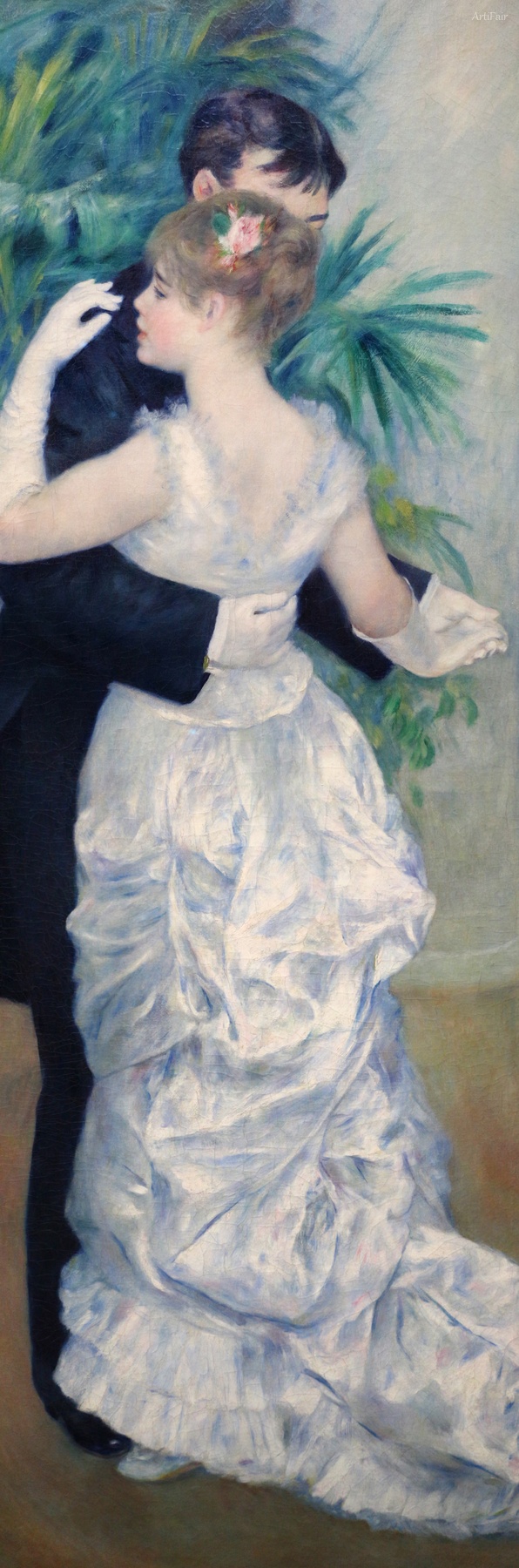
Dance in the City
Category:
Created:
1882
Likes:
0
Dimensions:
Download:
New users get 4 free credits. 2K costs 1 credit; 4K and Ultra HD are priced by resolution. Public domain artworks can be used commercially.
Dominant colors
Public domain download summary
This artwork is provided as a public domain image resource. The 2K file costs 1 credit for everyday creative work, while 4K and Ultra HD files are priced by resolution.
Art Appreciation
Dance in the City (Danse à la ville) is an oil-on-canvas painting by Pierre-Auguste Renoir, signed and dated 1883, in the Musée d'Orsay, Paris. It measures 179.7 by 89.1 cm and shows an elegant couple waltzing, at almost life size, in a ballroom.
It belongs to a group of three tall dance pictures that followed a commission for works on the theme of the dance from the dealer Paul Durand-Ruel in 1882; the others are Dance in the Country, its direct pendant at the Orsay, and Dance at Bougival in Boston. Renoir showed the pair at his exhibition at Durand-Ruel's gallery in 1883, at first simply as Dancers. The woman, seen from behind, was posed by Suzanne Valadon, then a model and later a painter herself and the mother of Maurice Utrillo; French Wikipedia states that she was pregnant with him at the time. Her partner was Renoir's friend Paul Lhote, a former officer and amateur painter, who also posed for the country dance.
The two pendants are the same size, and the Orsay describes them as two different, even opposite, aspects of dancing: the elegant restraint of the city dancers in a cool salon against the open-air gaiety of the country couple. Here the dancers hold each other close, as the waltz allowed, and take up less space; the tails of the man's coat swing out, but a marble column and potted plants behind give a sense of stability. The colours are mainly cool, the blue-white satin of Valadon's gown and her long white gloves set against his black evening clothes and the green palms. For the Orsay, the paintings mark Renoir's change in the early 1880s towards more precise drawing and a simpler range of colour, which he attributed to seeing Raphael's work in Italy.
The canvas was on deposit with Durand-Ruel from 1883 and belonged to him by 1886. It was shown in Paris again in 1892, in Brussels in 1904 and in London in 1905, and later in exhibitions including a 1939 Renoir portrait show in New York. In 1978 the French state accepted it in lieu of inheritance tax; it hung at the Jeu de Paume until 1986, when it was assigned to the Musée d'Orsay.