
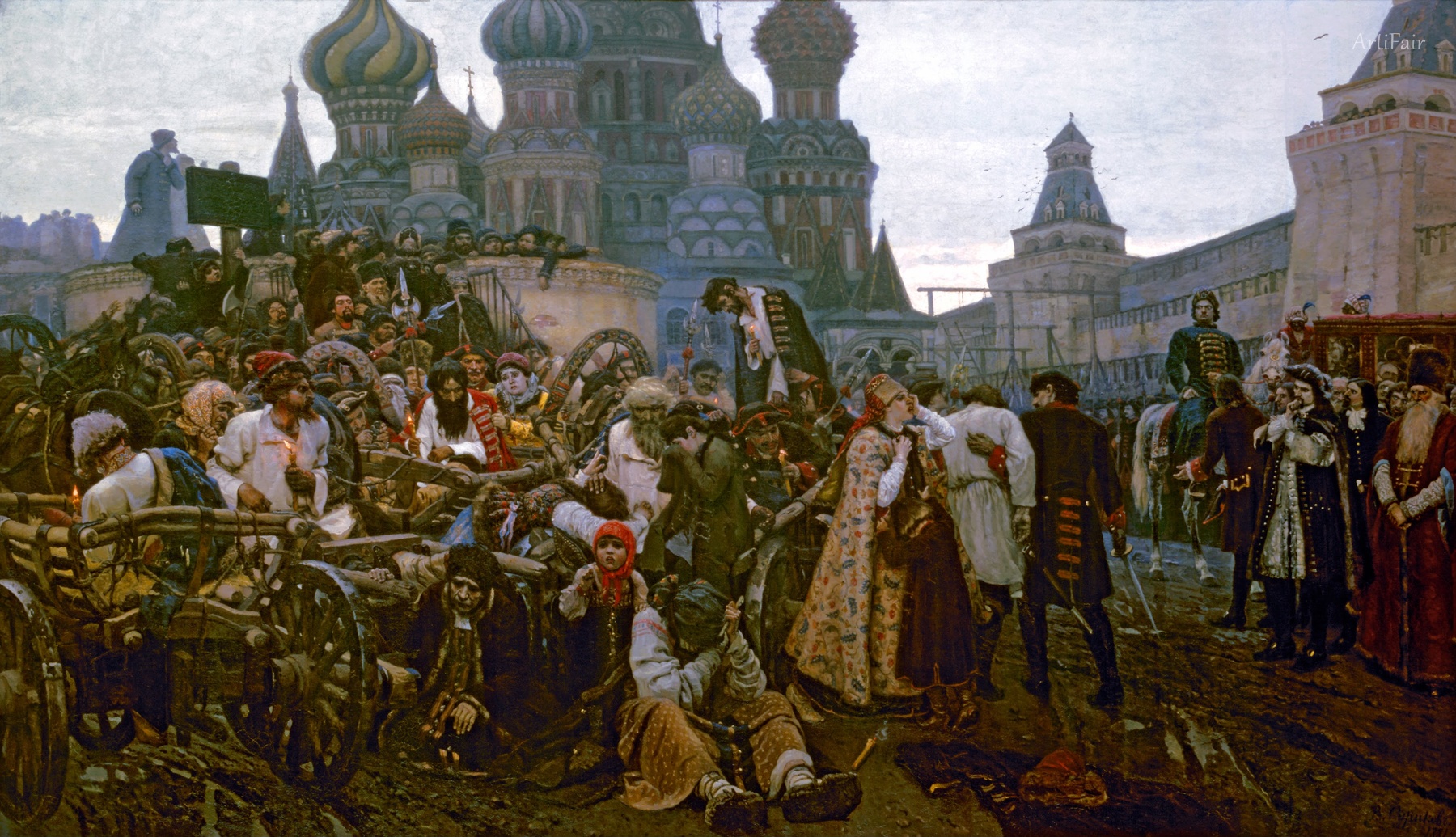
The Morning of the Execution of the Streltsy
Category:
Created:
1881
Likes:
0
Dimensions:
Download:
New users get 4 free credits. 2K costs 1 credit; 4K and Ultra HD are priced by resolution. Public domain artworks can be used commercially.
Dominant colors
Public domain download summary
This artwork is provided as a public domain image resource. The 2K file costs 1 credit for everyday creative work, while 4K and Ultra HD files are priced by resolution.
Art Appreciation
The Morning of the Execution of the Streltsy is an oil painting on canvas by the Russian history painter Vasily Surikov, completed in 1881 and held by the State Tretyakov Gallery in Moscow. The canvas measures about 218 × 379 cm and was his first large work on a subject from Russian history.
Surikov first sketched the composition in 1878, after finishing murals for the Cathedral of Christ the Saviour had given him enough money to choose his own subject. He later recalled that the scene came to him while standing on Red Square near the Lobnoye Mesto, looking at St Basil's Cathedral. The work took about three years. His main documentary source was the diary of Johann Georg Korb, secretary of the Austrian embassy, who described the mass executions of streltsy in October 1698; Surikov combined features of several of the executions rather than illustrating a single one. Some models came from his own circle: the black-bearded strelets was based on his maternal uncle, and the red-bearded one on a cemetery gravedigger.
The painting shows the aftermath of the failed streltsy revolt of 1698 on a misty autumn morning. Condemned men in white shirts hold burning candles in carts in front of the cathedral, surrounded by their wives, mothers and children. On the right the young Peter the Great sits on horseback among his courtiers, and the red-bearded strelets stares back at him across the square. No execution is shown; Surikov said he wanted to convey the solemnity of the last minutes rather than the execution itself. X-rays show that an early version included hanged men at the right.
The picture was shown at the ninth exhibition of the Peredvizhniki (Wanderers), which opened in St Petersburg on 1 March 1881, the day Alexander II was assassinated, and Pavel Tretyakov acquired it for his gallery. Ilya Repin praised it as a powerful picture, Mark Antokolsky said its merits outweighed its faults a hundredfold, while Vladimir Stasov had reservations. It is often grouped with Menshikov at Beryozovo (1883) and Boyarynya Morozova (1887) as a historical trilogy.