
The Inquisition Tribunal
Category:
Created:
1814
Likes:
1
Dimensions:
Download:
New users get 4 free credits. 2K costs 1 credit; 4K and Ultra HD are priced by resolution. Public domain artworks can be used commercially.
Dominant colors
Public domain download summary
This artwork is provided as a public domain image resource. The 2K file costs 1 credit for everyday creative work, while 4K and Ultra HD files are priced by resolution.
Art Appreciation
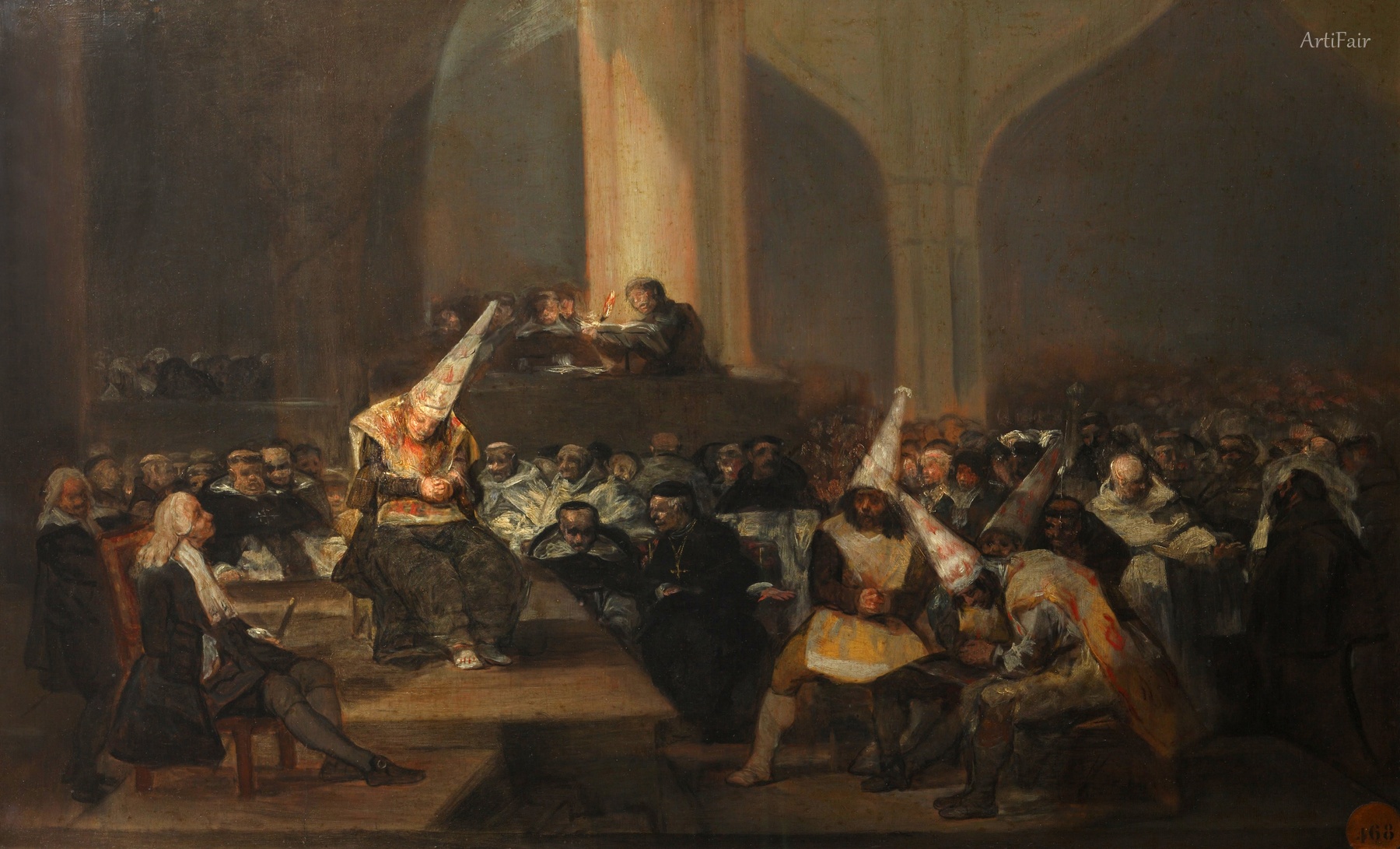
The Inquisition Tribunal (also known as Inquisition Scene or Auto de fe de la Inquisición) is a small oil-on-panel painting by Francisco Goya in the Real Academia de Bellas Artes de San Fernando, Madrid; the Academy dates it to 1808–1812, while other accounts place it between 1812 and 1819.
It belongs to a group of five small panels, with A Village Bullfight, The Madhouse, Procession of Flagellants and The Burial of the Sardine, that the Academy calls cabinet pictures in which Goya gave free rein to caprice and invention. Several of them show customs that enlightened liberals, Goya among them at the time, wanted to reform against the absolutist policy of Ferdinand VII. The merchant Manuel García de la Prada owned them and left them to the Academy.
Unlike the other scenes, this one was not drawn from life. Since the mid-18th century the Inquisition had replaced the public auto-da-fé with a private ceremony, so Goya evoked the past, possibly using Juan Antonio Llorente, historian of the Spanish Inquisition, whom he portrayed in 1810, and the famous Logroño witch trial, which he could have known through Leandro Fernández de Moratín. In a vaulted Gothic church the tribunal, scribes and friars surround four accused, who sit in tall pointed corozas and sanbenitos, the garments of infamy later hung in their parish churches; painted flames may signal death at the stake. Goya divides the panel into two zones of light: the individualised figures in front, and a dim, shapeless crowd behind. The Academy relates it to the wash drawings of Goya's Album C, most of them in the Prado, which attack abuses of justice. Goya himself was summoned by the Inquisition over Los Caprichos and again in 1815 over the Majas, without serious punishment.
The panel measures 46 × 73 cm. García de la Prada's will of 1836 left it to the Academy, which received it in 1839, and in 1885 it was engraved by José María Galván for the Academy's print series Cuadros selectos.