
Van Gogh's Chair
Category:
Created:
1888
Likes:
0
Dimensions:
Download:
New users get 4 free credits. 2K costs 1 credit; 4K and Ultra HD are priced by resolution. Public domain artworks can be used commercially.
Dominant colors
Public domain download summary
This artwork is provided as a public domain image resource. The 2K file costs 1 credit for everyday creative work, while 4K and Ultra HD files are priced by resolution.
Art Appreciation
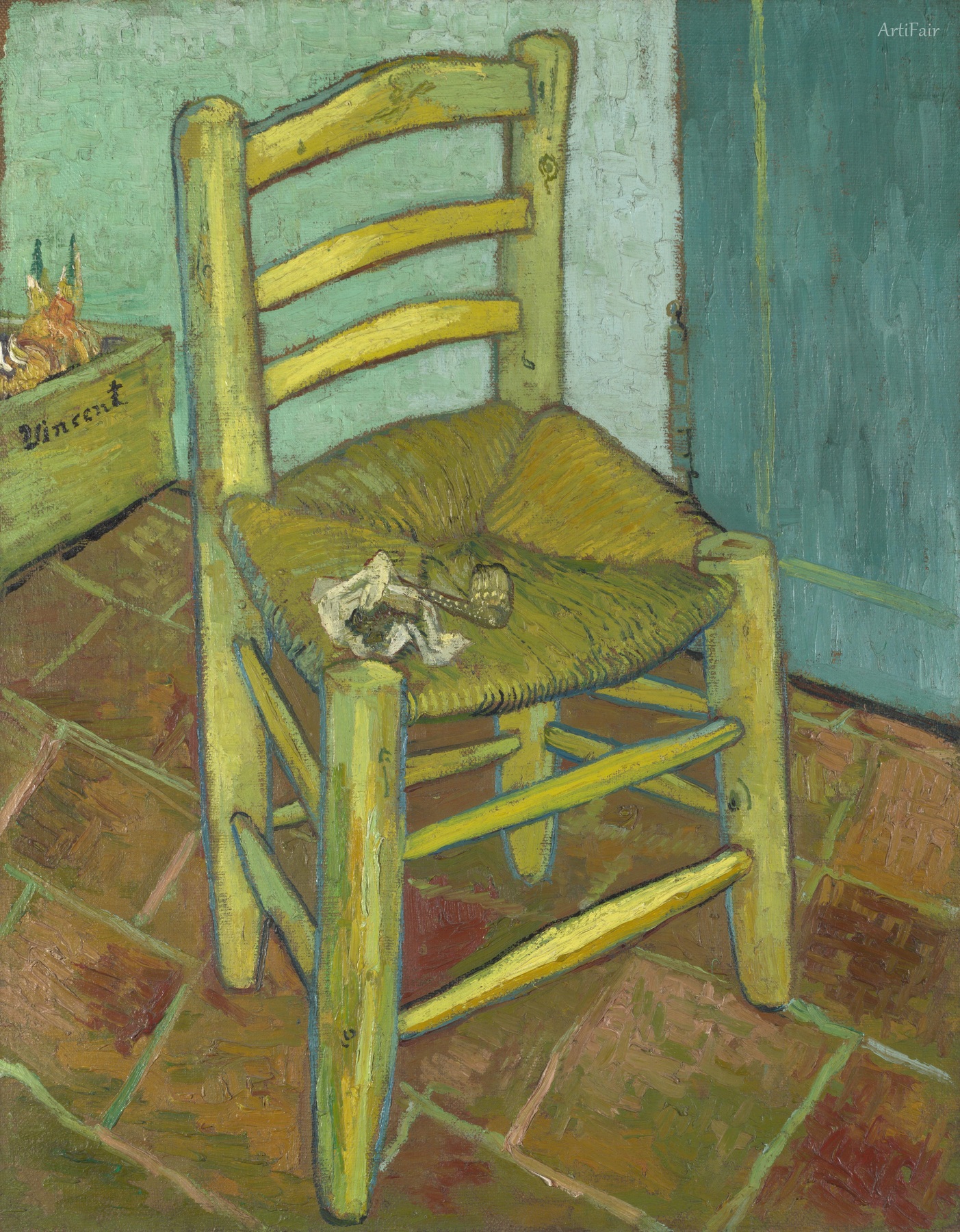
Van Gogh's Chair is an oil-on-canvas painting by Vincent van Gogh, begun in Arles in late 1888 and slightly reworked in January 1889; it is in the National Gallery, London.
Van Gogh started it in November 1888, soon after Paul Gauguin had joined him in the Yellow House, as one of a pair: its companion, Gauguin's Chair, is in the Van Gogh Museum, Amsterdam. The two canvases were meant to hang together, one chair turned to the right and the other to the left, and each stands in for a portrait of its owner. In a letter to Theo he described his own as a wooden rush-bottomed chair, all yellow, on red tiles against a wall in daylight, and Gauguin's as a red and green night effect with two novels and a candle on the seat. The chairs themselves may have been among the twelve he bought in September to furnish the house before Gauguin arrived.
Van Gogh's chair is plain, unpolished and slightly crooked, the kind of rustic seat that recalls his Dutch peasant pictures. On it lie his pipe and tobacco pouch; behind it a box signed 'Vincent' holds sprouting bulbs, possibly onions. Yellow and blue are set against Gauguin's reds and greens, and the blue contours around the chair legs relate to Cloisonnism, the style of flat colour areas bounded by outlines that Van Gogh explored with Emile Bernard. He said of the picture that he had tried for an effect of light by means of pure colour.
The empty chair already had meaning for him: he owned a copy of Luke Fildes's 1870 engraving The Empty Chair, made after the death of Charles Dickens. After the quarrel of 23 December 1888, when Van Gogh cut off part of his own ear and Gauguin left Arles, the pair took on added poignancy. Lent by the Van Gogh family to the Leicester Galleries in London in 1923, the painting was bought through the Courtauld Fund in 1924.