
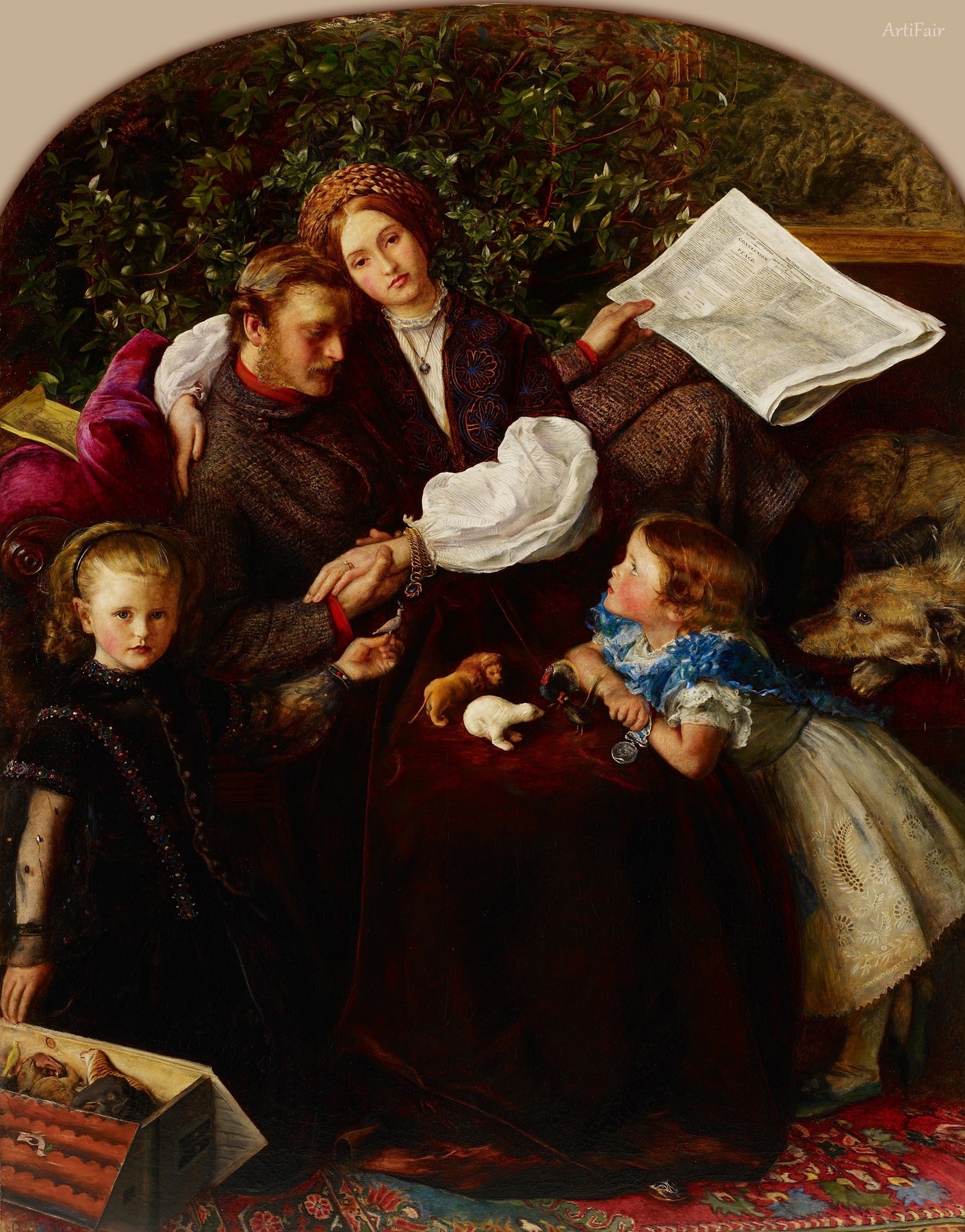
Peace Concluded, 1856
Category:
Created:
1856
Likes:
0
Dimensions:
Download:
New users get 4 free credits. 2K costs 1 credit; 4K and Ultra HD are priced by resolution. Public domain artworks can be used commercially.
Dominant colors
Public domain download summary
This artwork is provided as a public domain image resource. The 2K file costs 1 credit for everyday creative work, while 4K and Ultra HD files are priced by resolution.
Art Appreciation
Peace Concluded, 1856 is an oil painting on canvas by John Everett Millais, signed with his monogram and dated 1856; it is in the Minneapolis Institute of Art, which acquired it through the Putnam Dana McMillan Fund.
The picture marks the end of the Crimean War, fought between Russia and an alliance of Britain, France and the Ottoman Empire and settled by a treaty signed in Paris in 1856. There is some evidence that Millais first planned a satire on officers who went home from the Crimea on so-called urgent private affairs while ordinary soldiers stayed in harsh conditions. Once peace was declared the joke seemed out of date, and he turned the officer into a wounded man recovering at home.
The officer lies on a sofa reading the report of the peace in The Times, with an Irish wolfhound at his feet and a yellow part-issue of Thackeray's novel The Newcomes set aside behind him. His wife, painted from Millais's own wife Effie Gray, leans against him; a myrtle, traditional emblem of marital fidelity, grows behind her head. The children have been playing with a toy Noah's Ark, and the animals on their mother's lap stand for the warring nations: a lion for Britain, a bear for Russia, a turkey for the Ottoman Empire and a cockerel for France. The girl at left holds a dove with an olive branch, and the girl at right lifts her father's campaign medal. On the wall hangs a print by James Heath after John Singleton Copley's The Death of Major Peirson, which shows a British officer killed defending Jersey, the Millais family's home island, in 1781.
Shown at the Royal Academy in 1856, the painting drew mixed reviews. John Ruskin praised its colour, comparing Millais with Titian, and predicted that it would one day be counted 'among the world's best masterpieces', while other critics, including some of Millais's Pre-Raphaelite colleagues, disliked it and found the pose of the couple hard to read. The canvas measures 116.8 by 91.4 cm.