
Anxiety
Category:
Created:
1894
Likes:
0
Dimensions:
Download:
New users get 4 free credits. 2K costs 1 credit; 4K and Ultra HD are priced by resolution. Public domain artworks can be used commercially.
Dominant colors
Public domain download summary
This artwork is provided as a public domain image resource. The 2K file costs 1 credit for everyday creative work, while 4K and Ultra HD files are priced by resolution.
Art Appreciation
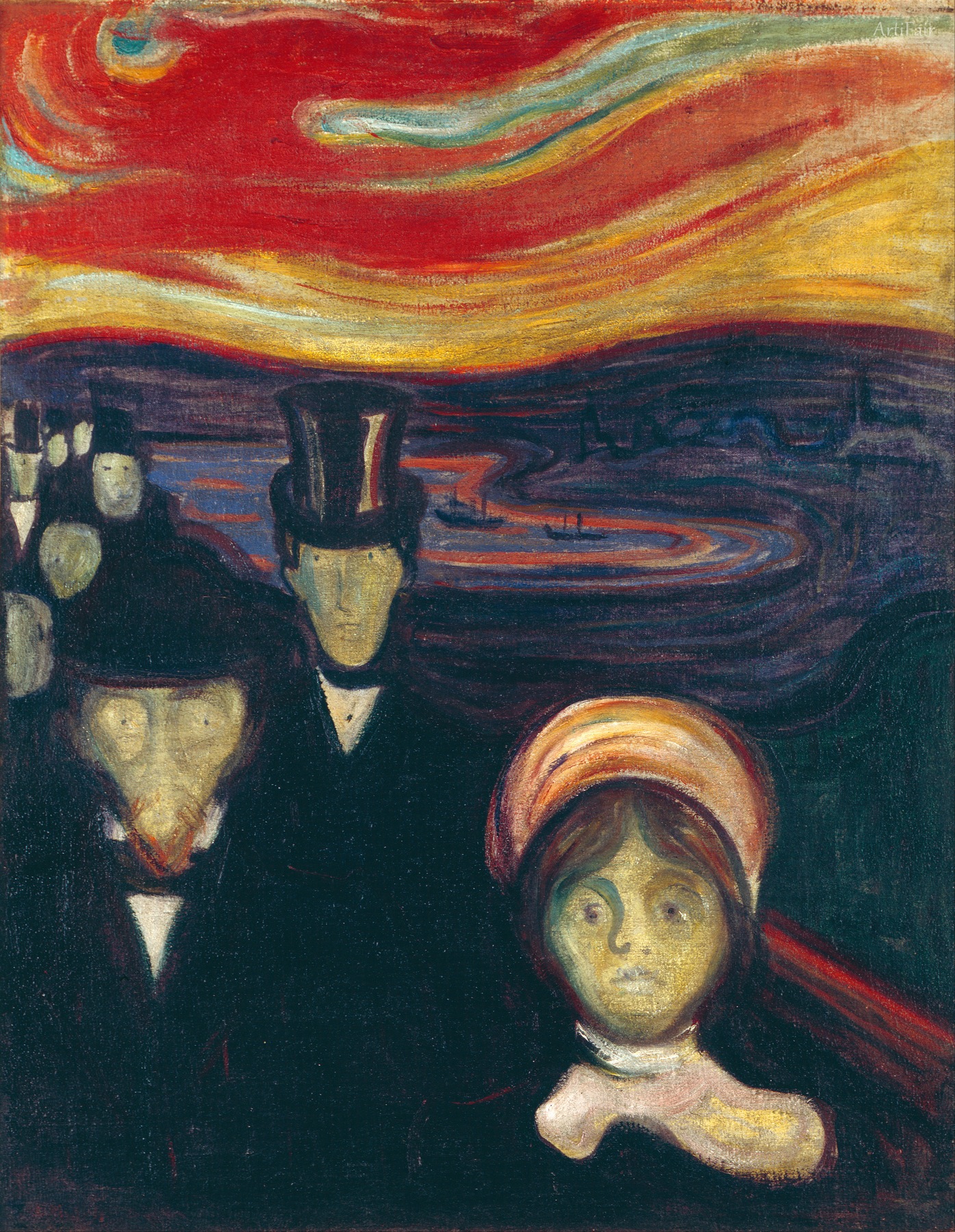
Anxiety (Angst) is an oil painting on canvas by Edvard Munch, dated 1894 and held by MUNCH, the Munch Museum in Oslo, under inventory number MM.M.00515; it measures about 94 × 74 cm.
The picture belongs to Munch's series the Frieze of Life, and when it was first shown within that group it carried the title Red Clouds. It joins two earlier motifs. From Evening on Karl Johan (1892) Munch took the crowd of pale, staring faces; from The Scream (1893) he took the setting on the east side of the Oslofjord, with a railing running diagonally across the picture, a view down to the water and ships, and a sky streaked with red. The art historian Arne Eggum thinks the work was painted in Berlin and reads the bearded man at the left, a figure new to the motif, as the Polish writer Stanisław Przybyszewski, a friend from Munch's Berlin circle.
Eggum also links the oncoming crowd to an episode Munch described in his own notes: as a young man walking along Karl Johans gate in Kristiania in search of his married lover Milly Thaulow, he felt that the passers-by were all staring at him and that his legs would give way. In this reading the woman in the bonnet and the man in the top hat stand for her and her husband. Gerd Woll, by contrast, treats the painting less as autobiography and more as a symbolist distillation of a mood, in which strong contrasting colours create unease.
In 1896 Munch reworked the motif as a lithograph, reversed in relation to the painting, and as a woodcut. In both prints the railing disappears and the figures spread across the foreground. A two-colour impression of the lithograph in black and red appeared in Ambroise Vollard's 1896 portfolio Les Peintres-Graveurs. The museum also keeps a watercolour of the subject from 1896 and a pen drawing from 1928–1930.