
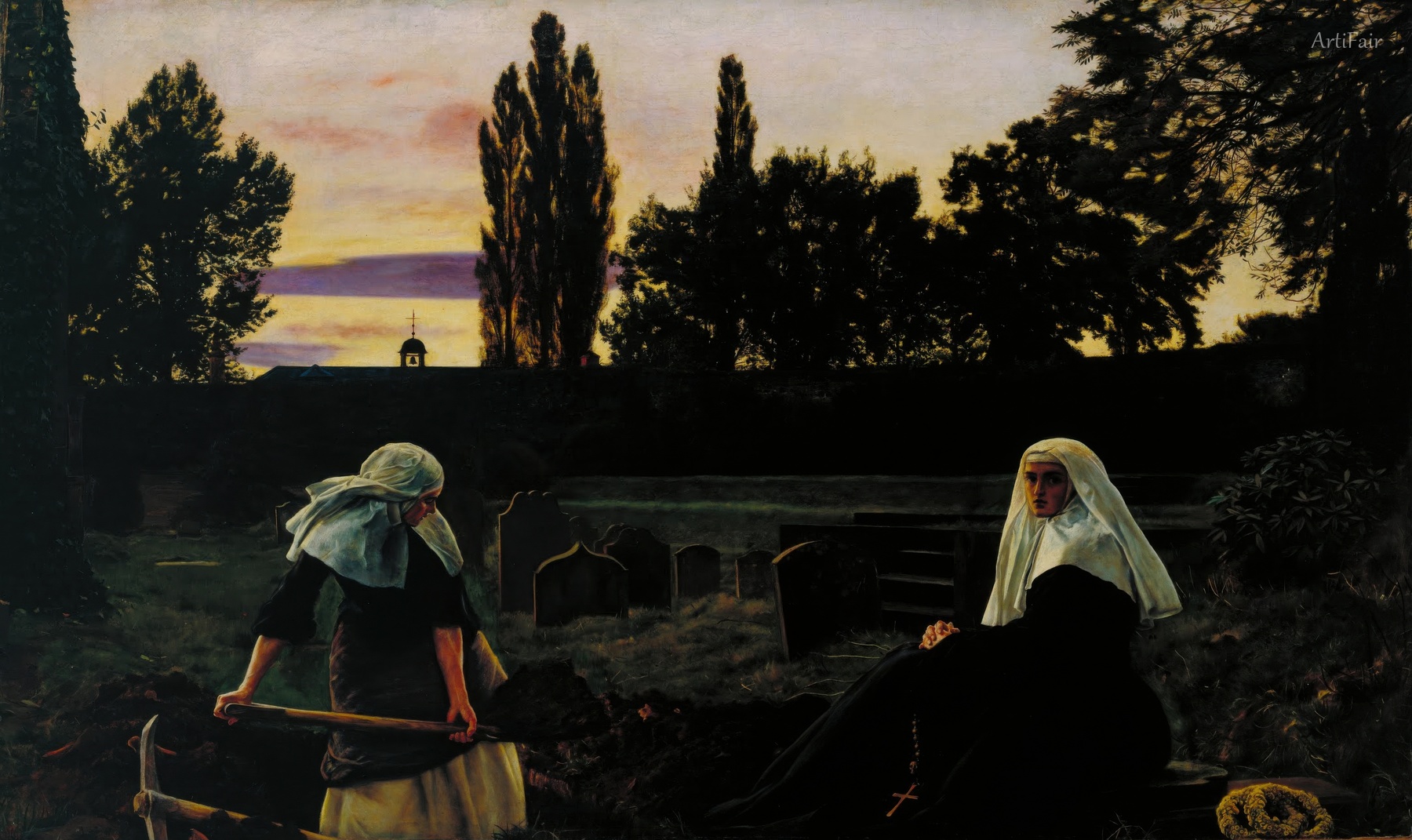
The Vale of Rest
Category:
Created:
1858
Likes:
0
Dimensions:
Download:
New users get 4 free credits. 2K costs 1 credit; 4K and Ultra HD are priced by resolution. Public domain artworks can be used commercially.
Dominant colors
Public domain download summary
This artwork is provided as a public domain image resource. The 2K file costs 1 credit for everyday creative work, while 4K and Ultra HD files are priced by resolution.
Art Appreciation
The Vale of Rest is an oil painting on canvas by John Everett Millais, painted in 1858–59 and presented to the Tate Gallery, London, by Sir Henry Tate in 1894. Millais is recorded as regarding it as his favourite among all his pictures.
According to his wife Effie, Millais had long intended to paint a picture with nuns, and the idea came to him on their Scottish honeymoon in 1855, when a coachman near Loch Awe told them of a ruined monastery on one of the islands. Work began only in late October 1858, when a sunset in the garden of Effie's family home, Bowerswell in Perth, moved him to fetch a large canvas. Effie remembered that the effect lasted so briefly that he had to paint 'like lightning', softening the colours later indoors. The garden supplied the wall, shrubs and trees; the grave and headstones were painted months afterwards in Kinnoull old churchyard, Perth, and by December 1858 he was working on the figures.
The title and its subtitle, 'Where the weary find repose', come from Mendelssohn's part-song 'Ruhetal' (Opus 59, no. 5), which Millais heard his brother William sing. Tate's catalogue describes the canvas as a pendant to Spring (1856–59, Lady Lever Art Gallery): where that picture only hints at mortality, here death is explicit. One nun digs a grave placed so that the viewer seems to stand in it beside her; the other, seated by funeral wreaths, wears a rosary with a skull and looks out of the picture. A coffin-shaped cloud, a Scottish omen of death, hangs in the evening sky.
After a private showing at Langham Chambers the picture went to the Royal Academy in 1859 alongside Spring. It failed to sell there, and Millais later let it go through the dealer D. T. White to the collector B. G. Windus. He repainted the seated nun's face after the exhibition and again in 1862, and Florence Claxton satirised the picture in her 1860 watercolour The Choice of Paris. The canvas measures 102.9 by 172.7 cm.