
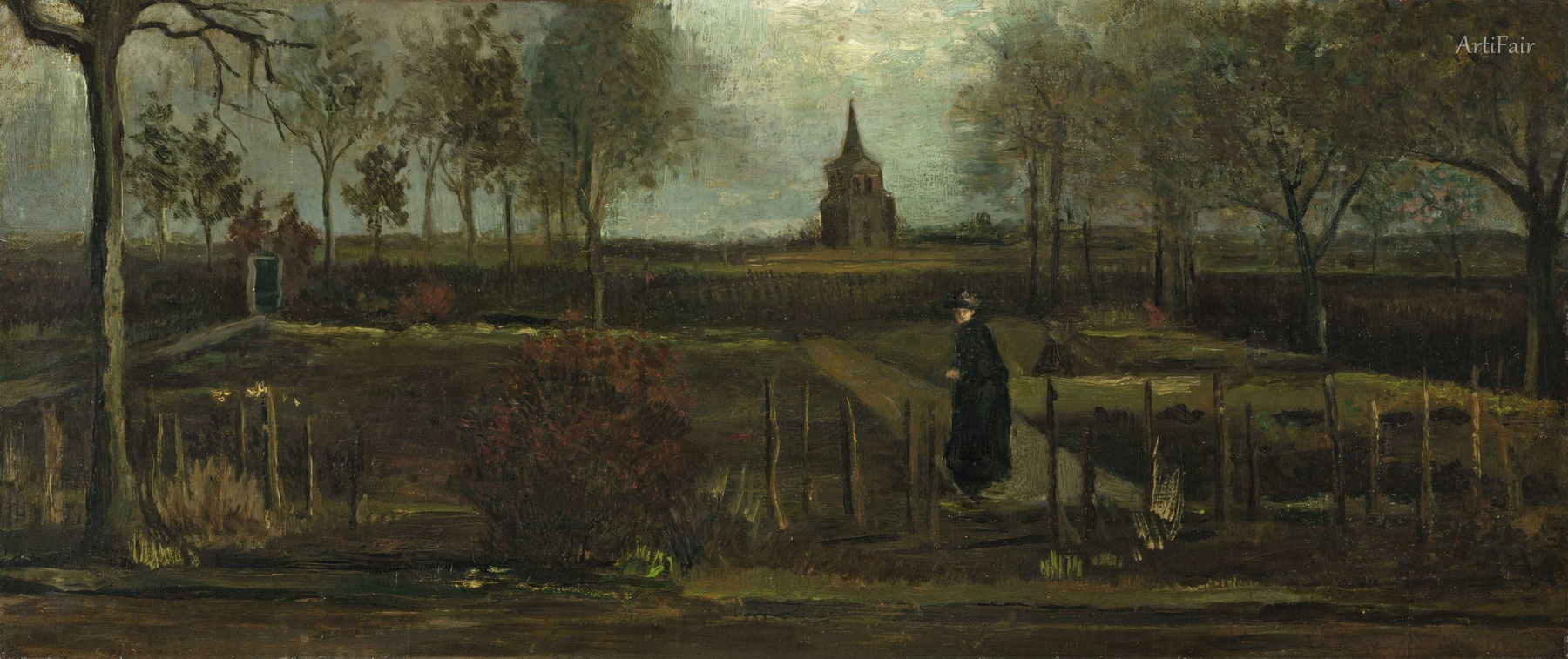
The Parsonage Garden at Nuenen
Category:
Created:
1884
Likes:
0
Dimensions:
Download:
New users get 4 free credits. 2K costs 1 credit; 4K and Ultra HD are priced by resolution. Public domain artworks can be used commercially.
Dominant colors
Public domain download summary
This artwork is provided as a public domain image resource. The 2K file costs 1 credit for everyday creative work, while 4K and Ultra HD files are priced by resolution.
Art Appreciation
The Parsonage Garden at Nuenen in Spring (Lentetuin, de pastorietuin te Nuenen in het voorjaar) is an oil painting by Vincent van Gogh, made in spring 1884 in Nuenen and owned by the Groninger Museum in the Netherlands.
In December 1883 Van Gogh moved in with his parents at the Reformed Church parsonage in Nuenen, near Eindhoven, where his father was pastor. He stayed almost two years, producing some 200 drawings and paintings, The Potato Eaters among them, and he recorded the walled garden behind the house through the changing seasons. In a letter to Anthon van Rappard of March 1884 he wrote that he was looking for the colour of the winter garden, but that it had already become a spring garden. Research by the restorer Marjan de Visser established that he began the canvas as a winter scene in 1883 and turned it into a spring one in 1884.
The picture is unusually wide, 25 × 57 cm. A woman in dark clothes walks along a garden path; beyond the hedges and bare trees rises the tower of the old Nuenen church, demolished in 1885. The browns and dull greens are typical of Van Gogh's Dutch period, with touches of green and red announcing spring.
The painting was mounted on an oak panel for a 1903 sale exhibition at the Oldenzeel gallery in Rotterdam, later passed to heirs in Groningen and entered the Groninger Museum in 1962. On 30 March 2020, Van Gogh's birthday, it was stolen while on loan to the Singer Laren museum, closed at the time because of the COVID-19 pandemic. The thief was sentenced to eight years in prison, and in September 2023 the art detective Arthur Brand secured the painting's return. During its restoration De Visser concluded that the woman's detailed face was not by Van Gogh and was probably added by an amateur painter during a 1903 restoration; she removed it, and the work went back on view in Groningen on 31 March 2026.