
Vampire
Category:
Created:
1895
Likes:
0
Dimensions:
Download:
New users get 4 free credits. 2K costs 1 credit; 4K and Ultra HD are priced by resolution. Public domain artworks can be used commercially.
Dominant colors
Public domain download summary
This artwork is provided as a public domain image resource. The 2K file costs 1 credit for everyday creative work, while 4K and Ultra HD files are priced by resolution.
Art Appreciation
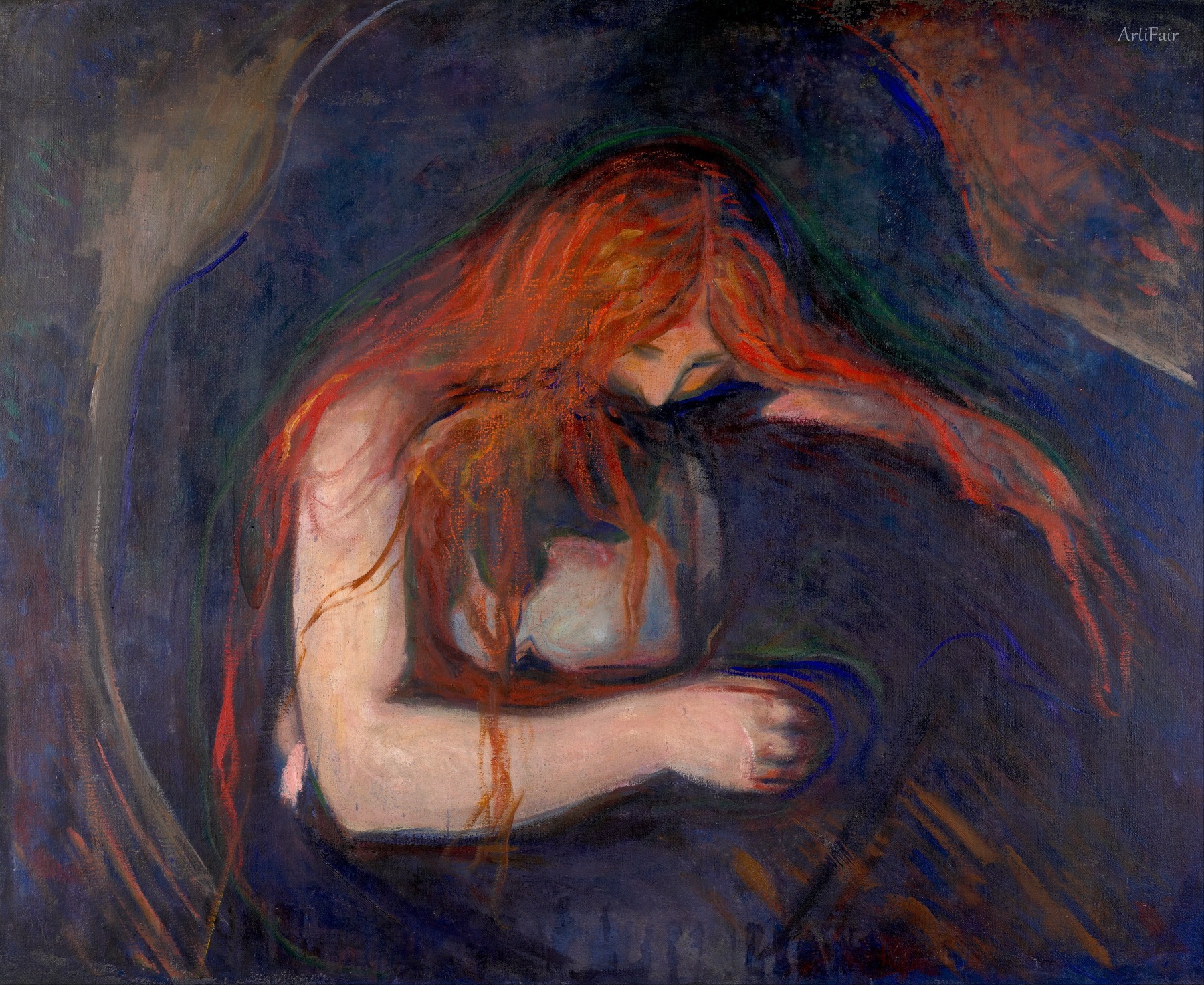
Vampire, originally titled Love and Pain, is an oil-on-canvas painting by Edvard Munch from 1895, one of several versions of the motif; this version, 91 by 109 cm, belongs to the Munch Museum in Oslo (MM.M.00679).
Munch painted the subject six times between 1893 and 1895 and returned to it in further versions between 1916 and 1925; there are also two lithographs of 1895. The other early paintings include an 1893 version in the Munch Museum, one in the Gothenburg Museum of Art and an 1894 canvas that sold at Sotheby's in 2008 for about 38 million dollars, then a record for the artist. This 1895 version is unsigned and is catalogued as Woll M 377. From its first showing in Berlin in December 1893, as part of a study for a series called Love, the motif belonged to the Frieze of Life, Munch's cycle of paintings on life, love and death.
A woman with long flame-red hair bends over a man who leans forward against her body, pressing her face into his neck as they embrace. The two figures merge into a pyramid, outlined by a dark shadow rising behind them, and the red-orange of her hair stands out against the deep blue-violet tones typical of Munch. His friend Adolf Paul recalled that the idea came when Munch asked him to kneel before a red-haired model in the studio while she bent over him.
The vampire reading came from the writer Stanisław Przybyszewski, who in 1894 described a broken man with a biting vampire's face on his neck, and August Strindberg wrote of it in similar terms. Munch accepted the title but wrote in 1933 that it gave the picture a literary character, insisting that it showed only a woman kissing a man on the neck. Scholars have read it instead as an image of love bound up with pain and dependence between the sexes.