
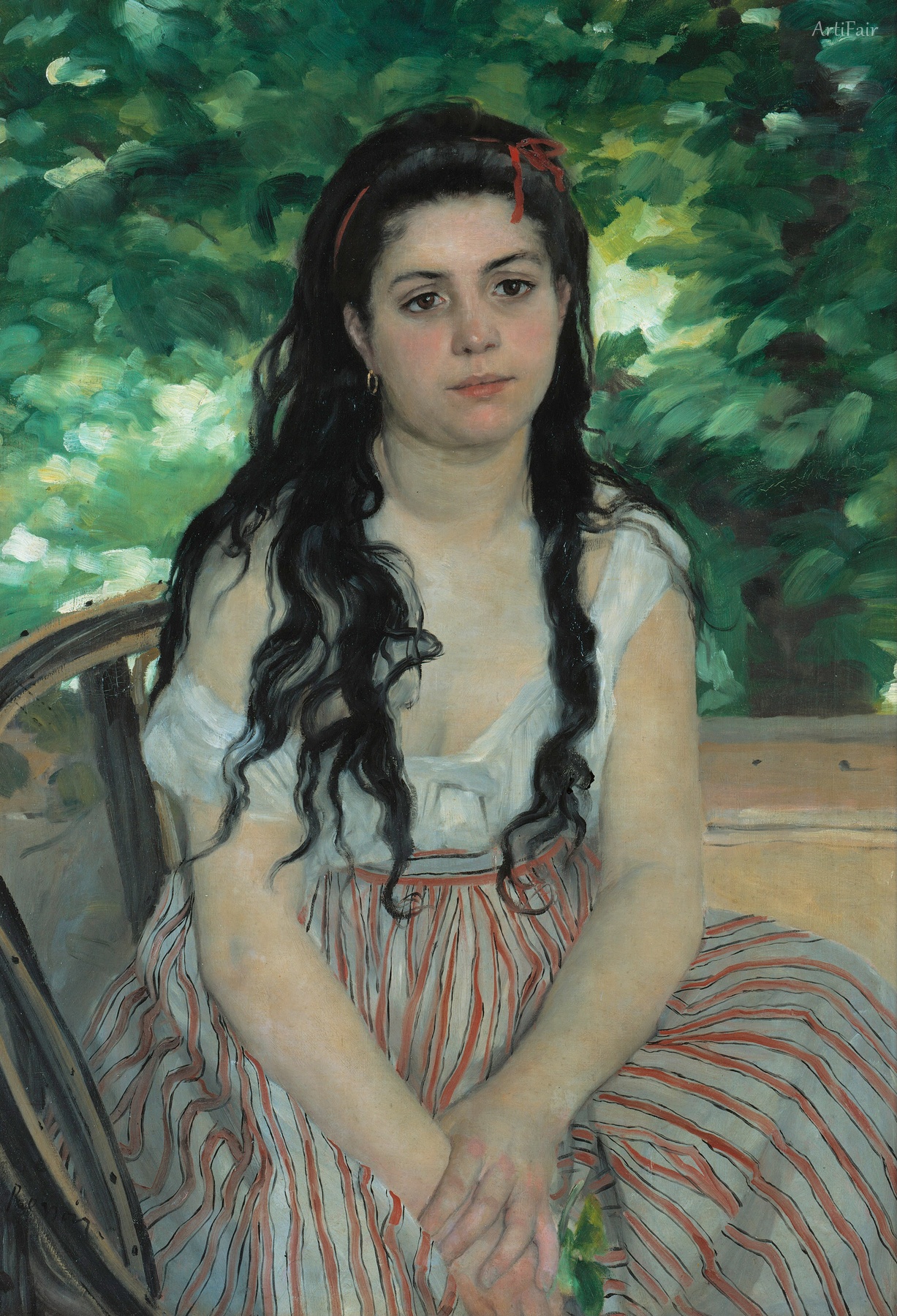
In Summer (Lise the Bohemian)
Category:
Created:
1868
Likes:
1
Dimensions:
Download:
New users get 4 free credits. 2K costs 1 credit; 4K and Ultra HD are priced by resolution. Public domain artworks can be used commercially.
Dominant colors
Public domain download summary
This artwork is provided as a public domain image resource. The 2K file costs 1 credit for everyday creative work, while 4K and Ultra HD files are priced by resolution.
Art Appreciation
In Summer (En été, also called La Bohémienne) is an oil-on-canvas painting by Pierre-Auguste Renoir from 1868, in the Alte Nationalgalerie, Berlin. The canvas, 85 by 59 cm, is a three-quarter-length portrait of Lise Tréhot, then about 20, Renoir's lover and principal model.
Renoir had met Lise through his friend Jules Le Cœur around 1865, and she posed for more than twenty of his figure paintings until their relationship ended in 1872. The full-length Lise with a Parasol had won him his first real notice from critics at the Salon of 1868, and that success may have encouraged him to paint her again the same year in a more informal way. In Summer was his only submission to the Salon of 1869, where it hung as En été, étude. The word study was probably added to excuse the loose handling of the background, which was far less finished than a Salon picture was expected to be; the painting attracted little critical attention, perhaps because of an unfavourable hanging.
Lise sits facing us on a chair beside a low ochre wall, her dark hair held by a thin red band and falling loose over a white bodice whose strap has slipped from her shoulder. Her hands rest in the lap of a red-and-white striped skirt, a few green leaves in one hand, and her gaze drifts to the right. The figure is carefully modelled under even studio light, while the foliage behind is dashed in with broad strokes and flecks of white sunlight. Renoir drew on the type of the bohemian girl, recalling Victor Hugo's Esmeralda, on Delacroix's Orphan Girl at the Cemetery, whose bodice also slips from one shoulder, and on Gustave Courbet. The picture marks a step from studio practice towards his looser Impressionist manner.
Théodore Duret bought it from a Paris dealer in March 1873 for 400 francs. It later belonged to François Depeaux of Rouen, and at his sale in 1906 it was bought jointly by Bernheim-Jeune, Durand-Ruel and Paul Rosenberg. Through Paul Cassirer, Hugo von Tschudi acquired it for the Nationalgalerie; in 1907 Mathilde Kappel, wife of the banker Marcus Kappel, paid the 8,000 marks as a gift.