
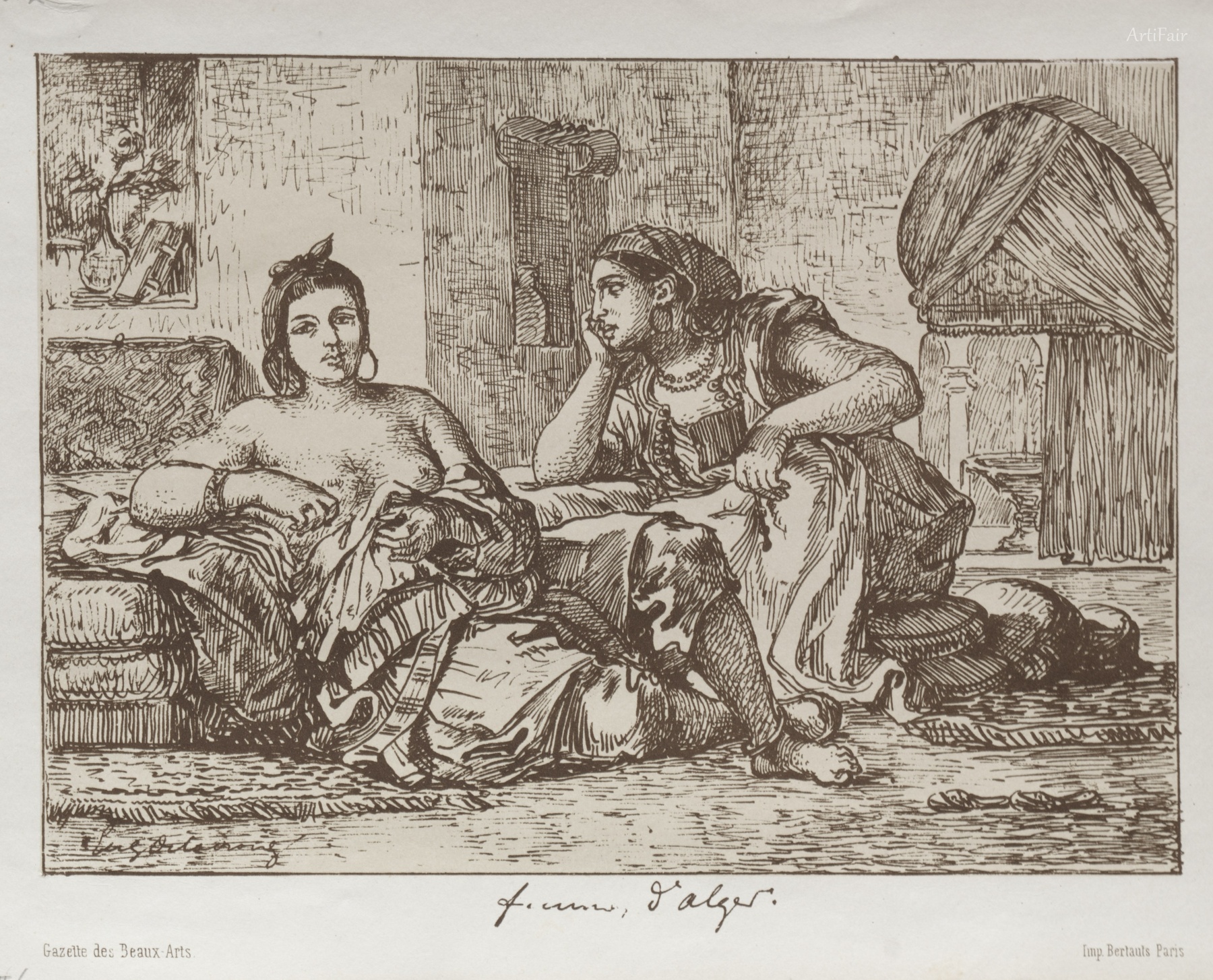
Women of Algiers
Category:
Created:
1833
Likes:
0
Dimensions:
Download:
New users get 4 free credits. 2K costs 1 credit; 4K and Ultra HD are priced by resolution. Public domain artworks can be used commercially.
Dominant colors
Public domain download summary
This artwork is provided as a public domain image resource. The 2K file costs 1 credit for everyday creative work, while 4K and Ultra HD files are priced by resolution.
Art Appreciation
Women of Algiers (Femmes d'Alger) is a pen lithograph printed in brown ink by Eugène Delacroix, drawn on the stone in 1833; this impression comes from the later edition printed by the Imprimerie Bertauts in Paris for the Gazette des Beaux-Arts, and the image measures about 16 × 22 cm.
The subject goes back to Delacroix's journey to North Africa in 1832. He travelled with the diplomatic mission of Charles de Mornay, sent by King Louis-Philippe to the Sultan of Morocco, and on the way home stopped for three days in Algiers, where, by chance, he was given access to the women's quarters of a private household. The quick sketches he made there fed his large painting Women of Algiers in Their Apartment, shown at the Salon of 1834 and now in the Louvre, and a second version of 1847–1849 in the Musée Fabre, Montpellier. The lithograph, made in the year between the journey and that Salon, treats the theme on a much smaller and more intimate scale.
Only two women appear. At the left one reclines bare-shouldered against cushions, her arm resting on a bolster; beside her another sits on the floor, leaning her head on her hand, her loose robe spread around her. A shelf with a vase and a curtained arched niche close the room behind them. Delacroix drew with a pen in lithographic ink, so the image keeps the look of a quick hatched drawing. He signed it on the stone at lower left, and the title is written by hand beneath.
The print is recorded in the catalogues of Delacroix's graphic work by Moreau (no. 52), Robaut (no. 479) and Delteil (no. 97). Impressions of the Gazette des Beaux-Arts edition, with the journal's name at lower left and the printer's at lower right, are held by the Hood Museum of Art at Dartmouth, the Kunsthalle Bremen and the Rijksmuseum in Amsterdam, among others.