
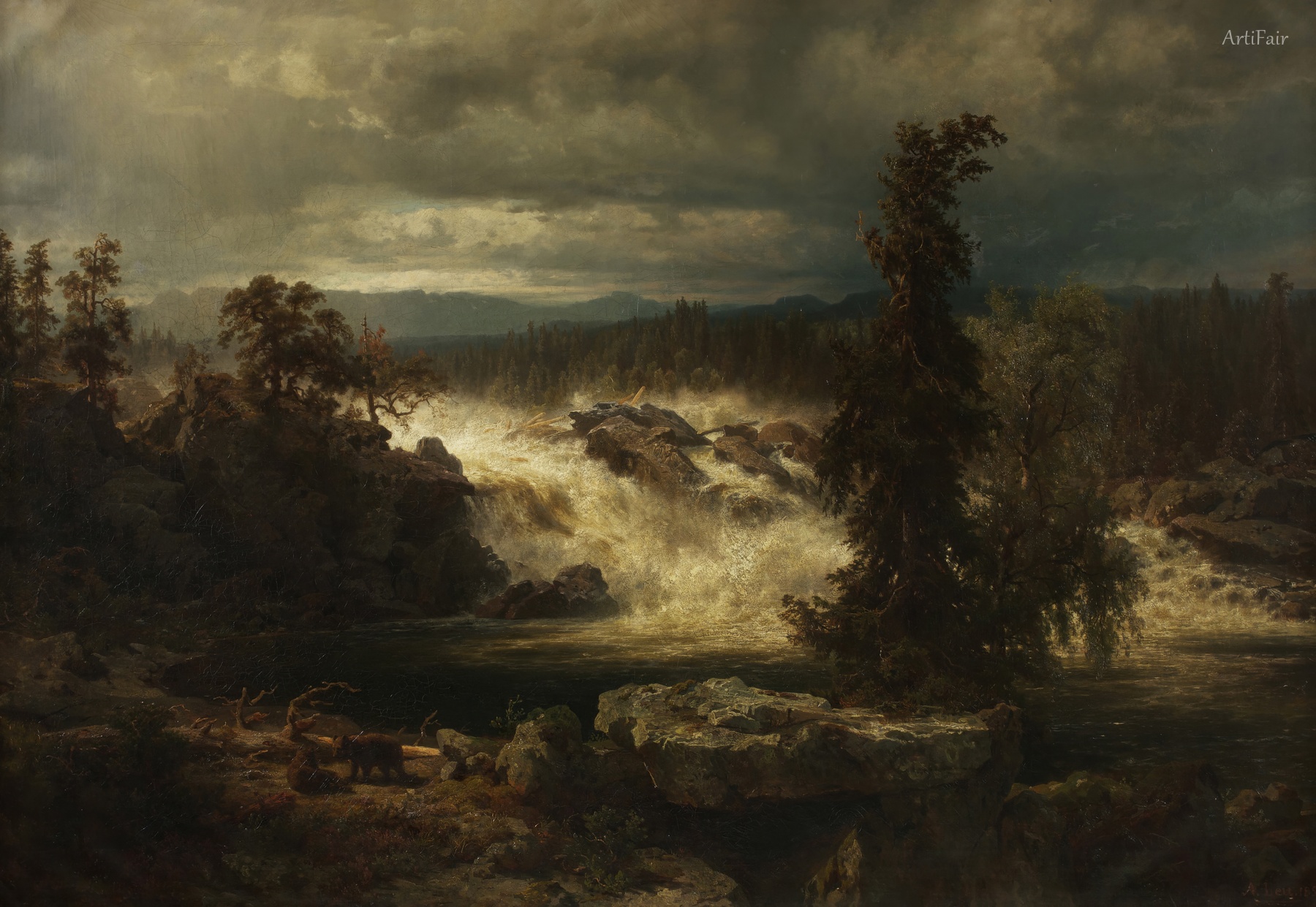
The Labro Falls near Kongsberg in Norway
Category:
Created:
1859
Likes:
0
Dimensions:
Download:
New users get 4 free credits. 2K costs 1 credit; 4K and Ultra HD are priced by resolution. Public domain artworks can be used commercially.
Dominant colors
Public domain download summary
This artwork is provided as a public domain image resource. The 2K file costs 1 credit for everyday creative work, while 4K and Ultra HD files are priced by resolution.
Art Appreciation
The Labro Falls near Kongsberg in Norway (Die Labrofälle bei Kongsberg in Norwegen) is an oil on canvas painted in 1859 by the German landscape painter August Leu; it belongs to the Belvedere in Vienna (inventory number 24).
Leu, born in Münster, trained in Düsseldorf in the early 1840s, mainly under Johann Wilhelm Schirmer at the Academy, and belonged to the Düsseldorf school of landscape painting. He travelled in Norway in 1843 and 1847, and his large Norwegian pictures helped make the country's scenery known in Germany; Andreas Achenbach and Hans Gude were among his models. He later worked widely in the Alps, received an honourable mention at the 1855 Paris Exposition, and in 1882 moved to Berlin as a royal professor and member of the Academy. He died at Seelisberg in Switzerland in 1897.
The Labrofossen is a waterfall on the river Numedalslågen at Labro, south of the centre of Kongsberg, with a drop of 41 metres; it was harnessed for hydroelectric power in 1910 and has often been painted. Leu, painting it more than a decade after his Norwegian journeys, turns it into a stormy Romantic scene: white water pours over a broad ledge of boulders beneath a dark, torn sky, a tall spruce bent by the wind stands against the spray, and a slab of rock fills the foreground, where a few antlered animals stand by the water at lower left. Contemporaries praised the carefully studied detail of his foregrounds and the dramatic overall effect of his northern scenes.
The canvas measures 122 by 178 cm and is signed and dated 'A. Leu. 1859' at lower right. According to the Belvedere, it was bought in 1859 at an exhibition of the Vienna Academy of Fine Arts; it is currently not on display.