
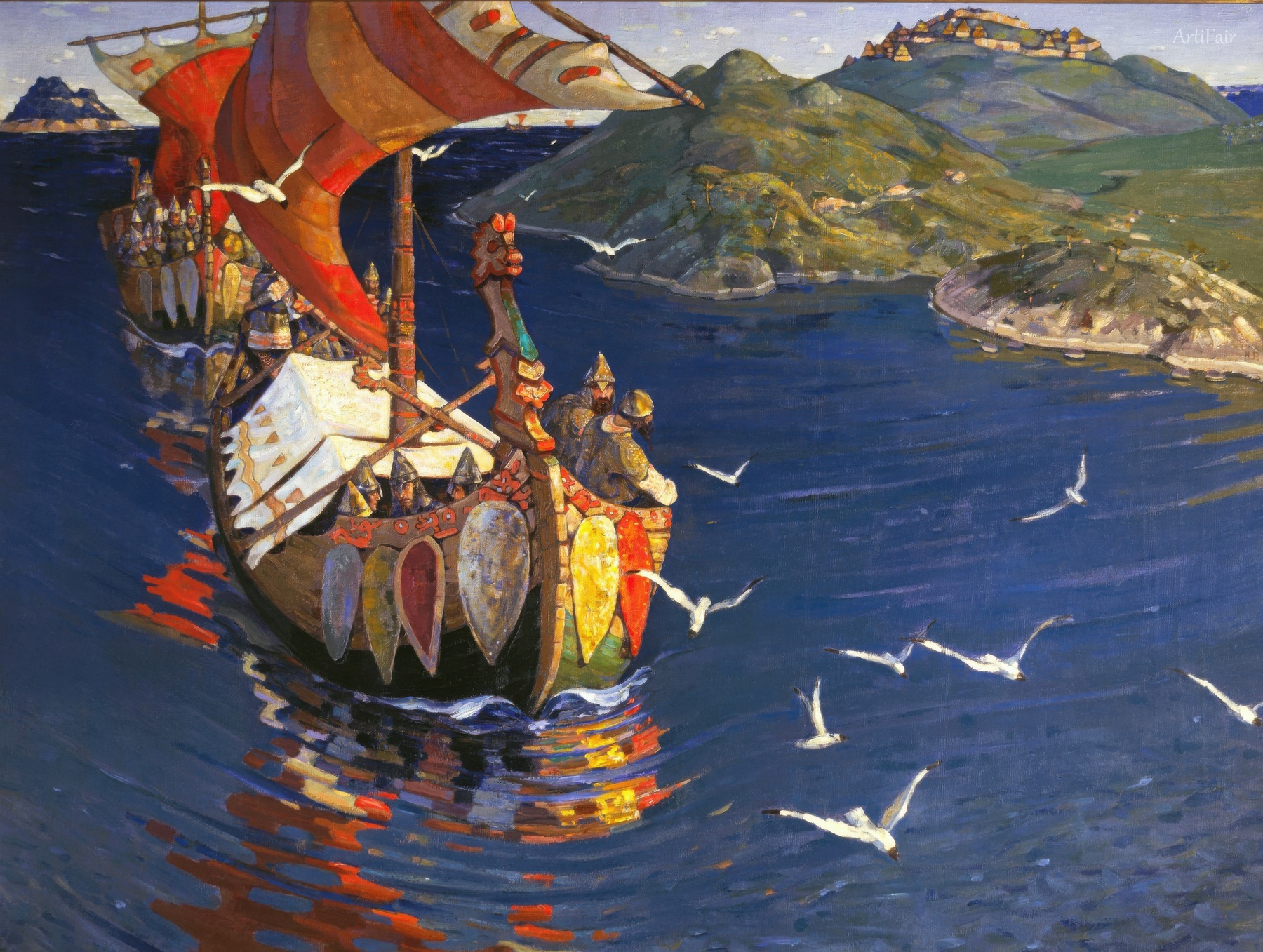
Overseas Guests
Category:
Created:
1901
Likes:
0
Dimensions:
Download:
New users get 4 free credits. 2K costs 1 credit; 4K and Ultra HD are priced by resolution. Public domain artworks can be used commercially.
Dominant colors
Public domain download summary
This artwork is provided as a public domain image resource. The 2K file costs 1 credit for everyday creative work, while 4K and Ultra HD files are priced by resolution.
Art Appreciation
Overseas Guests (Zamorskie gosti) is an oil-on-canvas painting by Nicholas Roerich, made in 1901 and now in the State Tretyakov Gallery, Moscow (inv. Zh-494); it measures 85 × 112.5 cm and belongs to his cycle The Beginnings of Rus. The Slavs.
The idea took shape in 1899, when the young Roerich travelled along the old waterway to Novgorod. He wrote that it was wondrous and frightening to realise that Varangian longships, the boats of the merchant Sadko and the Novgorod army bound for the battle of Shelon had sailed through those same places. In an article of the same year, On the Way from the Varangians to the Greeks, he imagined the scene in words: northern guests sailing past the low shore of the Gulf of Finland, the water soaked with the blue of a spring sky, a flock of gulls startled from the waves by the keel of the leading boat, and a long line of brightly painted ships. He painted the canvas itself in Paris.
The Tretyakov describes the picture as a symbolic image of the Varangians' arrival in Rus, noting that its theme also recalls Pushkin's Tale of Tsar Saltan. Roerich gave it the subtitle Folk Painting, and the dragon-prowed boats, red sails and deep blue water draw on motifs from Old Russian icon painting and folk applied art. Bright patches of colour are held within firm outlines, a manner the gallery compares to stained glass or painted wood carving and links to Art Nouveau; the warriors, ships and island town look like painted wooden toys, and the leading boat seems to drive straight towards the viewer. Russian writers also see the influence of his teacher Arkhip Kuindzhi in the decorative colour.
At the Imperial Academy of Arts exhibition of 1902 the painting was bought by Nicholas II for the palace at Tsarskoye Selo. It reached the Tretyakov in 1967 by exchange from the Pavlovsk palace museum. The work became one of Roerich's most reproduced images, and he made several repetitions, including a 1902 oil on cardboard in the Russian Museum, a pastel in Kirov and a tempera version in Minsk.