
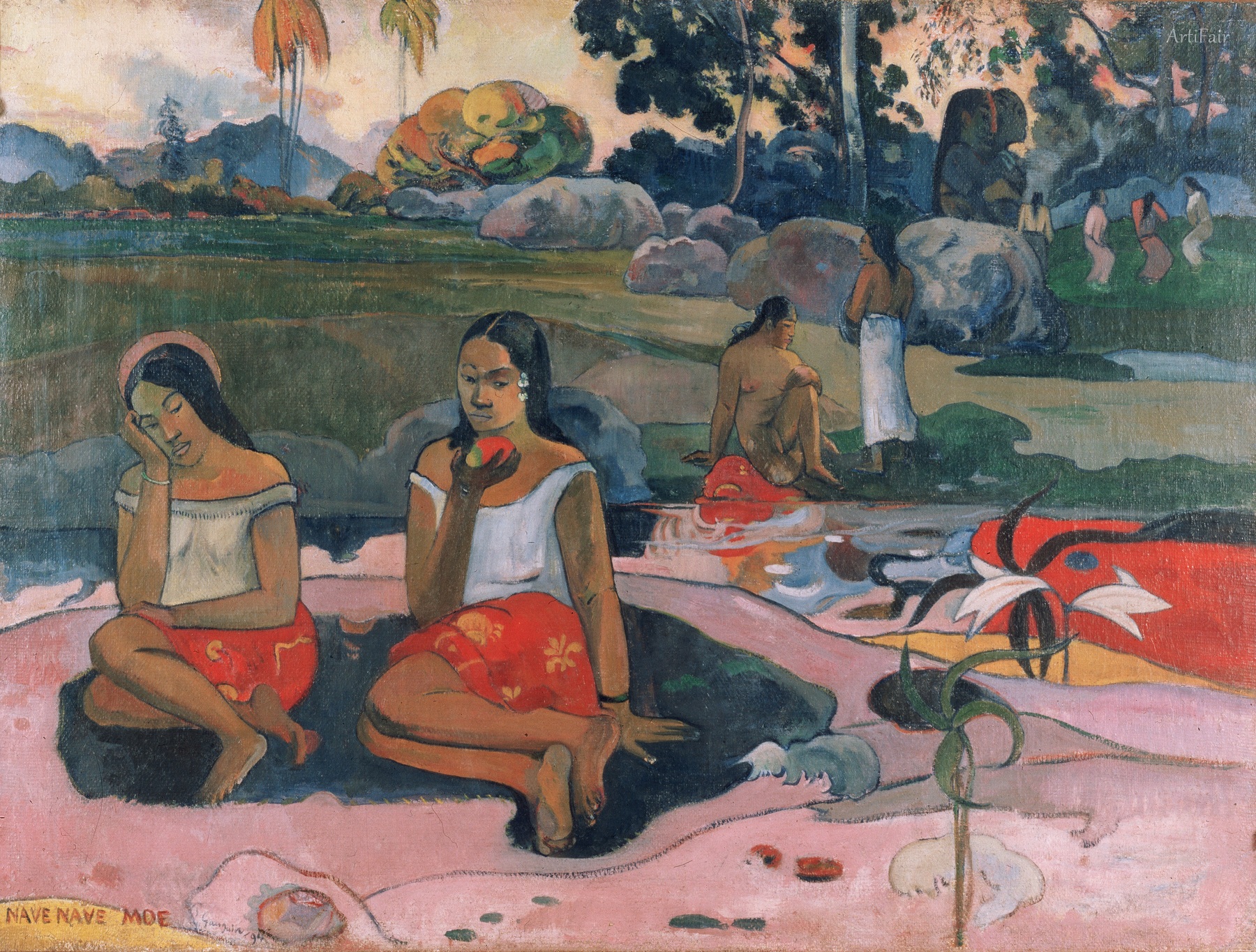
Sacred Spring: Sweet Dreams (Nave Nave Moe)
Category:
Created:
1894
Likes:
0
Dimensions:
Download:
New users get 4 free credits. 2K costs 1 credit; 4K and Ultra HD are priced by resolution. Public domain artworks can be used commercially.
Dominant colors
Public domain download summary
This artwork is provided as a public domain image resource. The 2K file costs 1 credit for everyday creative work, while 4K and Ultra HD files are priced by resolution.
Art Appreciation
Sacred Spring: Sweet Dreams (Nave nave moe) is an oil-on-canvas painting by Paul Gauguin, made in Paris in early 1894 and now in the State Hermitage Museum, St Petersburg. Gauguin painted it after coming back from his first stay in Tahiti, and the art historian A. G. Barskaya called it a composite image built from memories of Polynesia. The canvas measures 74 by 100 cm and carries the Tahitian title, his signature and the date 94 at lower left.
Much of the picture reassembles motifs Gauguin had already used. The two young women seated in the foreground, one with a halo and the other holding a fruit, appear together in his earlier Maori House and separately in The Large Tree at the Cleveland Museum of Art; he also placed them in the medallions of a woodcut designed as a title page for his book Noa Noa. The nude by the pool repeats the main figure of Are You Jealous? (Pushkin Museum), and the women dancing beside a double idol on the right are taken almost directly from In Olden Times (Thyssen-Bornemisza Museum). Barskaya linked the idol to the cult of the moon goddess Hina; Albert Kostenevich, citing the scholar R. Field, suggested it may be the supreme god Taaroa with one of his wives.
Kostenevich described the work as one of Gauguin's most contradictory: the upper zone is softer, the lower one more strongly cloisonnist. He read the spring as a religious symbol, the lilies as purity and the fruit as the apple of a Tahitian Eve, with the haloed figure as Mary; this meditative pair contrasts with the older women behind them, busy with worldly matters. The Tahitian title has been translated in several ways, including Delightful Dream.
At the Hôtel Drouot sale of 18 February 1895, held to fund Gauguin's return to Tahiti, it was listed as Eau délicieuse and bought by Émile Schuffenecker for 340 francs. Ambroise Vollard later showed it as Fête champêtre, and on 5 October 1907 the Moscow collector Ivan Morozov bought it for 8,000 francs. After nationalisation it hung from 1923 in the State Museum of New Western Art and passed to the Hermitage in 1931.