
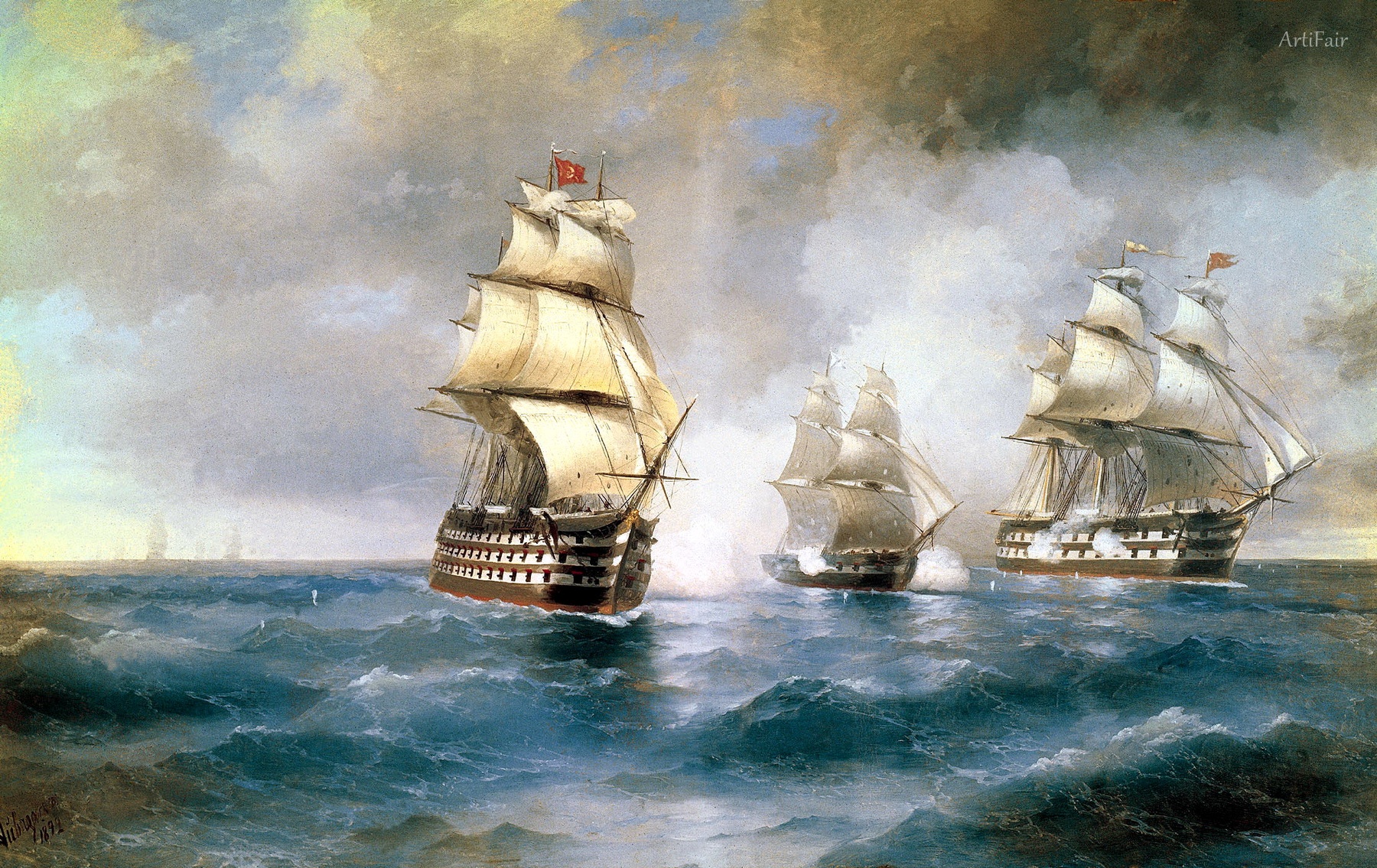
Brig Mercury Attacked by Two Turkish Ships
Category:
Created:
Date unknown
Likes:
0
Dimensions:
Download:
New users get 4 free credits. 2K costs 1 credit; 4K and Ultra HD are priced by resolution. Public domain artworks can be used commercially.
Dominant colors
Public domain download summary
This artwork is provided as a public domain image resource. The 2K file costs 1 credit for everyday creative work, while 4K and Ultra HD files are priced by resolution.
Art Appreciation
Brig Mercury Attacked by Two Turkish Ships is an oil on canvas painted by Ivan Aivazovsky in 1892; measuring 212 × 339 cm, it is in the Aivazovsky Art Gallery in Feodosia, Crimea.
The painting records an episode of the Russo-Turkish War of 1828–1829. On 14 May 1829, while patrolling near the Bosporus, the 18-gun Russian brig Mercury, commanded by Lieutenant-Captain Alexander Kazarsky, was overtaken in light winds by two of the largest Turkish ships of the line, Selimiye and Real Bey; one of them carried the Ottoman admiral. The officers' council decided to fight rather than surrender, prepared if necessary to blow up the brig alongside an enemy ship. The Feodosia gallery puts the odds at 184 guns against 18. By skilful manoeuvring Kazarsky kept the Turks from bringing their full firepower to bear, and Russian gunfire damaged the masts and rigging of both ships until they broke off the pursuit. Mercury was badly damaged but lost only four men and returned to Sevastopol. A Turkish navigator who took part wrote that the captain's name deserved to be inscribed in gold letters in the temple of glory, and a monument in Sevastopol bears the words 'To Kazarsky. An example to posterity'.
Aivazovsky, painter to the Main Naval Staff, recorded many victories of the Russian fleet and painted this canvas in old age, more than sixty years after the battle. He shows the tiny brig squeezed between the two towering ships under full sail on a bright day, with puffs of gun smoke between them and pale clouds overhead. Some writers note that sailing downwind, as here, would have favoured the square-rigged Turkish ships and question the accuracy of the arrangement, suggesting that he chose it to stress the brig's desperate position. Few of his many seascapes show ships in such close combat.
Aivazovsky had treated the subject once before, in 1848, with a painting of the brig meeting the Russian squadron after its victory.