
Arii Matamoe (The Royal End)
Category:
Created:
1892
Likes:
0
Dimensions:
Download:
New users get 4 free credits. 2K costs 1 credit; 4K and Ultra HD are priced by resolution. Public domain artworks can be used commercially.
Dominant colors
Public domain download summary
This artwork is provided as a public domain image resource. The 2K file costs 1 credit for everyday creative work, while 4K and Ultra HD files are priced by resolution.
Art Appreciation
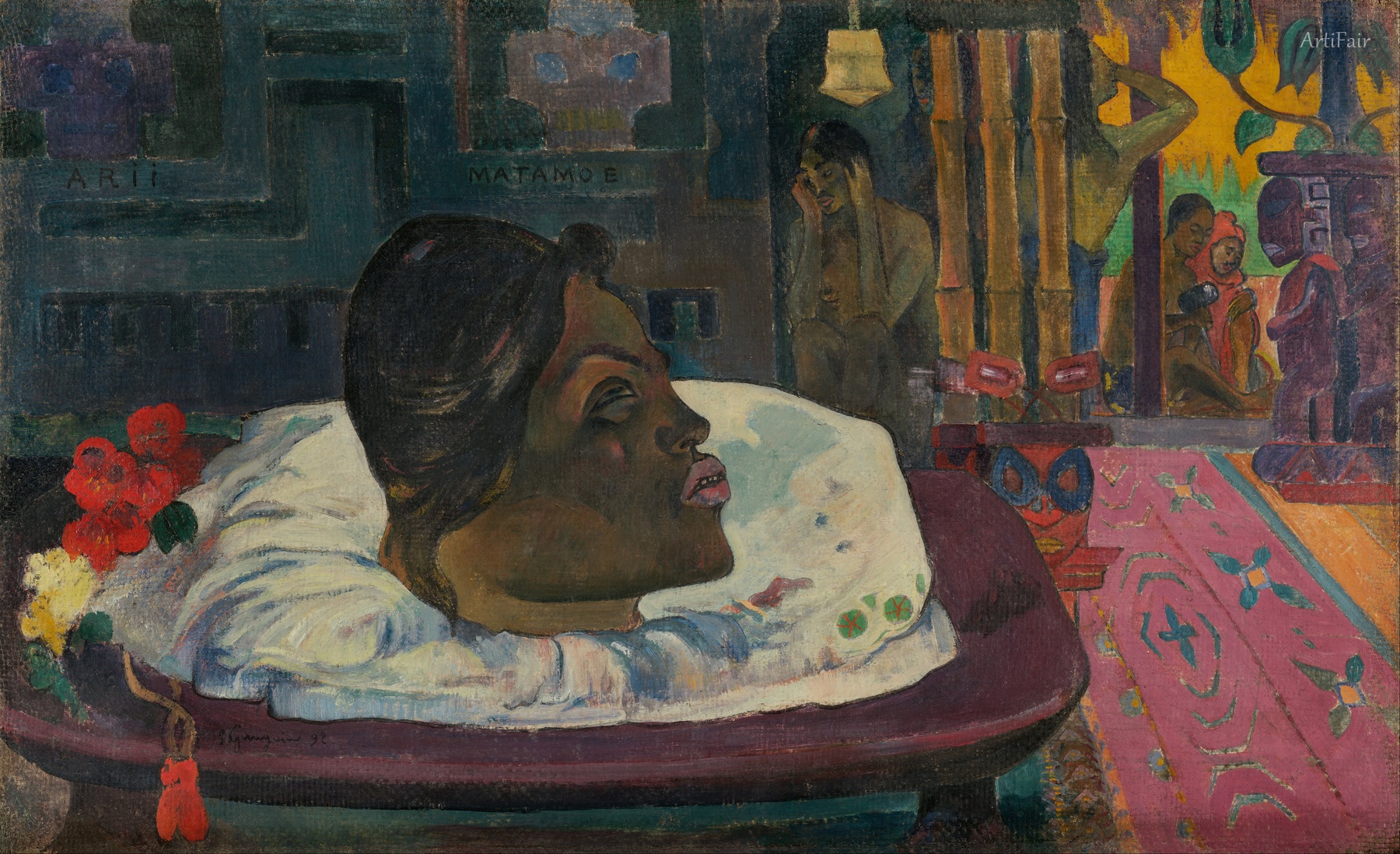
Arii Matamoe (The Royal End) is an oil painting on coarse fabric by Paul Gauguin, made in Tahiti in 1892 during his first stay on the island and now in the J. Paul Getty Museum, Los Angeles. It measures 45.1 by 74.3 cm and is inscribed ARii MATAMOE at upper left; arii means noble or royal, and matamoe, literally sleeping eyes, here implies death.
In June 1892 Gauguin told his friend Daniel de Monfreid that he had just finished a severed Kanak head, arranged on a white cushion in a palace of his own invention and guarded by women also of his invention, adding that he had stolen the head from a pine board. The death of Pōmare V, the last king of Tahiti, in 1891 shortly after Gauguin's arrival, and a guillotine execution he had witnessed years earlier are both thought to lie behind the image. Pōmare was not in fact beheaded or displayed, and such rites were at most uncommon in Tahiti; in Noa Noa, which reproduces a photograph of the painting, Gauguin presented the king's death as a metaphor for the loss of native culture under European rule.
The Getty describes the work as unique in his first Tahitian period, an interior with a morbid theme among many outdoor scenes. Behind the head a nude woman crouches in mourning against a wall patterned with skull motifs, another raises her arm to her mouth as if wailing, and a carved double tiki marks the threshold to the outside, where two figures sit. Gauguin mixed Tahitian, Javanese, French and Peruvian sources; the Getty notes that one mourning figure was inspired by a Peruvian mummy. Its curators have suggested he meant to shock Parisian audiences.
The painting was shown at Paul Durand-Ruel's gallery in Paris in November 1893 but did not sell. The painter Henry Lerolle bought it at auction in 1895 for 400 francs; it later belonged to the lawyer Georges Leven and, after the Second World War, to a Swiss collector who lent it only once after 1946. The Getty announced its purchase in March 2008 after eight years of negotiations, without disclosing the price.