
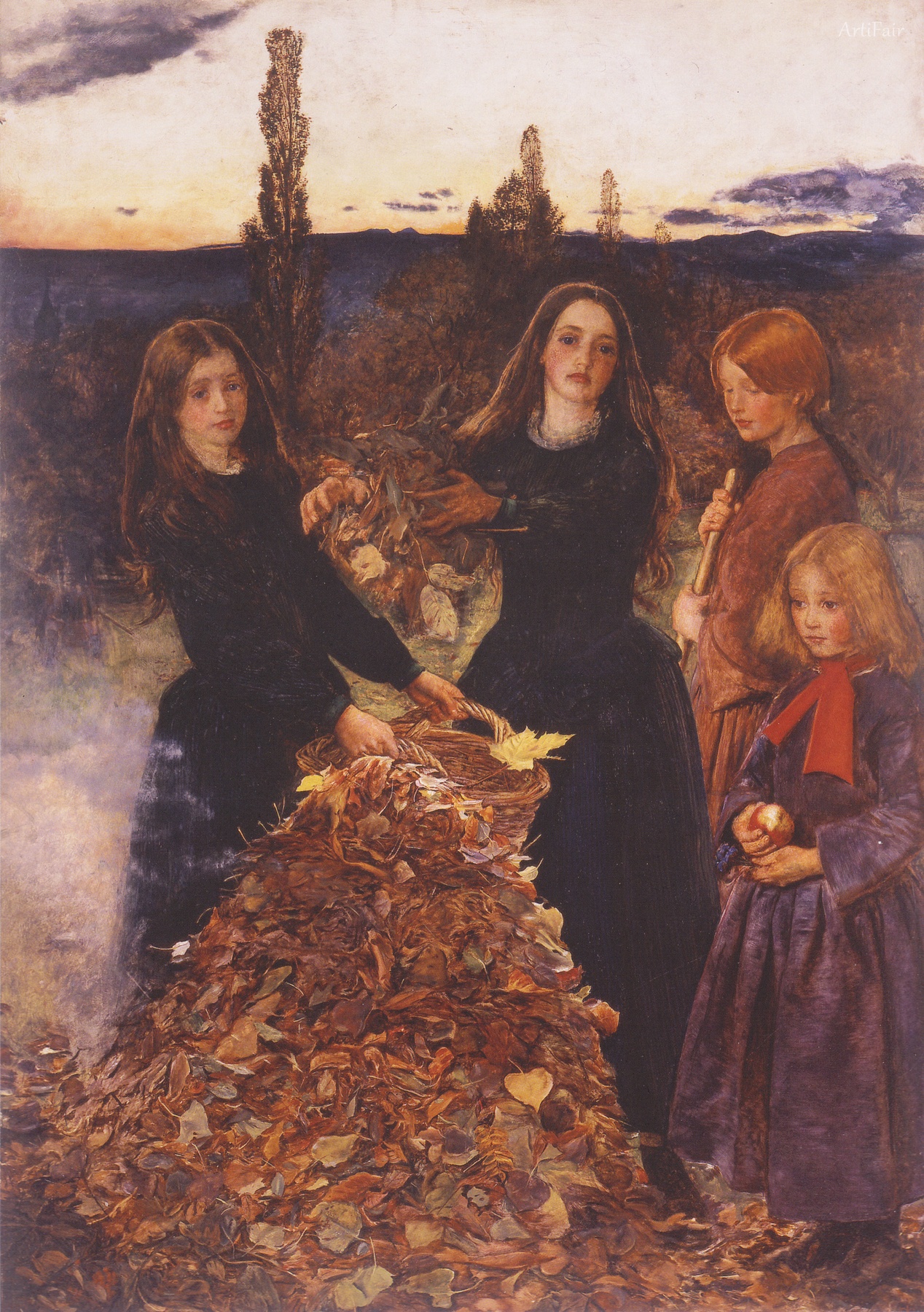
Autumn Leaves
Category:
Created:
1856
Likes:
0
Dimensions:
Download:
New users get 4 free credits. 2K costs 1 credit; 4K and Ultra HD are priced by resolution. Public domain artworks can be used commercially.
Dominant colors
Public domain download summary
This artwork is provided as a public domain image resource. The 2K file costs 1 credit for everyday creative work, while 4K and Ultra HD files are priced by resolution.
Art Appreciation
Autumn Leaves is an oil painting on canvas by John Everett Millais, begun in the autumn of 1855, finished in April 1856 and shown at the Royal Academy that year; Manchester Art Gallery bought it from the collector James Leathart in 1892.
Millais started the picture soon after returning from his honeymoon with Effie Gray, whom he had married in July 1855. It was painted in the garden of their home, Annat Lodge, on the edge of Perth, above the Gray family house of Bowerswell. The town lies hidden in the dusk, with only the tower of St John's Kirk showing, and beyond rise what Millais called the mountains of the Highlands, blue-black against the sunset. The two girls at left are Effie's sisters Alice, then about ten, and Sophie; the two at right are local girls, Matilda Proudfoot with the rake and Isabella Nicol with the apple, who also sat for The Blind Girl. Their plainer clothes mark a difference in class.
The girls are gathering leaves for a bonfire whose flames stay out of sight; only smoke rises from the heap. Effie wrote that her husband wanted a picture 'full of beauty and without a subject', yet Millais told the critic F. G. Stephens that he meant its solemnity to awaken the deepest religious reflection, and chose burning leaves as the subject most likely to do so. The picture is usually read as a meditation on the passing of youth and beauty. Malcolm Warner has linked it to lines from Tennyson's 'Tears, Idle Tears', and the apple held by the youngest girl has been seen as a hint of lost innocence.
John Ruskin called it the first instance of a perfectly painted twilight, and Joanna Boyce praised its depth of feeling in the Saturday Review. Later writers have counted it among the early influences on the Aesthetic Movement. The canvas measures 104.3 by 74 cm.