
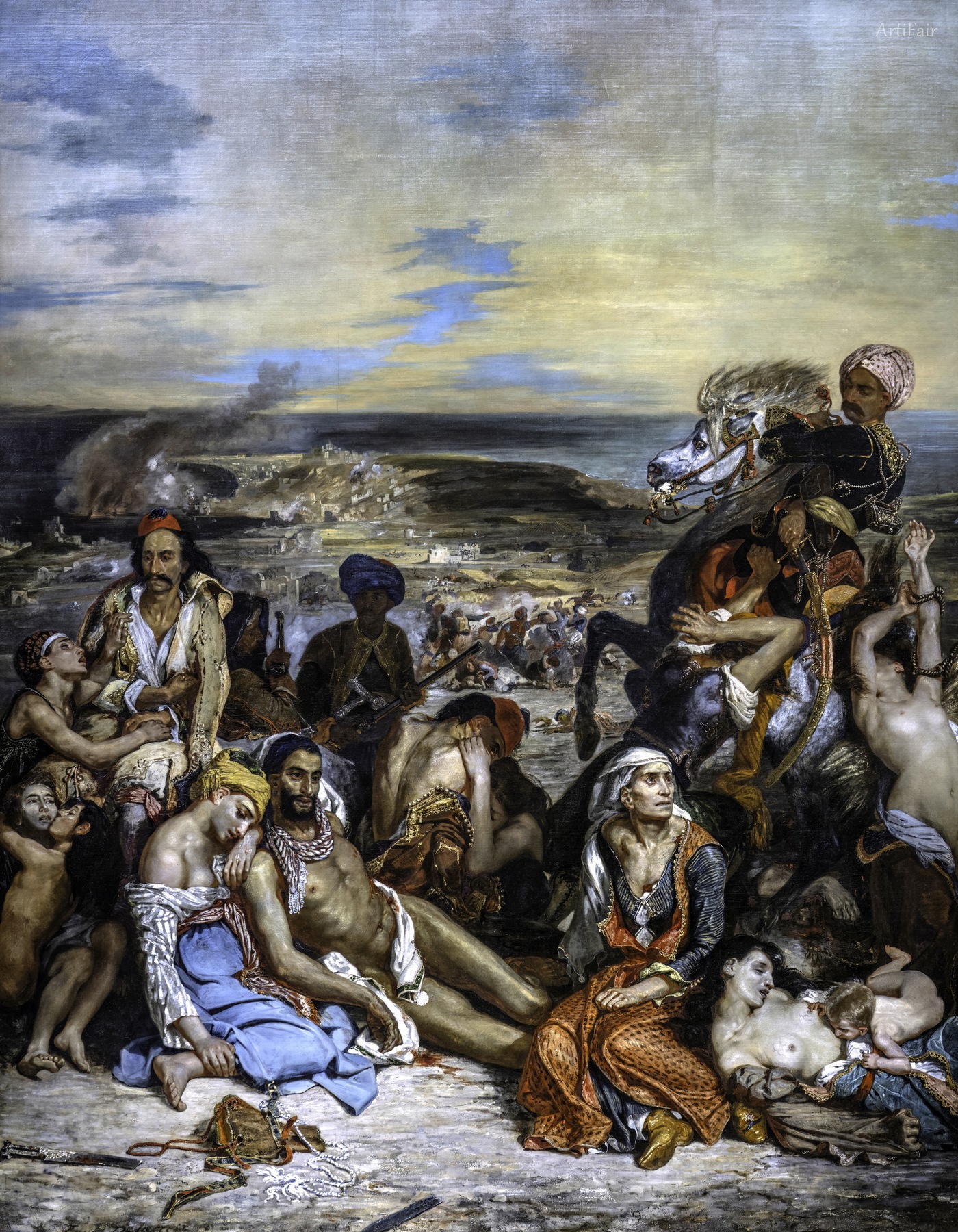
The Massacre at Chios
Category:
Created:
1824
Likes:
0
Dimensions:
Download:
New users get 4 free credits. 2K costs 1 credit; 4K and Ultra HD are priced by resolution. Public domain artworks can be used commercially.
Dominant colors
Public domain download summary
This artwork is provided as a public domain image resource. The 2K file costs 1 credit for everyday creative work, while 4K and Ultra HD files are priced by resolution.
Art Appreciation
The Massacre at Chios (Scènes des massacres de Scio) is an oil painting on canvas by Eugène Delacroix, completed for the Salon of 1824 and now in the Musée du Louvre, Paris (INV 3823); it is 419 cm high and 354 cm wide.
The picture responds to events of the Greek War of Independence. From 12 April 1822 Ottoman forces attacked the island of Chios for several months; some twenty thousand inhabitants were killed and most of the survivors were deported into slavery. As early as September 1821 Delacroix had told a friend he hoped to make his name with a Greek subject at the Salon, and in May 1823 he committed himself to this one. It was only his second major painting, after Dante and Virgil in Hell.
There is no hero. Thirteen Greek civilians are crowded into the foreground in two loose pyramids, an echo of Géricault's Raft of the Medusa, for which Delacroix had posed. On the left the wounded and the dying sit in resignation; on the right an Ottoman horseman twists above a woman bound to his horse, while at his feet an old woman looks up and an infant reaches for its dead mother. Behind, the land opens into burning settlements and a scorched plain, with colour laid in drifting bands.
At the Salon, which opened on 25 August 1824, it hung in the same room as Ingres's Vow of Louis XIII, the start of the public rivalry between the two painters. Antoine-Jean Gros, whose Plague of Jaffa Delacroix had drawn on, called it the massacre of painting, and Ingres spoke of fever and epilepsy, yet the state bought it that year for 6,000 francs for the Musée du Luxembourg, and Delacroix received a second-class medal. It moved to the Louvre in November 1874. A restoration between October 2019 and January 2020 found almost no later repainting, casting doubt on the belief that Delacroix reworked the background in 1847.