
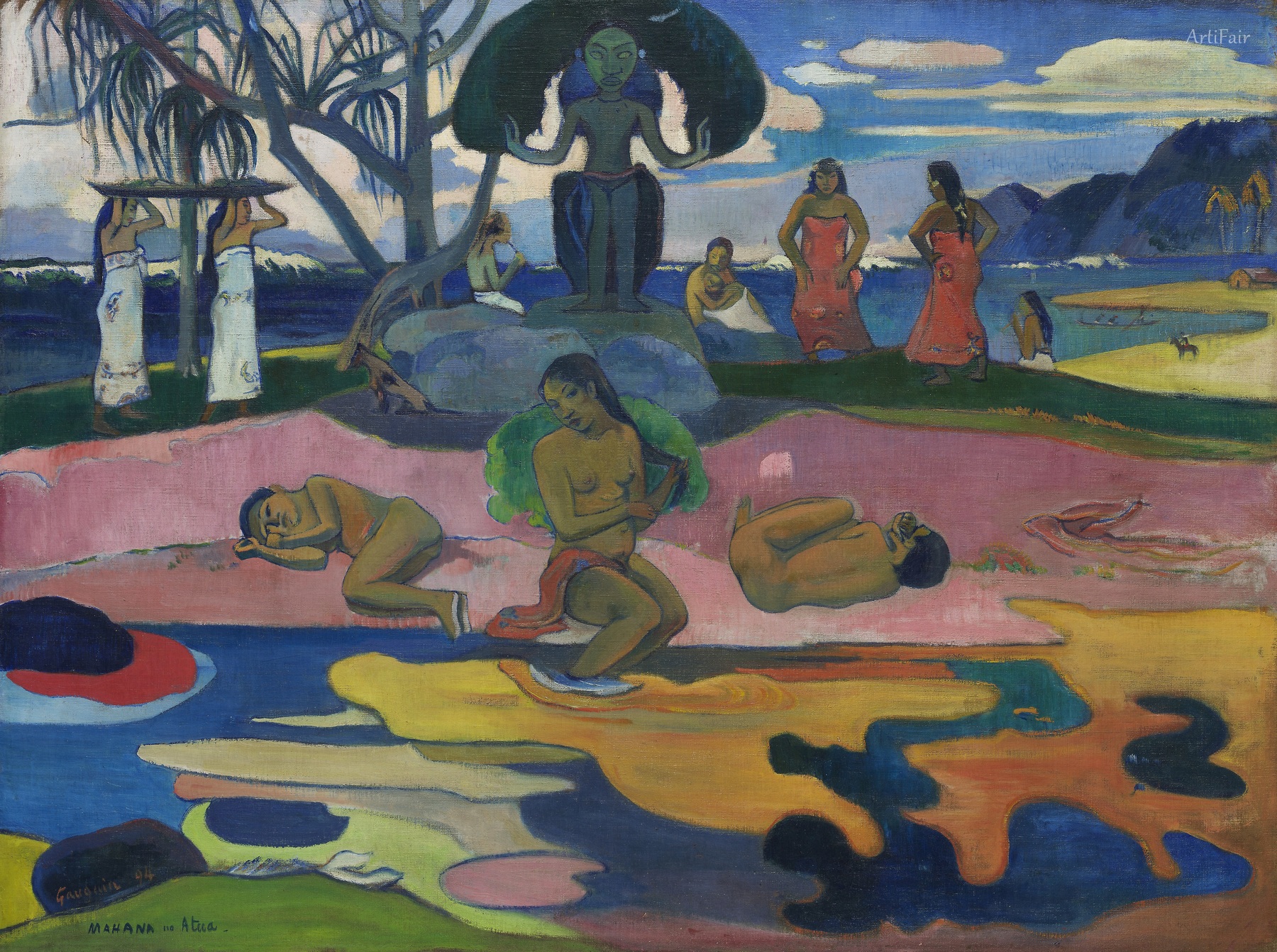
Day of the God (Mahana no Atua)
Category:
Created:
1894
Likes:
0
Dimensions:
Download:
New users get 4 free credits. 2K costs 1 credit; 4K and Ultra HD are priced by resolution. Public domain artworks can be used commercially.
Dominant colors
Public domain download summary
This artwork is provided as a public domain image resource. The 2K file costs 1 credit for everyday creative work, while 4K and Ultra HD files are priced by resolution.
Art Appreciation
Day of the God (Mahana no atua) is an oil painting on linen canvas by Paul Gauguin, made in Paris in 1894 and now in the Art Institute of Chicago. It measures 68 by 91 cm and belongs to the museum's Helen Birch Bartlett Memorial Collection.
Unlike Gauguin's other Tahitian landscapes, this picture was produced in Paris shortly after his first stay on the island, and it is built from imagination and memory rather than observation. A carved idol, identified as the goddess Hina, stands on a rock near the shore at the top of the composition, and the human figures are arranged around it in a symmetrical pattern of twos and threes. On the left two women carry offerings; on the right two others dance the upaupa, an erotic Tahitian dance that the colonial authorities tried to ban. In the foreground a bather sits with her feet in the water between two reclining figures, who may also be read as one person seen from two angles. Their poses have suggested birth, life and death, though Gauguin never explained the group.
Below them the water dissolves into interlocking flat zones of acid pink, yellow, blue and black. The Art Institute calls the composition one of the most abstract and avant-garde of Gauguin's career, and its simplified forms and strong colour are typical of his Post-Impressionist work.
The first owner was Edgar Degas, who bought the painting for 500 francs from Gauguin's studio exhibition in December 1894. At the sale of Degas's collection in Paris in March 1918 it fetched 12,600 francs under the title Le Repos au bord de la mer (Tahiti). It later belonged to George Bernheim in Paris, was sold in 1925 to the Chicago collector Frederic Clay Bartlett and was given to the Art Institute in 1926. It has appeared in many exhibitions, among them the 1929 exhibition Cézanne, Gauguin, Seurat and Van Gogh at the Museum of Modern Art in New York, The Private Collection of Edgar Degas at the Metropolitan Museum of Art in 1997 to 1998, and Tate Modern's Gauguin: Maker of Myth in 2010 to 2011.