
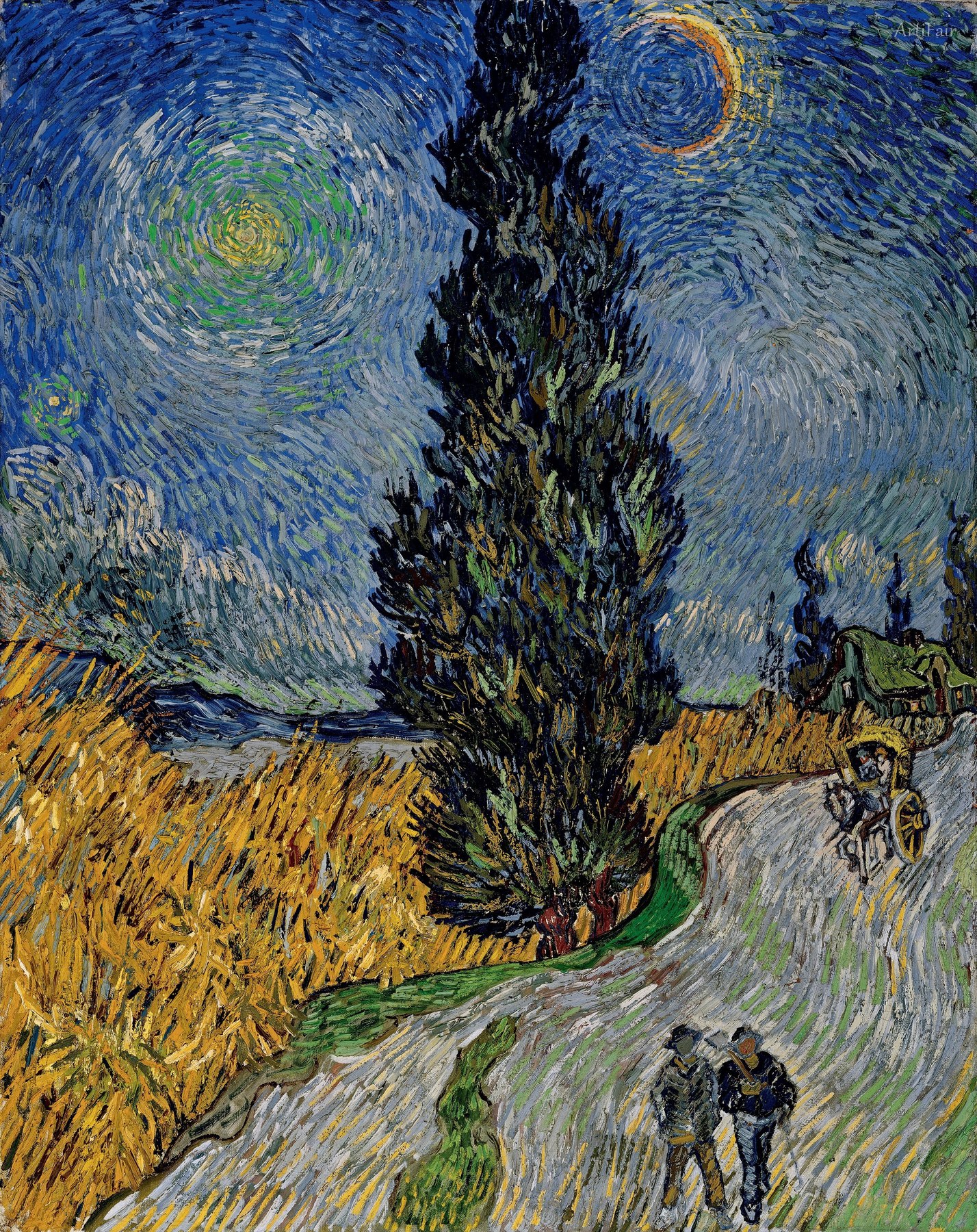
Road with Cypress and Star
Category:
Created:
1890
Likes:
0
Dimensions:
Download:
New users get 4 free credits. 2K costs 1 credit; 4K and Ultra HD are priced by resolution. Public domain artworks can be used commercially.
Dominant colors
Public domain download summary
This artwork is provided as a public domain image resource. The 2K file costs 1 credit for everyday creative work, while 4K and Ultra HD files are priced by resolution.
Art Appreciation
Road with Cypress and Star, also known as Country Road in Provence by Night, is an oil painting on canvas by Vincent van Gogh, made at Saint-Rémy-de-Provence around 12–15 May 1890 and now in the Kröller-Müller Museum, Otterlo. It measures about 92 × 73 cm.
Van Gogh had admitted himself to the asylum of Saint-Paul-de-Mausole in May 1889 and stayed for a year. This is generally considered the last painting he made there, shortly before he left for Auvers-sur-Oise. The museum stresses that it is not a real view but a landscape composed at will, probably as a final reminder of Saint-Rémy and a summary of his impressions of Provence. For him the cypress was the ultimate symbol of the region: he had earlier written to Theo that the trees still preoccupied him, that he wanted to do something with them like his sunflower canvases, and that they were as beautiful in line and proportion as an Egyptian obelisk. He had also wanted to paint cypresses at night since his time in Arles in 1888.
A huge cypress runs off the top of the canvas and splits the sky in two: on one side a bright star, on the other a thin crescent moon. Below, two walkers come along a road through wheat, followed by a small carriage, with a lit house among trees beyond. The whole surface is built from short, rhythmic, wavy strokes set side by side. An astronomical study has suggested that the sky may reflect a close conjunction of Mercury and Venus on 20 April 1890.
In June 1890, from Auvers, Van Gogh wrote to Paul Gauguin that the painting's themes were close to those of Gauguin's Christ in the Garden of Olives. Writers such as Kathleen Powers Erickson and Naomi Maurer have read it as reflecting his sense that his own death was near, with the cypress dividing old from new.