
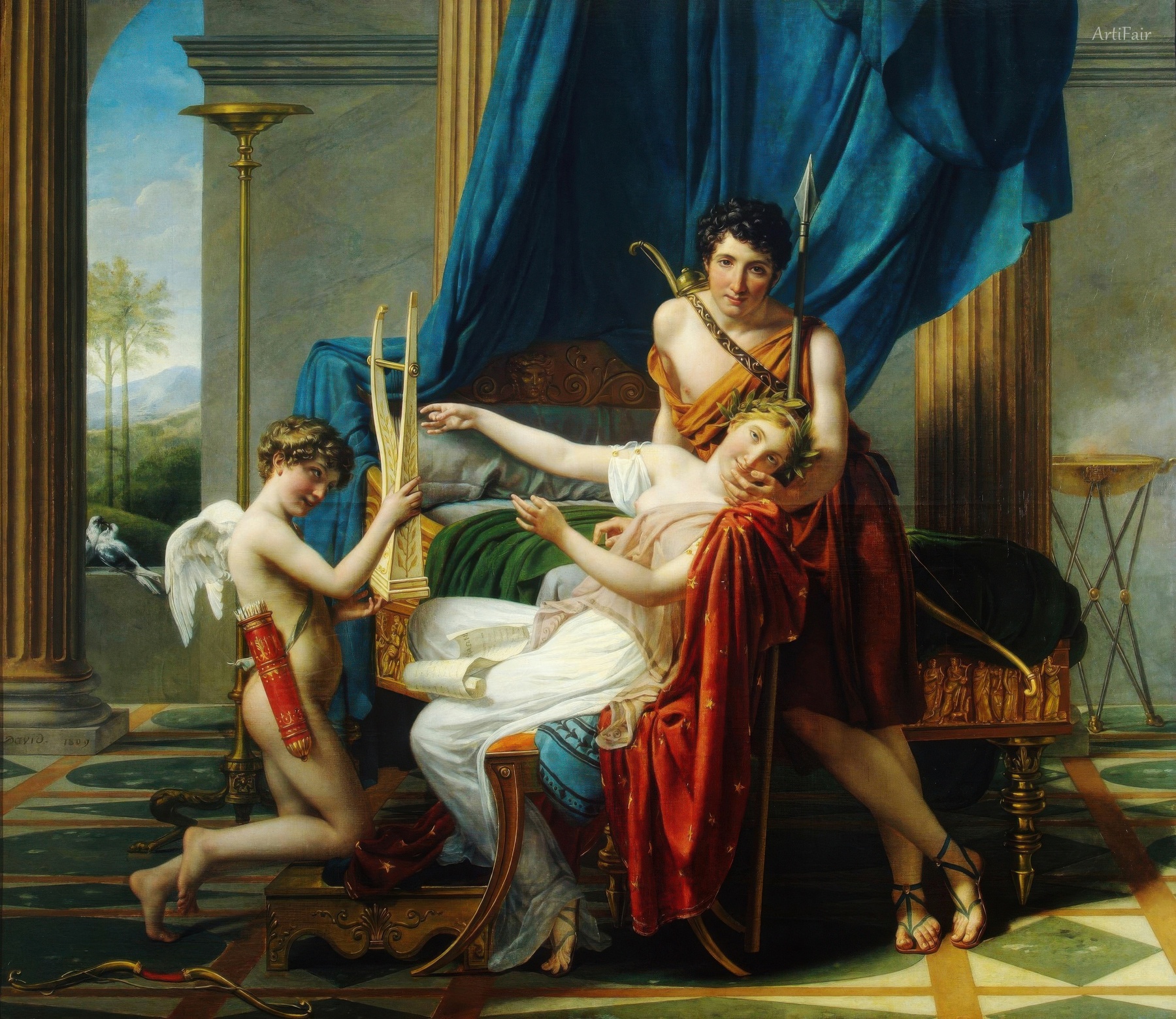
Sappho and Phaon
Category:
Created:
1809
Likes:
1
Dimensions:
Download:
New users get 4 free credits. 2K costs 1 credit; 4K and Ultra HD are priced by resolution. Public domain artworks can be used commercially.
Dominant colors
Public domain download summary
This artwork is provided as a public domain image resource. The 2K file costs 1 credit for everyday creative work, while 4K and Ultra HD files are priced by resolution.
Art Appreciation
Sappho and Phaon (Sapho, Phaon et l'Amour) is an oil painting on canvas by Jacques-Louis David, dated 1809 and now in the State Hermitage Museum, Saint Petersburg, the only work by David in that collection.
The picture was ordered by the Russian prince Nikolai Yusupov, a collector of French art who bought from fashionable Paris painters during his stay in the city. According to the Russian Wikipedia account, the commission was placed on 9 July 1808 for 12,000 livres and the choice of subject was left to David; because he was then Napoleon's official painter, the private job was carried out quietly. After the grand ceremonial canvases of the Empire, David turned here to a light, Anacreontic treatment of antiquity, and the work belongs with his paintings of mythological lovers that began with The Loves of Paris and Helen of 1788.
The Greek poet Sappho sits at the foot of a bed, a scroll of her verses on her knee, while Phaon, holding a spear and bow, leans over to cradle her head. Cupid kneels before her and holds up her lyre; Venus's doves rest on the threshold. The Greek text on the scroll gives the opening lines of one of Sappho's odes, to which David added a dedication to Phaon. The legend of her unrequited love for Phaon arose long after the poet's death and was developed in a verse letter from Sappho to Phaon in Ovid's Heroides.
Yusupov took the canvas, which measures 225.3 × 262 cm, to Russia. After the 1917 revolution it was nationalised with the family collection and entered the Hermitage in 1925; it was restored in 1970. Critics have not always been kind to it, and David himself wrote to Yusupov in 1814 asking for a small sketch of it, since he had kept no record of the picture in Paris.