
Saint Eulalia
Category:
Created:
1885
Likes:
2
Dimensions:
Download:
New users get 4 free credits. 2K costs 1 credit; 4K and Ultra HD are priced by resolution. Public domain artworks can be used commercially.
Dominant colors
Public domain download summary
This artwork is provided as a public domain image resource. The 2K file costs 1 credit for everyday creative work, while 4K and Ultra HD files are priced by resolution.
Art Appreciation
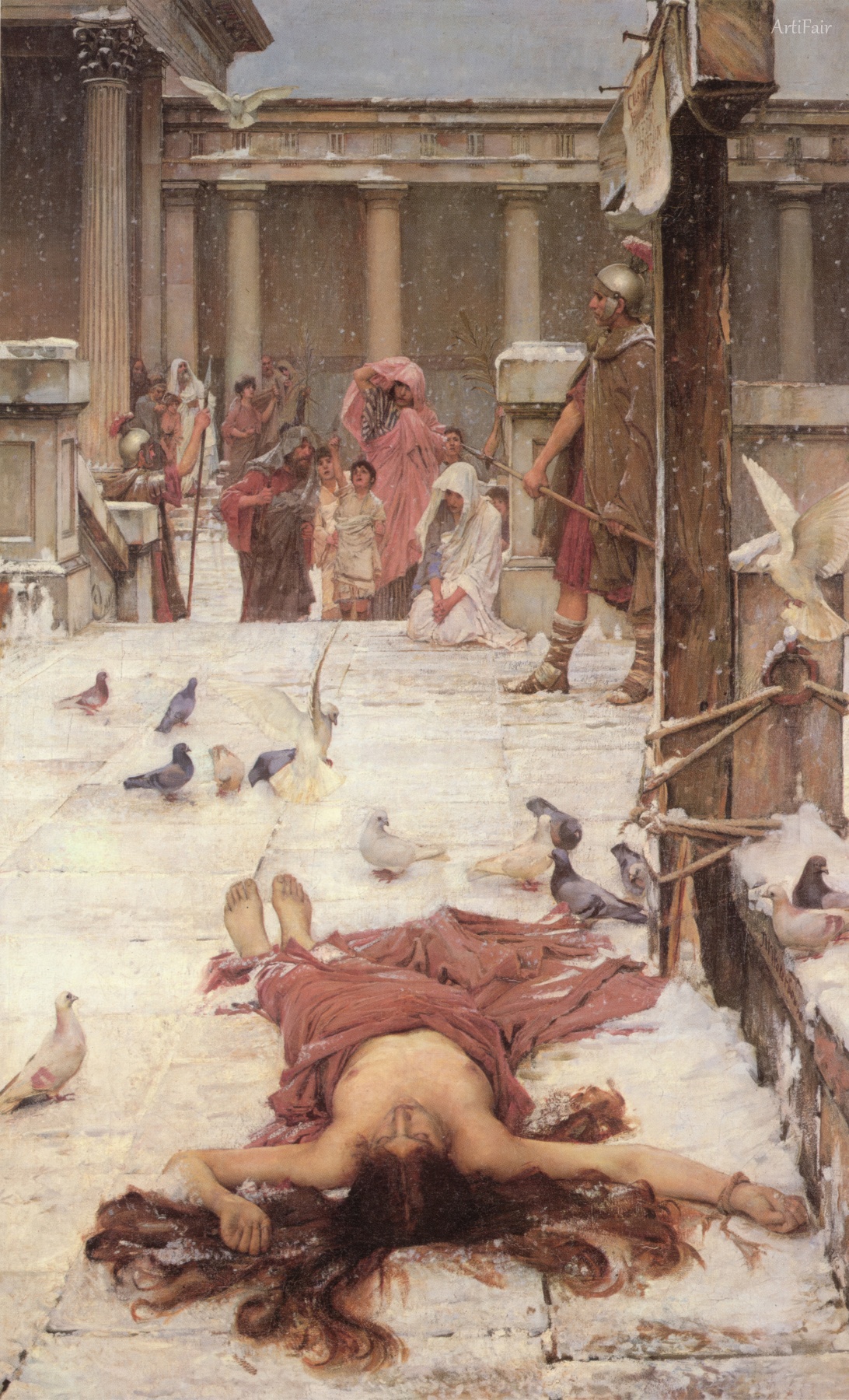
Saint Eulalia is an oil painting on canvas by John William Waterhouse, exhibited at the Royal Academy in 1885 and presented to the Tate Gallery, London, by Sir Henry Tate in 1894.
Eulalia of Mérida was an early Christian martyred in 304 AD, under the emperor Diocletian, for refusing to sacrifice to the Roman gods; she is said to have been twelve years old. Her death was horrific: according to tradition she was torn with iron hooks and burned with torches until the flames caught her hair. Waterhouse leaves all this out and shows the moment afterwards. When he exhibited the picture he added a note citing the poet Prudentius, who wrote that her body, lying in the forum after her martyrdom, was shrouded by a miraculous fall of snow. Prudentius also told of a white dove that flew from her mouth to heaven at the moment of death, and Waterhouse painted sixteen doves; the youngest mourner points up at one hovering bird, a sign of her departing soul.
The painter moved the scene from Mérida to the Forum in Rome and made the body appear unharmed, with a wooden cross at right implying crucifixion. Tate describes the composition as extremely daring. The saint lies sharply foreshortened across the foreground, leading the eye into an empty centre, while the distant mourners form a pyramid and a soldier's spear and a zigzag of ropes draw the gaze back down to her outflung arms. The nudity was new in Waterhouse's work, but the youth of the saint and the historical setting spared him criticism.
The picture was well received. A reviewer in The Magazine of Art found the conception full of power and originality and praised the drawing of the foreshortened figure, and the painting secured Waterhouse's election as an Associate of the Royal Academy. The canvas measures 188.6 by 117.5 cm.