
The Fall of the Rebel Angels
Category:
Created:
1562
Likes:
0
Dimensions:
Download:
New users get 4 free credits. 2K costs 1 credit; 4K and Ultra HD are priced by resolution. Public domain artworks can be used commercially.
Dominant colors
Public domain download summary
This artwork is provided as a public domain image resource. The 2K file costs 1 credit for everyday creative work, while 4K and Ultra HD files are priced by resolution.
Art Appreciation
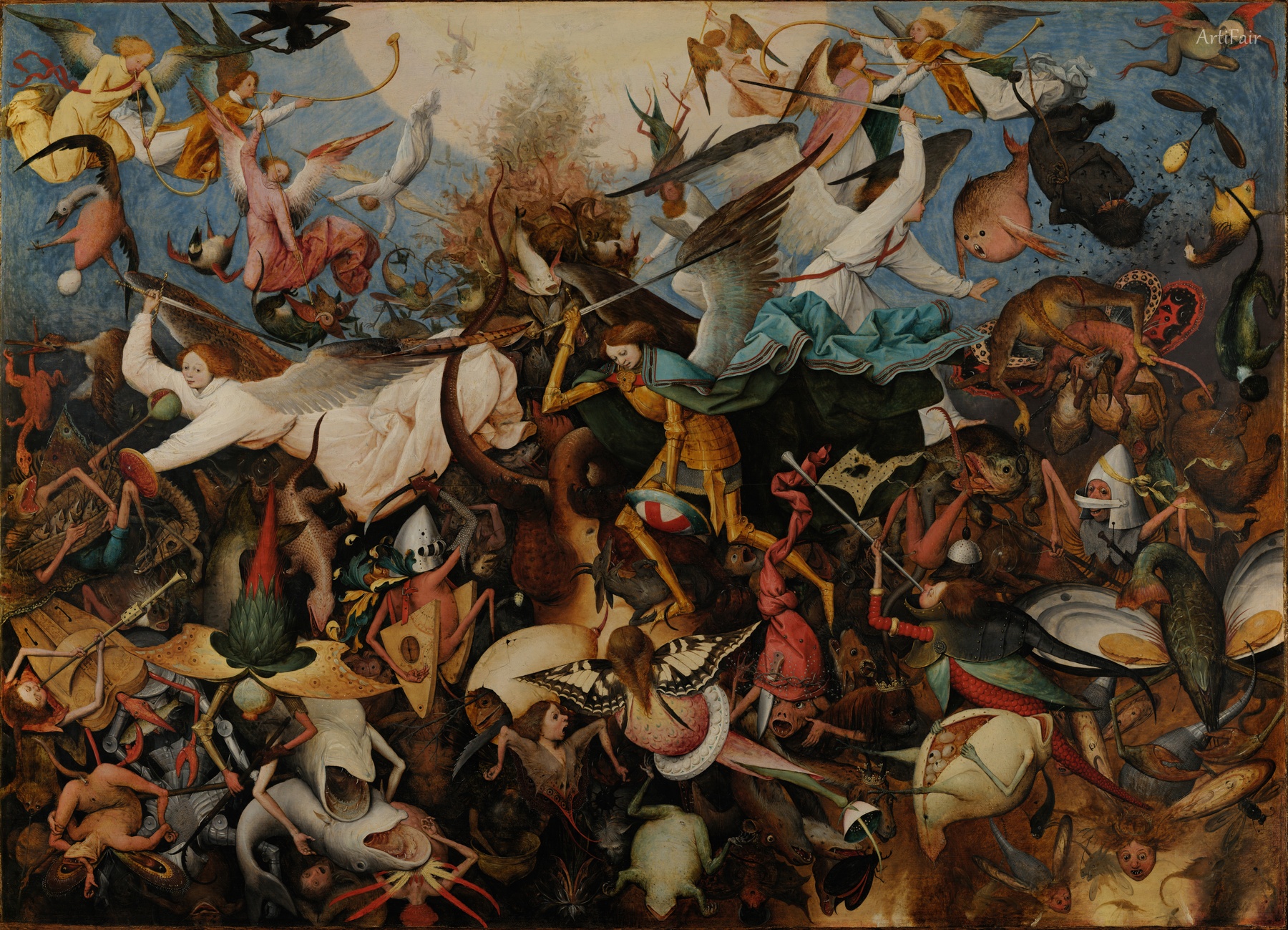
The Fall of the Rebel Angels is an oil painting on panel by Pieter Bruegel the Elder, signed and dated 1562, measuring 117 by 162 cm and held by the Royal Museums of Fine Arts of Belgium in Brussels (Oldmasters Museum).
The subject comes from chapter 12 of the Book of Revelation, the war in heaven in which the archangel Michael drives out Lucifer and the angels who rebelled with him. Bruegel puts Michael, in gilded armour and wielding a sword, at the centre of a dense crowd, with two white-robed angels fighting at his side and trumpeting angels in the upper corners. Below them the falling rebels turn into hybrid monsters, part human, part fish, insect or bird, filling almost every inch of the panel. A central figure among many small ones was a favourite arrangement for Bruegel at this time, used also in Dull Gret and in his engraved series of the Vices and Virtues for the Antwerp publisher Hieronymus Cock.
The debt to Hieronymus Bosch is so plain that the unsigned panel was once given to Bosch, and before that to Pieter Brueghel the Younger. When the frame was removed during a restoration, the inscription BRVEGEL MDLXII was found at the bottom edge, settling the attribution. Albrecht Dürer's Apocalypse woodcut of Saint Michael fighting the dragon and a Fall of the Rebel Angels by Frans Floris have also been proposed as models. Tine Luk Meganck has argued that the picture works like a cabinet of curiosities, and that creatures such as a feather-crowned nude figure point to knowledge of the Americas that postdates Bosch.
The museum bought the panel in 1846 from Félix Stappaerts for 500 francs. In 1944 Walther Vanbeselaere suggested it forms a trilogy with The Triumph of Death and Dull Gret, an idea developed by Anna Pawlak in 2011. Because the old panel is fragile, it is very rarely lent.