
Liberty Leading the People
Category:
Created:
1830
Likes:
3
Dimensions:
Download:
New users get 4 free credits. 2K costs 1 credit; 4K and Ultra HD are priced by resolution. Public domain artworks can be used commercially.
Dominant colors
Public domain download summary
This artwork is provided as a public domain image resource. The 2K file costs 1 credit for everyday creative work, while 4K and Ultra HD files are priced by resolution.
Art Appreciation
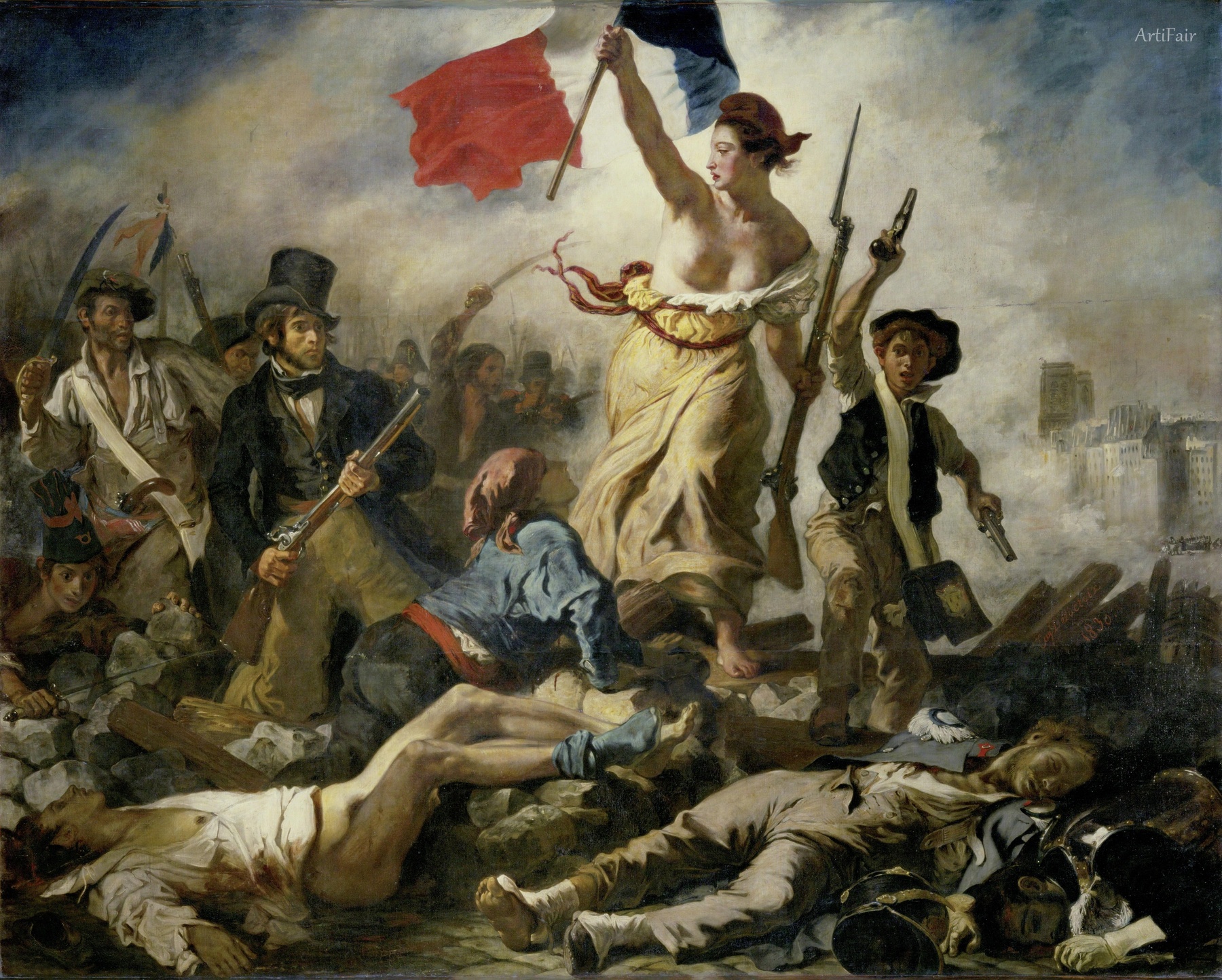
Liberty Leading the People (La Liberté guidant le peuple) is an oil-on-canvas painting by Eugène Delacroix, made in the autumn of 1830 to commemorate the July Revolution that toppled King Charles X; it hangs in the Louvre, Paris.
Delacroix was already the acknowledged leader of the French Romantic school when he took up the subject. In a letter to his brother dated 21 October 1830 he wrote that he had embarked on a modern subject — a barricade — and that if he had not fought for his country he would at least paint for her. The finished canvas, 260 by 325 cm, was first shown at the official Salon of 1831.
A bare-breasted woman of the people wearing a Phrygian cap — an allegory of Liberty, and an image now identified with Marianne, emblem of the French Republic — strides barefoot over the bodies of the fallen, holding the tricolour in one hand and a bayonetted musket in the other. Around her Delacroix placed fighters of different classes: a man in a top hat, an École Polytechnique student in a bicorne, and a boy brandishing two pistols. A second tricolour flies from the towers of Notre-Dame in the distance. Several figures were probably borrowed from prints by Nicolas Charlet. The work is sometimes wrongly taken to show the 1789 Revolution.
The state bought the painting in 1831 for 3,000 francs, intending to hang it in the throne room of the Palais du Luxembourg as a reminder to Louis-Philippe of the revolution that made him king. That plan was abandoned; after the June Rebellion of 1832 it was returned to the artist as too inflammatory to display and was only shown again briefly after 1848, before entering the national collections.