
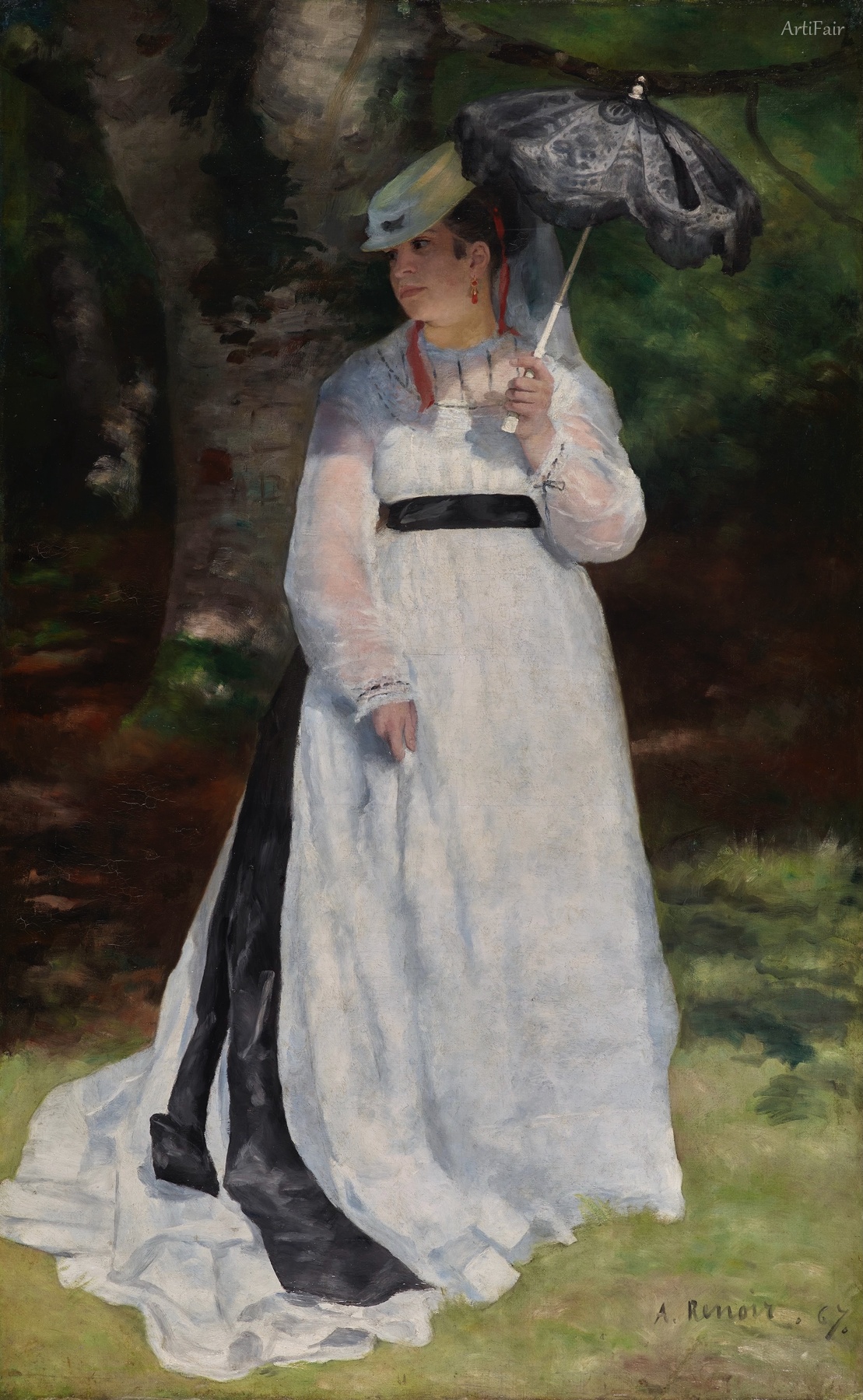
Lise with a Parasol
Category:
Created:
1867
Likes:
0
Dimensions:
Download:
New users get 4 free credits. 2K costs 1 credit; 4K and Ultra HD are priced by resolution. Public domain artworks can be used commercially.
Dominant colors
Public domain download summary
This artwork is provided as a public domain image resource. The 2K file costs 1 credit for everyday creative work, while 4K and Ultra HD files are priced by resolution.
Art Appreciation
Lise with a Parasol (Lise – La femme à l'ombrelle) is an oil-on-canvas painting by Pierre-Auguste Renoir, dated 1867 and now in the Museum Folkwang, Essen. Almost life-size at 184 by 115.5 cm, it shows his companion and favourite model Lise Tréhot standing at the edge of a sunlit forest clearing.
Renoir met Lise, born in 1848, through his friend Jules Le Cœur in 1865, and she sat for him until 1872. He began the picture in the summer of 1867, when he was 26 and still struggling: earlier Salon entries had been rejected and he could rarely sell his work. The museum places the setting in the forest of Fontainebleau, while more recent research cited by Wikipedia points to the forest of Chantilly. Submitted to the Salon of 1868 simply as Lise, it was accepted and became his first critical success there, though officials moved it, with works by Monet and Bazille, to a remote room nicknamed the dépotoir.
Lise faces us in strong sunlight, but her face is turned aside and shaded by a black lace parasol, so that the white muslin dress, not the face, catches the light. Renoir recorded the fashionable details carefully: black ribbons at the neckline and sleeves, a small straw hat with tulle and red ribbons matching her drop earrings, and initials A and L carved in a tree trunk behind her. Critics saw the influence of Gustave Courbet; Zola and Zacharie Astruc linked it to Manet's Olympia and Monet's Camille, and Théophile Thoré praised the natural effect of the light. Others mocked the contrast, the caricaturist André Gill likening Lise to a soft cheese out for a stroll.
Unable to sell it, Renoir kept the canvas rolled on the floor until Théodore Duret, whom he had met in 1872, bought it on the spot in his studio for 1,200 francs. Duret sold it to Paul Durand-Ruel in 1890. In May 1901 Paul Cassirer acquired it, and later that month Karl Ernst Osthaus paid 18,000 gold marks for it for his Folkwang museum in Hagen, which moved to Essen in 1922. Max Liebermann, who had wanted it himself, is said to have asked where Hagen was.