Back to gallery
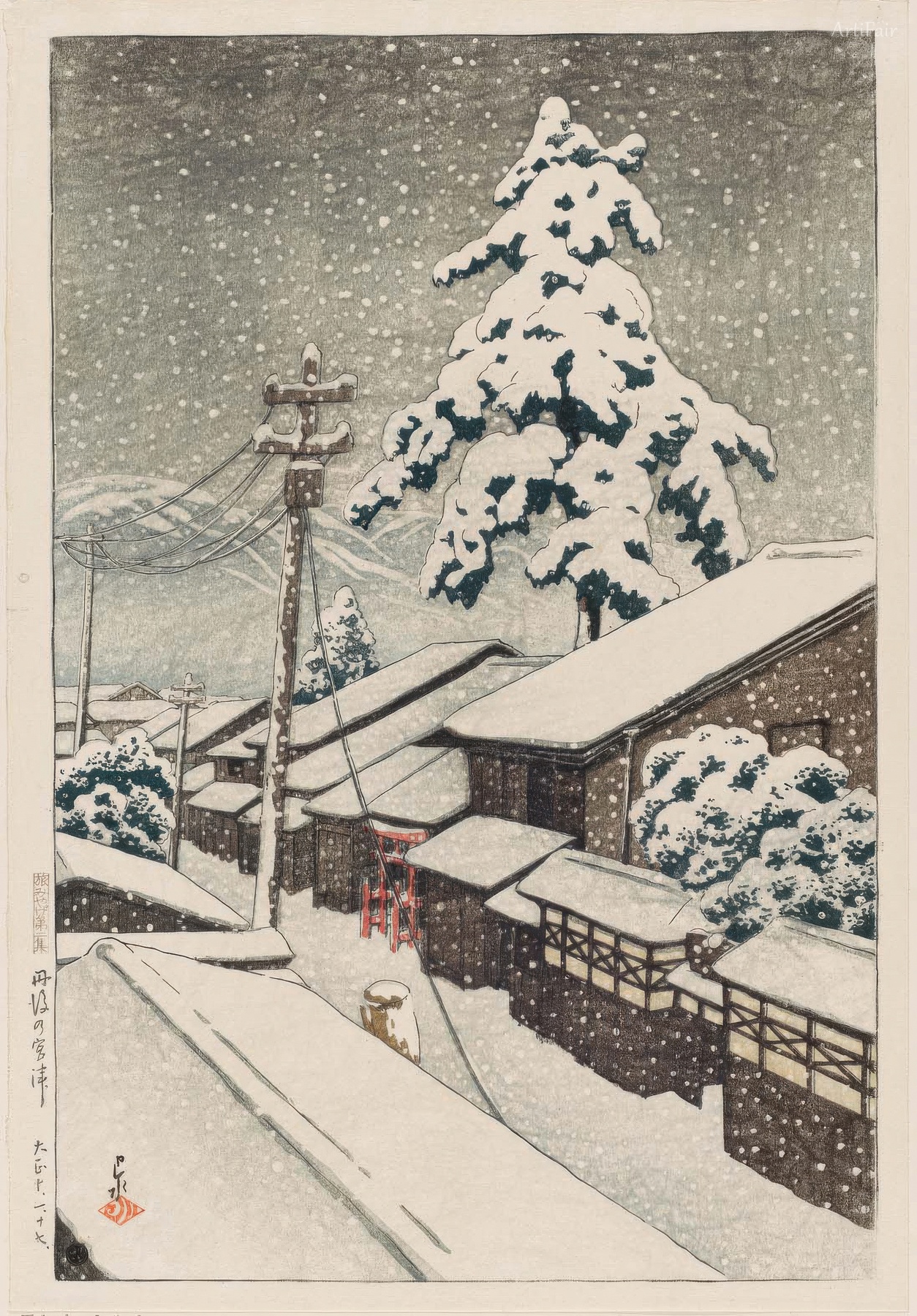
Travel Notes II: Tango no Miyazu

Art Appreciation

This evocative print captures a serene winter scene of a quiet Japanese village gently blanketed in snow. The artist masterfully employs a restrained color palette dominated by soft grays, whites, and muted browns, punctuated by the subtle red of a torii gate peeking through the snow. The composition leads the eye down a winding path flanked by snow-laden rooftops and a wooden fence, ascending toward the impressive, snow-heavy tree that stands stoic against the falling flakes. The delicate yet fluid brushwork conveys a profound stillness, with every falling snowflake rendered as a tiny, luminous dot, inviting the viewer into this hushed moment in time.

The balance between man-made structures and natural elements captures a timeless harmony, emblematic of Japanese aesthetics. The telephone poles and wires add a subtle modern contrast to the traditional setting, highlighting the era's intersection of innovation and heritage. There is a gentle melancholic mood, a quiet beauty evoking the chill and calm of winter; one almost hears the soft whisper of snowflakes meeting the earth. This print, created in the early 20th century, reflects the shin-hanga movement’s dedication to blending traditional Japanese woodblock techniques with influences from Western art, producing works that are both culturally resonant and aesthetically captivating.

Travel Notes II: Tango no Miyazu

Hasui Kawase

Category:

Created:

1921

Likes:

0

Dimensions:

2192 × 3144 px

Download:

Related artworks

Nikko Lake Chuzenji 1930
Morning at Daikon Riverside, Tokyo
White Phoenix Castle of Iga-Ueno
Fujiya Hotel, Miyamashita, Hakone
Nagasaki Shofukuji Temple
Full Moon Island at Shirahama
Hall of the Great Buddha
Travel Notes II (Second Collection of Travel Souvenirs) Echigo Urahama 1921
Enshu Shinichi Town 1931
Travel Notes I (First Collection of Travel Souvenirs) Mutsu's Ibatanuma 1919
Under the Fields of Shiobara
Bamboo Grove, Tamagawa River 1953
Mount Inari in Nagano Prefecture, 1947