
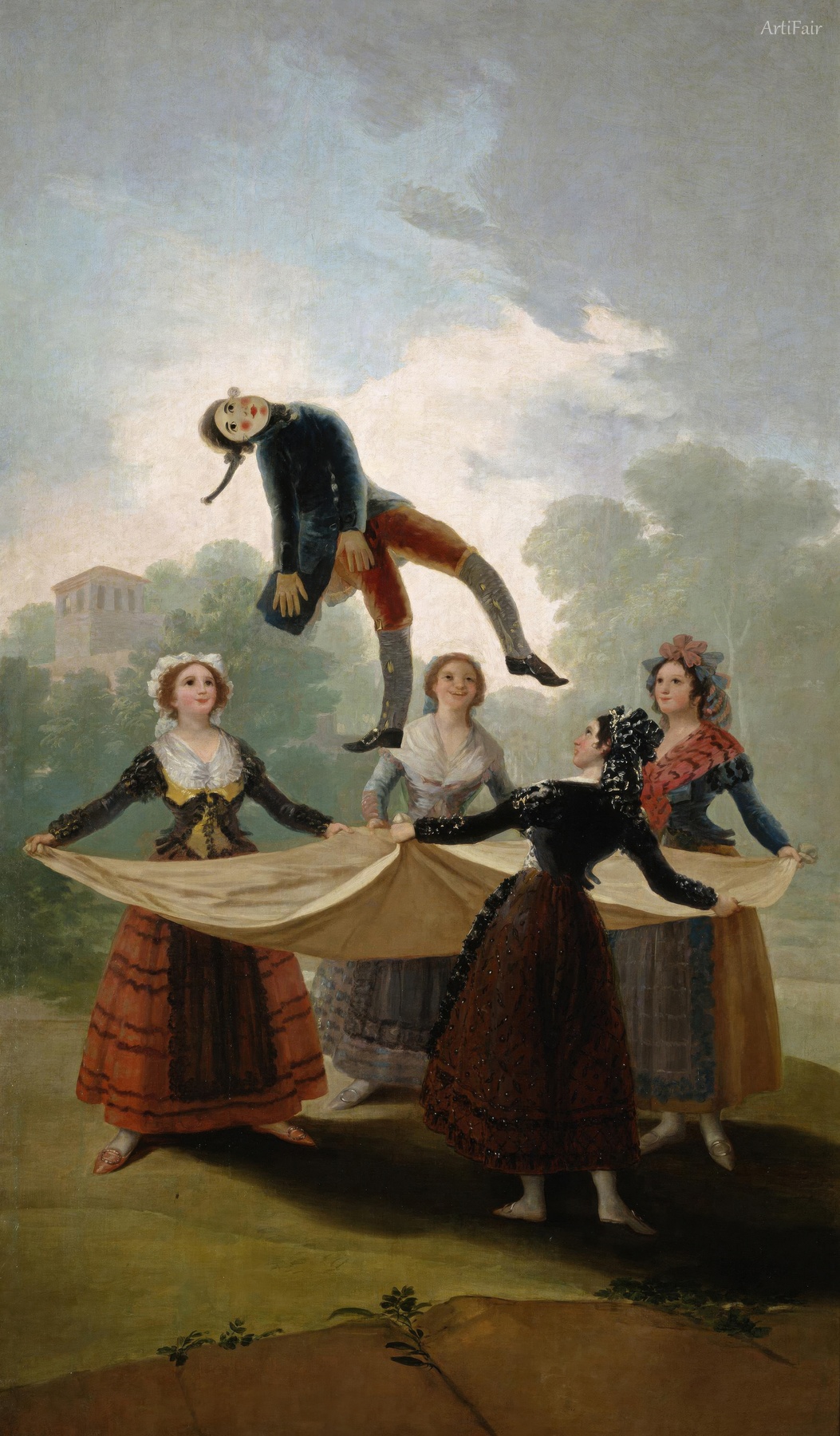
The Straw Manikin
Category:
Created:
1791
Likes:
0
Dimensions:
Download:
New users get 4 free credits. 2K costs 1 credit; 4K and Ultra HD are priced by resolution. Public domain artworks can be used commercially.
Dominant colors
Public domain download summary
This artwork is provided as a public domain image resource. The 2K file costs 1 credit for everyday creative work, while 4K and Ultra HD files are priced by resolution.
Art Appreciation
The Straw Manikin (El pelele) is an oil-on-canvas cartoon, a full-size design for weavers, painted by Francisco Goya in late 1791 and early 1792; measuring 267 × 160 cm, it is in the Museo del Prado, Madrid (P000802).
The picture belongs to Goya's seventh and last series of designs for the Real Fábrica de Tapices de Santa Bárbara, the royal weaving workshop in Madrid, intended for wall hangings in the office of King Charles IV at El Escorial. Its companions included The Wedding, The Stilts and Las mozas del cántaro, for which Goya used a stretcher of the same size. The series turns on games played by women and children, and several scenes treat relations between the sexes with an irony that anticipates his Caprichos etchings.
Four young women dressed as majas stand in a circle in a wooded landscape, laughing as they toss a manikin dressed in a man's coat and breeches high into the air from a stretched blanket. Blanket-tossing a straw figure was a popular carnival game, and the Prado reads the scene as an allegory of women's power over men, a theme Goya returned to in the Caprichos and Disparates prints. The scholar Janis Tomlinson has suggested the figure may be a real man, a dandy with a painted face, rather than a doll. In preparatory sketches the manikin holds its head up as if enjoying the flight; in the cartoon the head hangs and the body is twisted, which makes the game look harsher. One of the sketches, 35 × 23 cm, is in the Hammer Museum, Los Angeles. The Prado notes features typical of Goya's late cartoons: softer colour and contrasts of light that create depth, so that the manikin's silhouette stands out against the sky.
After the hanging was woven the cartoon stayed with the Royal Factory, was moved to storerooms in the Royal Palace in Madrid in 1856–1857, and entered the Prado by royal orders of 1870. The image later inspired a scene in Enrique Granados's opera Goyescas, and it appeared on a Spanish postage stamp in 1958.