
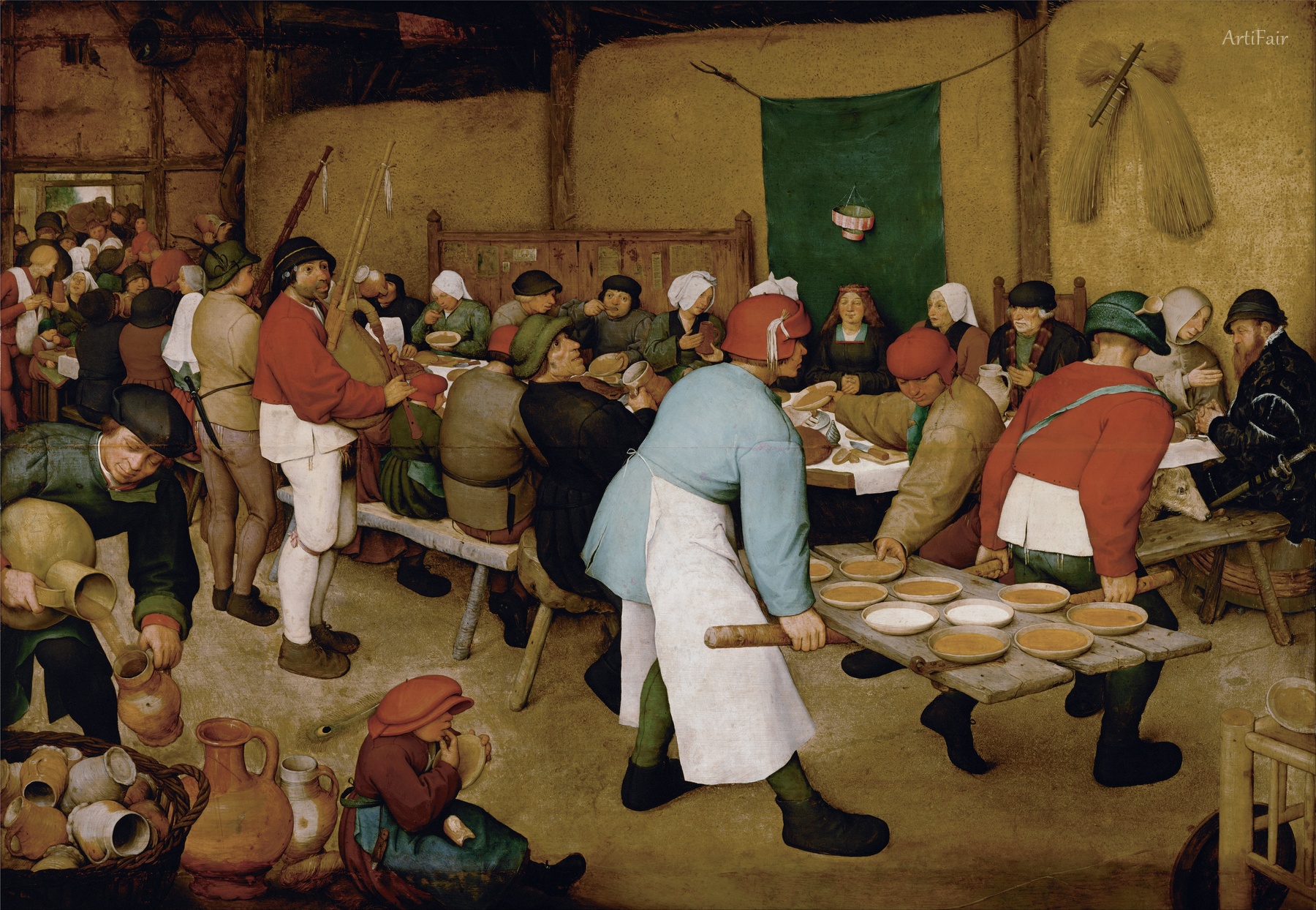
The Peasant Wedding
Category:
Created:
1568
Likes:
0
Dimensions:
Download:
New users get 4 free credits. 2K costs 1 credit; 4K and Ultra HD are priced by resolution. Public domain artworks can be used commercially.
Dominant colors
Public domain download summary
This artwork is provided as a public domain image resource. The 2K file costs 1 credit for everyday creative work, while 4K and Ultra HD files are priced by resolution.
Art Appreciation
The Peasant Wedding is an oil painting on oak panel by Pieter Bruegel the Elder, painted in 1567 or 1568 (the museum gives 1568), in the Kunsthistorisches Museum, Vienna.
It is one of the late pictures of village life that earned Bruegel the nickname Peasant Bruegel, although he was an educated city artist and many of these works carry moral or symbolic meaning. Archduke Ernst bought it in Brussels in 1594; it then passed to Emperor Rudolf II in Prague and later to Archduke Leopold Wilhelm. During the Second World War it was stored with other works in the salt mine at Altaussee and returned to Vienna in October 1945. At some point the panel was cut down at the bottom and later extended again by 5 cm.
The feast takes place in a barn at harvest time; two crossed sheaves with a rake on the straw wall recall the farm work. Unlike Bruegel's earlier bird's-eye views, the scene is seen at eye level. The bride sits quietly in front of a green cloth with a paper crown hung above her. Two men bring in plates of porridge on a door taken off its hinges, a man at left pours beer into jugs, two bagpipers play, a child in the foreground licks a plate, and at the far right a Franciscan friar talks with the lord of the manor, whose dog peers from under the table. The Kunsthistorisches Museum notes that this apparent snapshot is carefully composed and that, by Flemish custom, the groom was not present at the feast; his identity has nonetheless been endlessly debated.
A puzzling third foot under the servant carrying the door has been explained as the foot of the crouching man beside him; Pieter Brueghel the Younger simply omitted it in a copy. The painting was parodied in Asterix in Belgium. It measures 113 × 164 cm.