
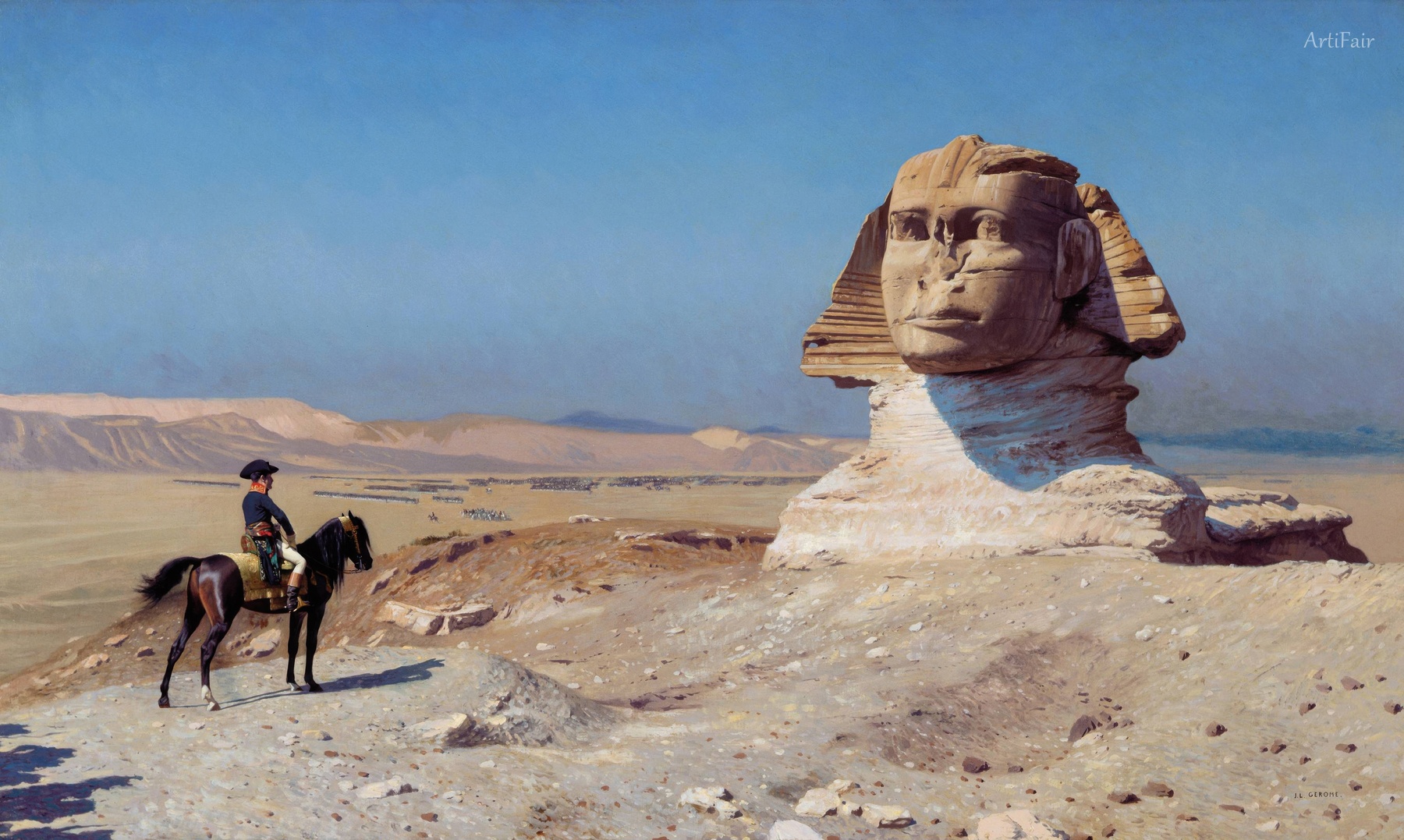
Bonaparte Before the Sphinx
Category:
Created:
1868
Likes:
2
Dimensions:
Download:
New users get 4 free credits. 2K costs 1 credit; 4K and Ultra HD are priced by resolution. Public domain artworks can be used commercially.
Dominant colors
Public domain download summary
This artwork is provided as a public domain image resource. The 2K file costs 1 credit for everyday creative work, while 4K and Ultra HD files are priced by resolution.
Art Appreciation
Bonaparte Before the Sphinx, also called Oedipus (Œdipe), is an oil painting on canvas by Jean-Léon Gérôme, linked to his Napoleonic series of about 1867 but first exhibited at the Paris Salon of 1886; it belongs to Hearst Castle, San Simeon, California.
At the end of the Second Empire, with the centenary of Napoleon's birth approaching in 1869, Gérôme painted a group of canvases showing General Bonaparte in Cairo and the desert during the Egyptian campaign of 1798–1799. He had visited Egypt four times since 1855 and was already known for Egyptian scenes, and the Fondation Napoléon suggests the Napoleonic legend mainly gave him a new outlet for his Orientalism. In each picture Bonaparte appears lost in thought rather than in action. Because the painting was shown only in 1886, some references give that year as its date, while the French Wikipedia article places it between 1867 and 1886.
The Sphinx takes up half of the 61.6 × 101.9 cm canvas, facing the small figure of Bonaparte on horseback. Gérôme left the pyramids of Giza out of the frame to concentrate on this confrontation. The horse's flicking tail, the shadows of the general staff in the lower left corner and the troops moving across the plain hint that the action is about to resume before the Battle of the Pyramids on 21 July 1798. In 1798 the Sphinx was in fact buried in sand up to its shoulders.
By titling the picture Oedipus at the 1886 Salon, Gérôme cast Bonaparte as the hero who answered the Sphinx's riddle and became king. The New York Times reviewer counted it among his finest historical studies, while caricaturists compared the Sphinx's headdress with Napoleon's famous hat. William Randolph Hearst bought it in 1898 together with its pendant, Bonaparte in Cairo. A shot in Ridley Scott's 2023 film Napoleon recreates the composition.