
The Subsiding of the Waters of the Deluge
Category:
Created:
Date unknown
Likes:
0
Dimensions:
Download:
New users get 4 free credits. 2K costs 1 credit; 4K and Ultra HD are priced by resolution. Public domain artworks can be used commercially.
Dominant colors
Public domain download summary
This artwork is provided as a public domain image resource. The 2K file costs 1 credit for everyday creative work, while 4K and Ultra HD files are priced by resolution.
Art Appreciation
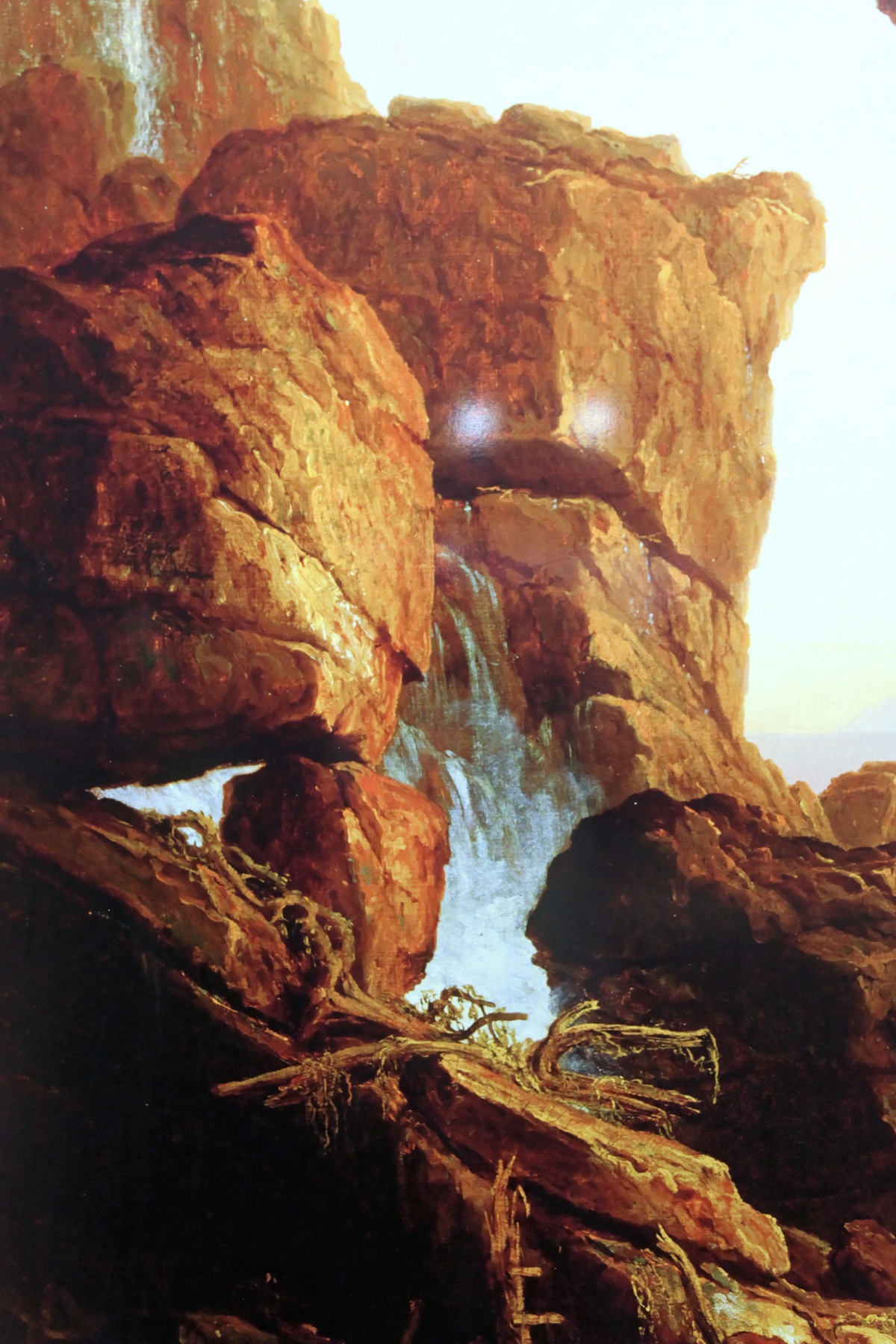
The Subsiding of the Waters of the Deluge is an oil painting on canvas by Thomas Cole, dated 1829, in the Smithsonian American Art Museum, Washington, D.C. (1983.40). It measures 90.8 by 121.4 cm. The image here shows a section from the left side of the canvas, where the receding flood pours as a waterfall through an arch of rock.
The subject is the end of the Great Flood in Genesis, when the rains have stopped and the waters begin to drain from the earth. Cole prepared it with unusual care for a religious scene: he gathered extensive notes on geology and consulted scientists, among them Benjamin Silliman of Yale, to imagine what the land might have looked like once the water withdrew.
The whole composition is seen from inside a dark cavern that frames a bright opening onto the sea. Bare, scoured rocks rise on either side, stripped of soil; the waterfall in this detail carries the flood back towards the sea, and broken trees and a shattered mast lie among the boulders. A single skull rests against the rocks. In the luminous distance, at the centre of the painting, the ark floats on calm water and a dove flies towards land. The Smithsonian reads the picture in national terms: Cole saw America as a new start for civilisation and likened the American Revolution to the Flood, sweeping away the despotism of the British Crown, so the subsiding waters suggest a peaceful future for the young republic and a world washed clean of human folly.
The painting was exhibited at the National Academy of Design in 1829 and again in 1831, then disappeared from view. It resurfaced in 1974 and entered the Smithsonian collection as a gift of Mrs. Katie Dean in memory of Minnibel S. and James Wallace Dean, combined with a museum purchase.