
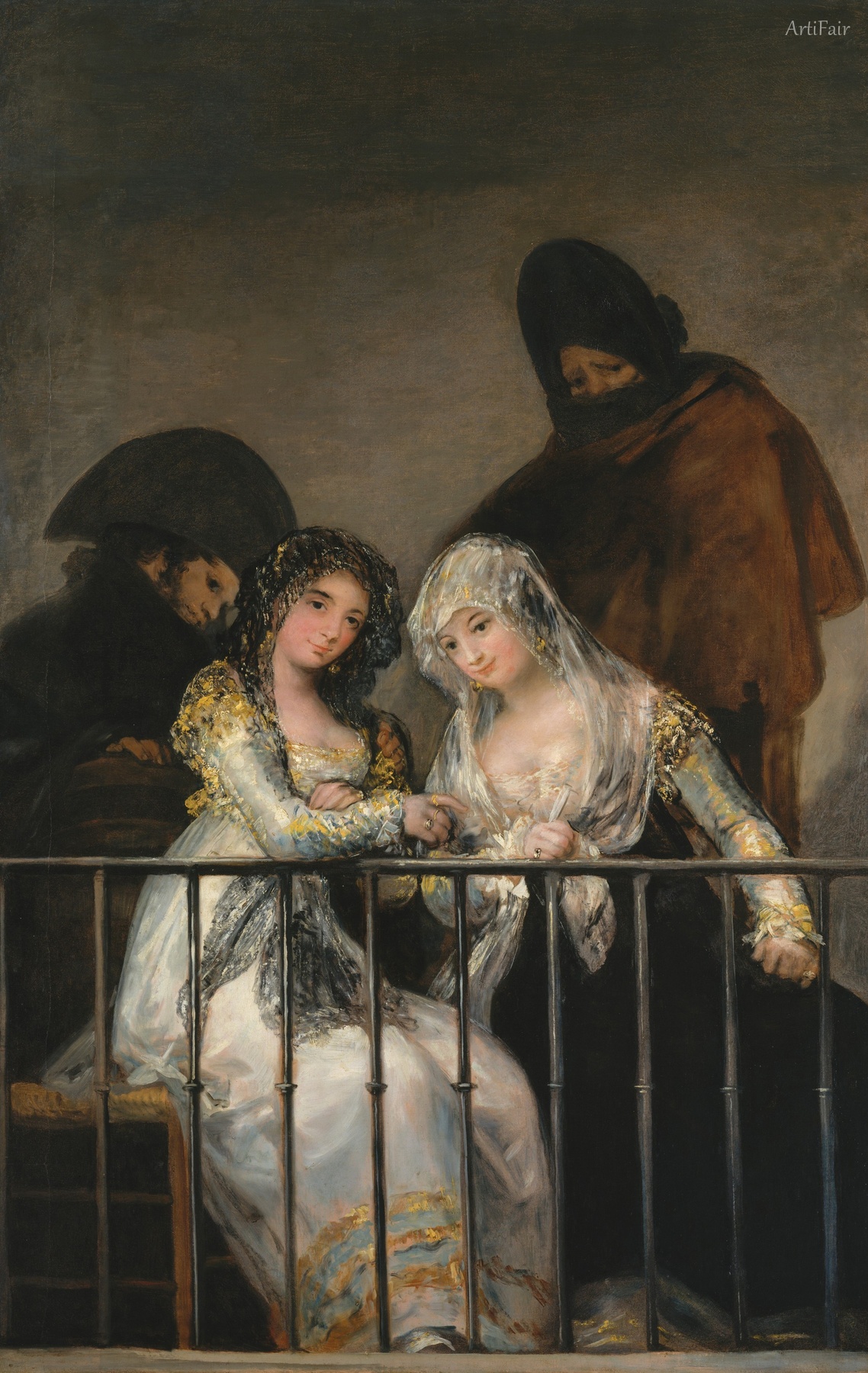
Majas on Balcony
Category:
Created:
1812
Likes:
0
Dimensions:
Download:
New users get 4 free credits. 2K costs 1 credit; 4K and Ultra HD are priced by resolution. Public domain artworks can be used commercially.
Dominant colors
Public domain download summary
This artwork is provided as a public domain image resource. The 2K file costs 1 credit for everyday creative work, while 4K and Ultra HD files are priced by resolution.
Art Appreciation
Majas on a Balcony is an oil on canvas attributed to Francisco Goya, dated about 1800–1810 by its owner, the Metropolitan Museum of Art, New York (29.100.10); it measures 194.9 × 125.7 cm. It is a second version of a composition whose original, painted by Goya around 1808–1812, is in the Rothschild collection in Switzerland.
Two young women in the lavish dress of majas, the fashionable women of Madrid's popular classes, lean against an iron railing, one in a black lace mantilla and the other in a white one. Behind them, half in shadow, stand two men wrapped in cloaks and broad hats, one with his face muffled to the eyes. The contrast between the bright, ornamented women and the dark, anonymous men is the core of the picture; Spanish commentators note that showing oneself at windows and balconies was a typical way for prostitutes to display themselves, and read the men as pimps or clients. The railing cuts the canvas into two zones and the women's heads lean together to form a triangle, part of a strict geometric scheme.
The Met version was long accepted as by Goya, but its authorship has been doubted since 1989. The museum suggests it may be a variant in which Goya explored a different emphasis, or the work of a close follower; Wikipedia notes proposals that it could be a replica by his son Javier Goya or a damaged and heavily restored original. Compared with the Rothschild picture, the two figures on the right are placed differently. The Fundación Goya en Aragón records the suggestion that it was meant as a companion to a replica of Goya's Old Women (Time).
The painting was in the collection of the Infante Sebastián of Portugal and Spain by 1835 and passed to his son, the Duke of Marchena, whose heirs sold it to the dealer Durand-Ruel in the early 1900s. H. O. Havemeyer bought it, and it came to the Met with the bequest of Louisine Havemeyer in 1929. Goya's balcony composition, which sets the picture plane at the edge between street and interior, influenced Édouard Manet's The Balcony of 1868–69.