
The Oath of the Horatii
Category:
Created:
1785
Likes:
0
Dimensions:
Download:
New users get 4 free credits. 2K costs 1 credit; 4K and Ultra HD are priced by resolution. Public domain artworks can be used commercially.
Dominant colors
Public domain download summary
This artwork is provided as a public domain image resource. The 2K file costs 1 credit for everyday creative work, while 4K and Ultra HD files are priced by resolution.
Art Appreciation
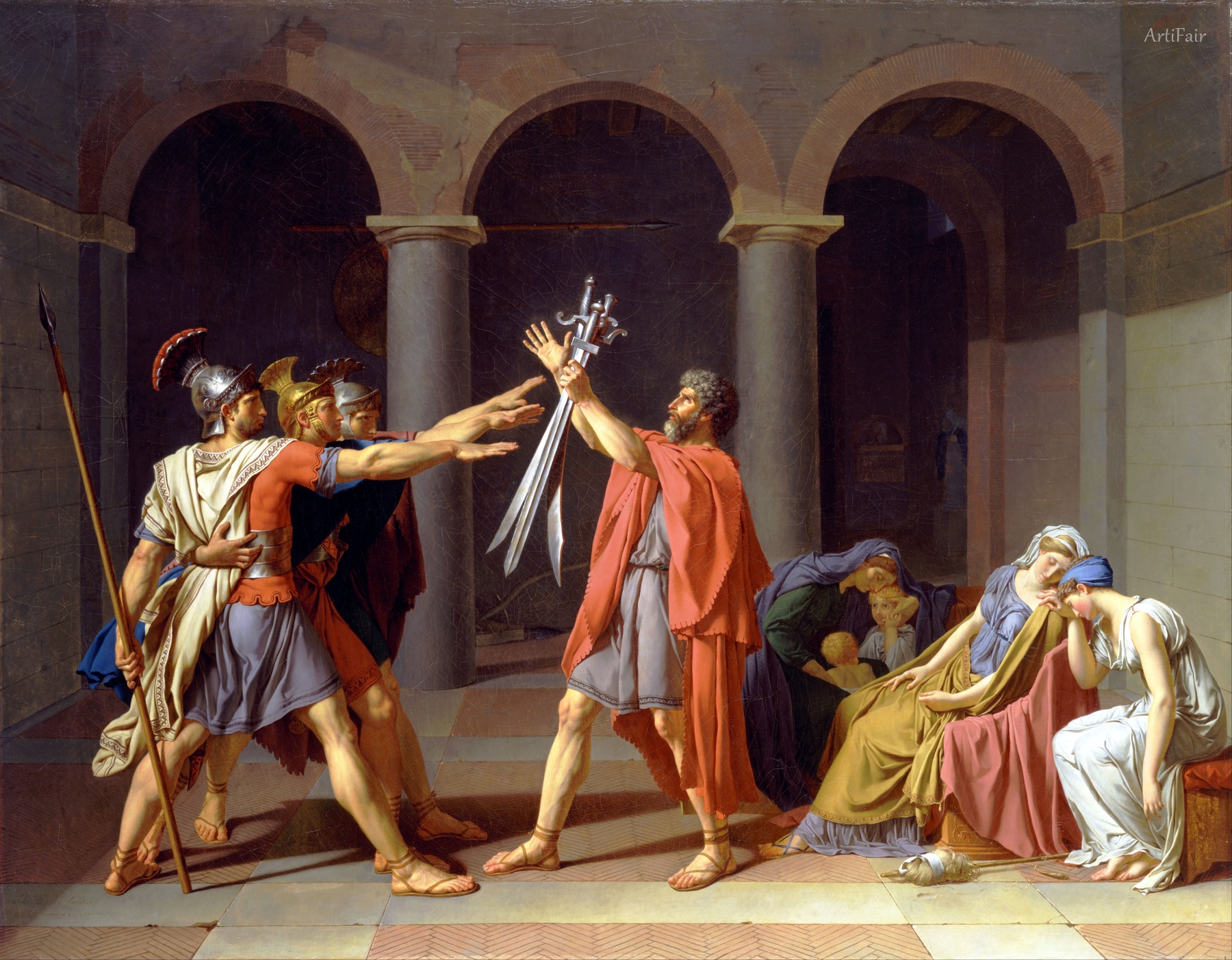
This version of The Oath of the Horatii is an oil-on-canvas replica painted in 1786 in the studio of Jacques-Louis David, measuring 130.2 × 166.7 cm and now in the Toledo Museum of Art, Ohio; the life-size original of 1784–85 is in the Louvre.
The first canvas was a royal commission arranged through Charles-Claude Flahaut de la Billaderie, an assistant of King Louis XVI. David painted it in Rome, showed it there to great interest, and then sent it to the Salon of 1785, where it made his reputation and became a model of Neoclassical painting. Its success led the courtier Comte de Vaudreuil to order this reduced replica. It follows the original closely, the main difference being a distaff with spun thread added near the women's feet. David's pupil Anne-Louis Girodet is reported to have helped paint it, and some catalogues, including Wikidata and Wikimedia Commons, list it under Girodet's name after David.
The subject comes from Livy's history of early Rome. To settle a war between Rome and Alba Longa without full battle, each city chose three champions: the Horatii brothers for Rome, the Curiatii for Alba. The moment of the oath itself is David's invention. Under a row of three arches the brothers, arms outstretched, swear on the swords their father holds up, while on the right the women of the family slump in grief, since the two families were joined by marriage and betrothal and whatever the outcome they would lose someone they loved. The straight, taut lines of the men against the curved forms of the women, the frieze-like profile figures and the smooth, almost invisible brushwork are typical of the style. In the years before the Revolution of 1789 the picture was read as an exhortation to put duty to the state above private feeling.