
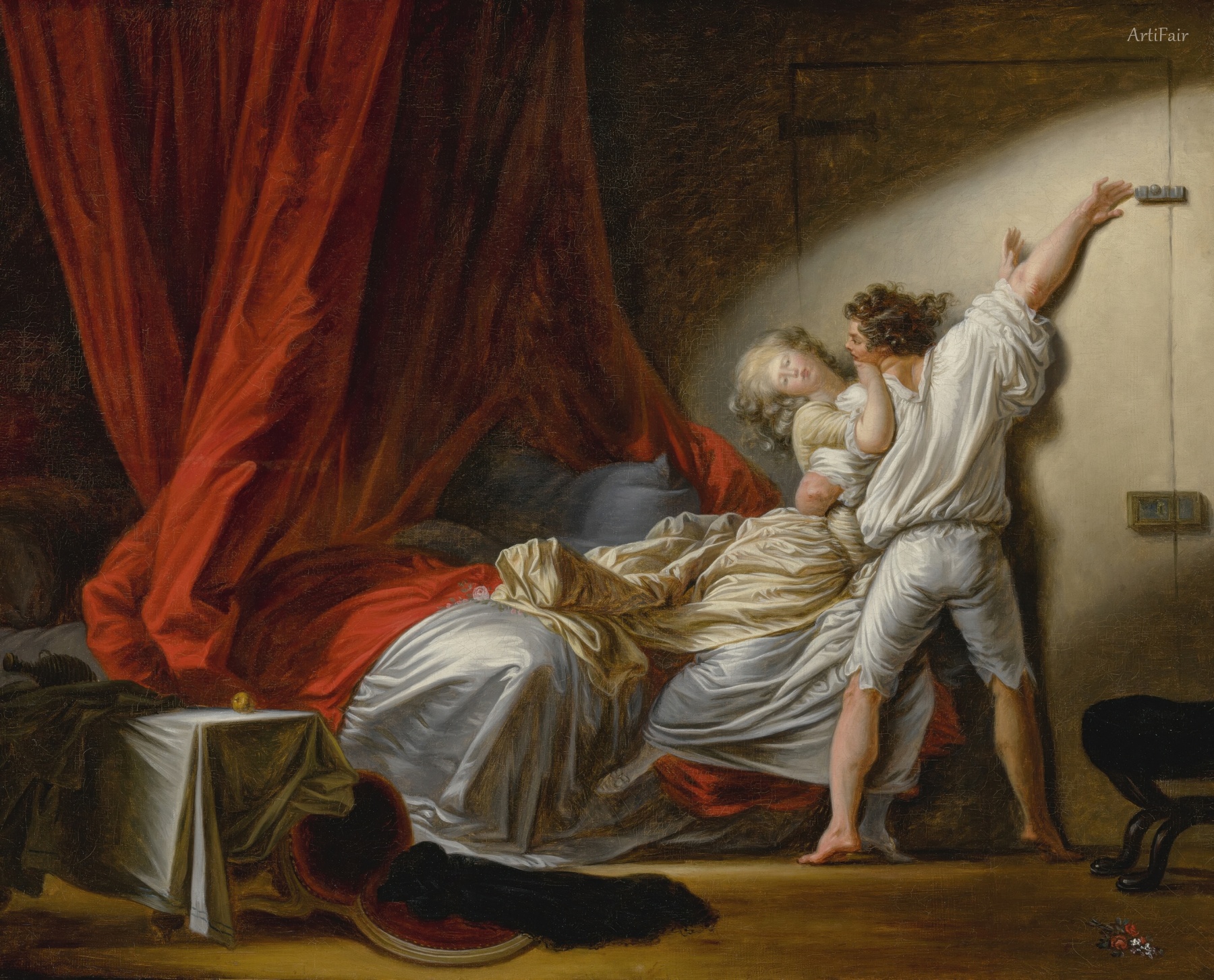
The Bolt
Category:
Created:
1777
Likes:
1
Dimensions:
Download:
New users get 4 free credits. 2K costs 1 credit; 4K and Ultra HD are priced by resolution. Public domain artworks can be used commercially.
Dominant colors
Public domain download summary
This artwork is provided as a public domain image resource. The 2K file costs 1 credit for everyday creative work, while 4K and Ultra HD files are priced by resolution.
Art Appreciation
The Bolt (Le Verrou), also called The Lock, is an oil painting on canvas by Jean-Honoré Fragonard, painted around 1777–1778 and now in the Musée du Louvre, Paris (inventory RF 1974 2).
Fragonard, who had won the Prix de Rome in 1752 with a history painting, became much sought after for galant scenes painted on commission for aristocratic patrons, such as The Swing of 1767. This picture was painted for Louis-Gabriel, Marquis de Véri, a collector of contemporary French art, as a companion to an Adoration of the Shepherds by Fragonard that was already in his collection; the pairing set profane love against sacred love. Fragonard worked the composition out in earlier drawings and in a small oil sketch, which sold at Christie's in 1999 and is now in the Louvre Abu Dhabi.
In a disordered bedroom, a young man in shirt and breeches holds a young woman in a satin gown with one arm and stretches the other up to slide the bolt of the door. Her own arm also reaches towards the bolt, and whether she is resisting or yielding has been argued over ever since; the unmade bed, the overturned furniture and an apple lying in the light on the table are often read as clues. Light falls on the couple like a stage spotlight, and the great red drapery of the bed canopy fills more than half of the canvas, which measures about 74 × 94 cm.
The painting was sold after Véri's death in December 1785 and became widely known through Maurice Blot's engraving of 1784, while the original itself dropped from view. It passed through French private collections and was sold in 1969 as 'attributed to Fragonard'; the dealer François Heim then sold it to the Louvre in 1974. Heirs of a former owner later sued to have the sale annulled for mistake over authorship, but France's Cour de cassation rejected their claim in 1987, in a ruling still cited in French contract law.