
Leonidas at Thermopylae
Category:
Created:
1814
Likes:
1
Dimensions:
Download:
New users get 4 free credits. 2K costs 1 credit; 4K and Ultra HD are priced by resolution. Public domain artworks can be used commercially.
Dominant colors
Public domain download summary
This artwork is provided as a public domain image resource. The 2K file costs 1 credit for everyday creative work, while 4K and Ultra HD files are priced by resolution.
Art Appreciation
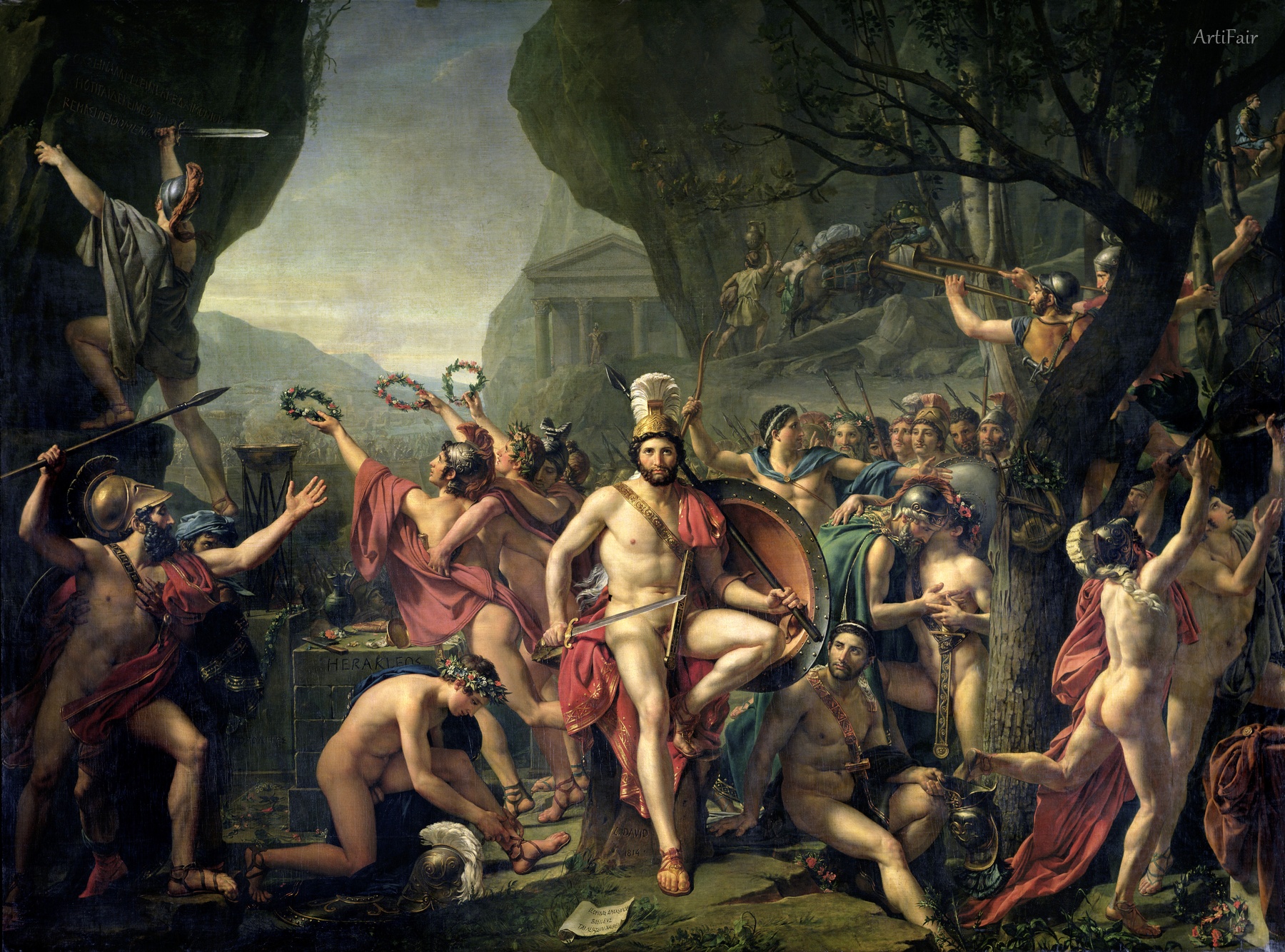
Leonidas at Thermopylae (Léonidas aux Thermopyles) is a large oil-on-canvas history painting by Jacques-Louis David, signed and dated 1814, measuring 3.95 × 5.31 m; it is in the Louvre, Paris (INV 3690).
David conceived the picture from 1798 as a pendant to The Intervention of the Sabine Women. According to the Louvre he painted it between 1802 and 1804, set it aside, took it up again in June 1813 and finished it in October 1814; his pupil Georges Rouget assisted. The long gap spans Napoleon's empire: work resumed as the allied powers were advancing on France, and the subject of a small army sacrificing itself to defend its homeland against an invader gained new topicality. It had first been intended for the collector Count Sommariva but stayed in the artist's studio.
The scene is the pass of Thermopylae in 480 BC, just before the battle against the Persian army of Xerxes. David's own description, quoted by the Louvre, explains the moment: trumpeters on the heights signal the first movements of the Persians, and the Spartans run to arms and embrace for the last time. Leonidas, seated on a rock among his three hundred, meditates on the coming death of his friends. Below him in shadow his brother-in-law Agis puts on his helmet; two young men seize weapons hanging from branches; a priest points to the sky; and at the left a soldier carves into the rock the epitaph telling passers-by to go and tell Sparta that its men lie here, obedient to its laws. Leonidas is the stillest and most brightly lit figure in a crowd of idealised nudes in motion.
David showed the finished painting in his studio in the former Collège de Cluny from October to December 1814. In December 1819 Louis XVIII bought it together with the Sabine Women for a combined 100,000 francs, 50,000 for each; it hung in the Musée du Luxembourg and moved to the Louvre in 1826.