
Melancholy
Category:
Created:
1892
Likes:
0
Dimensions:
Download:
New users get 4 free credits. 2K costs 1 credit; 4K and Ultra HD are priced by resolution. Public domain artworks can be used commercially.
Dominant colors
Public domain download summary
This artwork is provided as a public domain image resource. The 2K file costs 1 credit for everyday creative work, while 4K and Ultra HD files are priced by resolution.
Art Appreciation
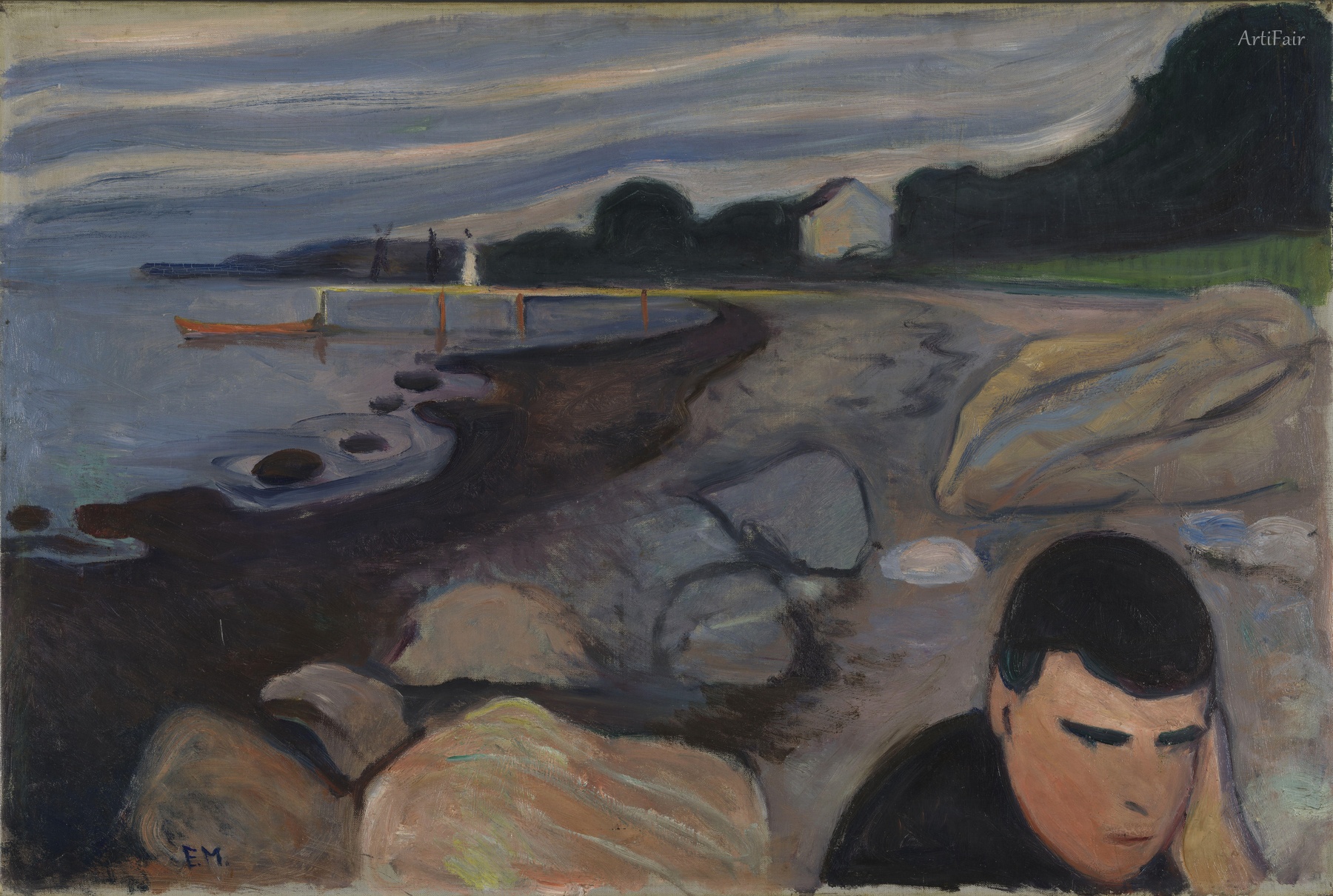
Melancholy is an oil-on-canvas painting by Edvard Munch, probably made in 1892, showing a dejected man on the shore at Åsgårdstrand while a couple heads for a boat on the jetty behind him; it is in the National Museum of Norway, Oslo (NG.M.02813).
The subject grew out of the summer of 1891 at Åsgårdstrand, the small resort on the Oslofjord where Munch watched his friend Jappe Nilssen's unhappy affair with Oda Krohg, the married wife of the painter Christian Krohg. The episode revived memories of Munch's own earlier love for a married woman, so the brooding figure is linked to both men. Munch painted the motif five times; the National Museum's canvas, 64 by 96 cm, is thought to be the second. It is connected to a vignette he struggled over in Nice that winter for a book of poems by Emanuel Goldstein, and sketches from that stay come close to this composition.
Unlike the other versions, this one pushes the man into the lower right corner, his face turned out of the frame instead of shown in profile, in the classic melancholy pose of head resting on hand. The dark shoreline sweeps diagonally into depth towards a jetty where a man and a woman, followed by a man with oars, walk to a boat. Flat, simplified forms and flowing contours link the picture to Synthetism and mark a turn towards Symbolism; the critic Jens Thiis later called it the defining image of jealousy and praised the composition, cut off by the frame in the Japanese manner.
The painting was first shown, as Sad Evening, at Munch's exhibition at Tostrupgården in Kristiania in autumn 1892, and was also in his exhibition at the Verein Berliner Künstler in Berlin, which closed after a few days amid press attacks. In 1893 it hung in Berlin again in the group headed Study for a Series: Love, the nucleus of the Frieze of Life. Owned by Conrad Pineus and later by Christian and Charlotte Mustad, it was bequeathed by the Mustads in 1959 and entered the museum's collection in 1970.