
The Artist’s Garden in Giverny
Category:
Created:
1900
Likes:
1
Dimensions:
Download:
New users get 4 free credits. 2K costs 1 credit; 4K and Ultra HD are priced by resolution. Public domain artworks can be used commercially.
Dominant colors
Public domain download summary
This artwork is provided as a public domain image resource. The 2K file costs 1 credit for everyday creative work, while 4K and Ultra HD files are priced by resolution.
Art Appreciation
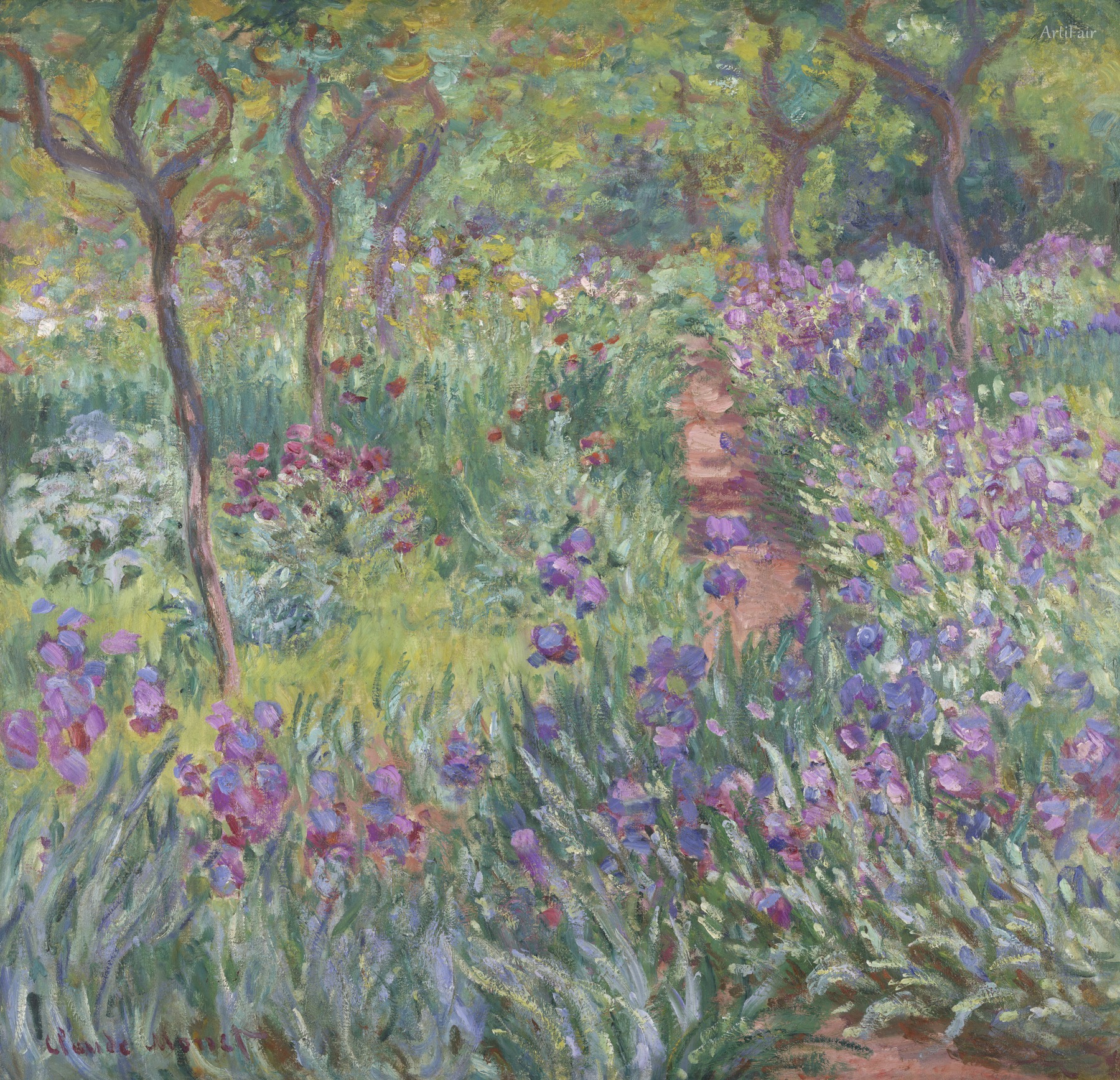
The Artist's Garden in Giverny is an oil on canvas painted by Claude Monet in 1900, showing irises along a path in his garden at Giverny; it is in the Yale University Art Gallery, New Haven.
Monet created the garden at Giverny himself, working on it from the end of 1883 until the end of his life, and it became the subject of a great many of his paintings over his last three decades. It was essentially a garden of perennials enlivened by annuals, laid out on principles he kept to: no bare earth, no dark flowers, and as much blue as possible. In 1900, the year of this canvas, he turned sixty and began two major projects, a series of views of the Thames in London and a series of his water garden at Giverny.
Here a narrow path rises through the garden between beds of irises in shades of violet, blue and pink, under slender, twisting tree trunks, with clumps of other flowers in the middle distance. There is no horizon and no glimpse of the house, so the canvas is filled with foliage and blooms. A Yale publication on its French Impressionist paintings points to this picture as evidence that, by the turn of the century, aspects of Symbolism had begun to touch Monet's art, as his late Giverny works became more fragmentary and evocative, with bold colour and thick layers of paint. The Musée d'Orsay owns a different garden view with irises from the same year.
The painting measures 89.5 by 92.1 cm and is signed at lower left. It is catalogued by Daniel Wildenstein as no. 1622. Its provenance runs from the artist, possibly through Georges Bernheim in 1918, to the collector Sir Alfred Chester Beatty in Dublin and then Mrs A. E. Pleydell-Bouverie; by 1966 it belonged to Paul and Bunny Mellon, who gave it to Yale in 1983.