
The Favourites of the Emperor Honorius
Category:
Created:
1883
Likes:
1
Dimensions:
Download:
New users get 4 free credits. 2K costs 1 credit; 4K and Ultra HD are priced by resolution. Public domain artworks can be used commercially.
Dominant colors
Public domain download summary
This artwork is provided as a public domain image resource. The 2K file costs 1 credit for everyday creative work, while 4K and Ultra HD files are priced by resolution.
Art Appreciation
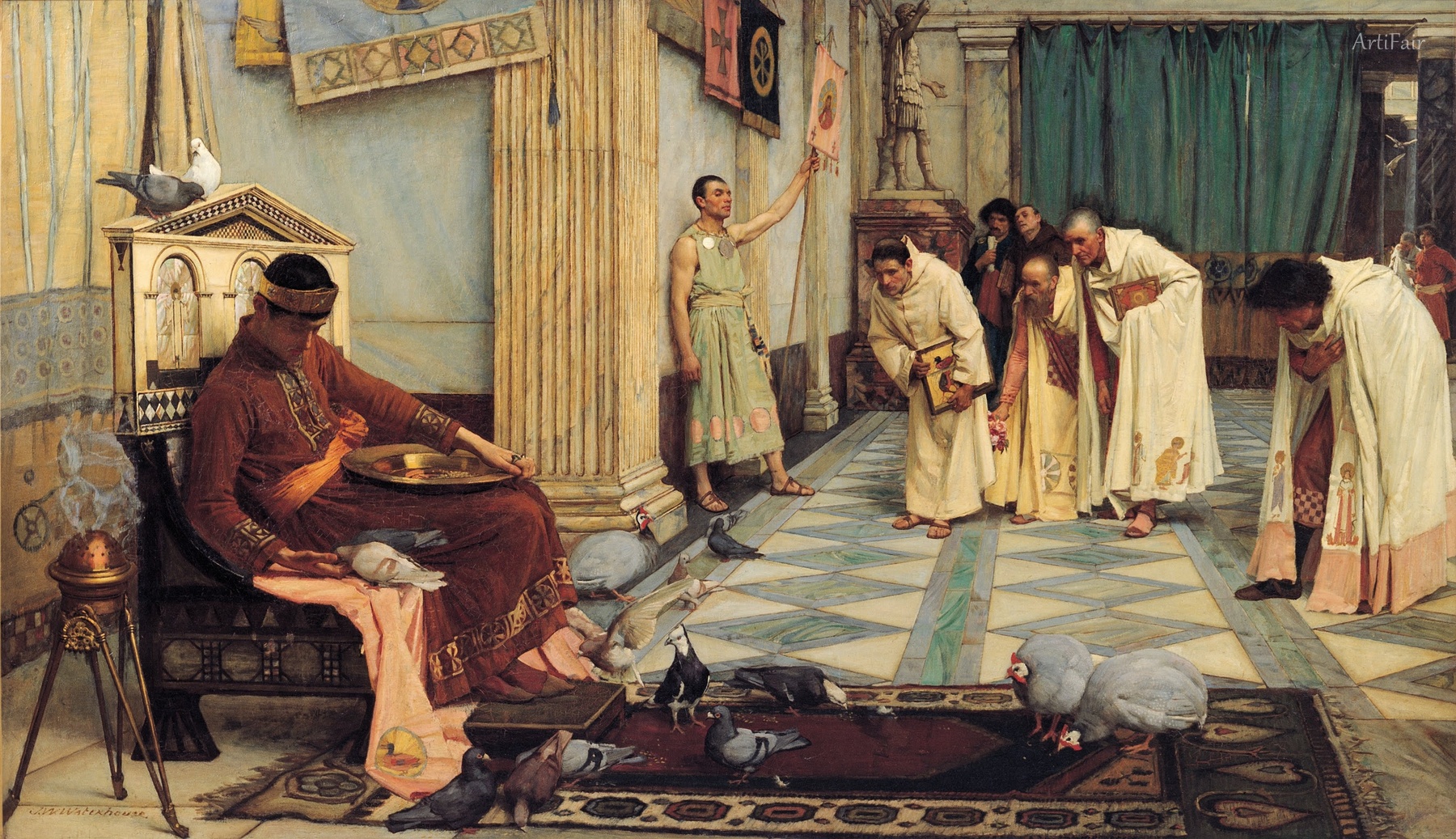
The Favourites of the Emperor Honorius is an oil painting on canvas by John William Waterhouse, made in London around 1883 and held by the Art Gallery of South Australia, Adelaide.
Honorius became emperor of the Western Roman Empire as a boy after the death of his father Theodosius I and reigned from 393 to 423, years in which Italy was invaded and Rome itself was sacked by the Visigoths. After the invasion of 401 he moved his court from Milan to Ravenna, protected by marshes. The Byzantine historian Procopius tells how a eunuch brought him word in Ravenna that Rome had perished; the emperor was dismayed, thinking of a large cockerel he kept named Rome, and relieved to learn that only the city had fallen. Edward Gibbon called the story improbable, but it reflects how contemporaries saw a ruler now counted among the weakest Roman emperors, and Waterhouse appears to allude to it.
The emperor sits at the left, wrapped in dark robes beside a brazier on a tripod, holding a dish and leaning toward the pigeons gathered on a rug at his feet. At a distance on the right, a group of dignitaries in pale robes bow and wait for an audience he ignores. Writers have pointed out the contrast between the dark tones around Honorius and the light colours of his courtiers, the way a single figure is set against a group, the attendant at the back who draws aside a curtain with one hand on his hip, and the statue of Augustus behind, a reminder of a stronger ruler.
The painting, signed at lower left but not dated, measures 119.3 by 205.0 cm and carries accession number 0.52. It was bought in 1883 with a South Australian Government grant; according to the historian James Grout, the gallery acquired it while it was still on view. The gallery notes that this was the first work by Waterhouse to enter a public collection anywhere. Adelaide added his Circe Invidiosa in 1892.