
Salome Dancing before Herod
Category:
Created:
1876
Likes:
2
Dimensions:
Download:
New users get 4 free credits. 2K costs 1 credit; 4K and Ultra HD are priced by resolution. Public domain artworks can be used commercially.
Dominant colors
Public domain download summary
This artwork is provided as a public domain image resource. The 2K file costs 1 credit for everyday creative work, while 4K and Ultra HD files are priced by resolution.
Art Appreciation
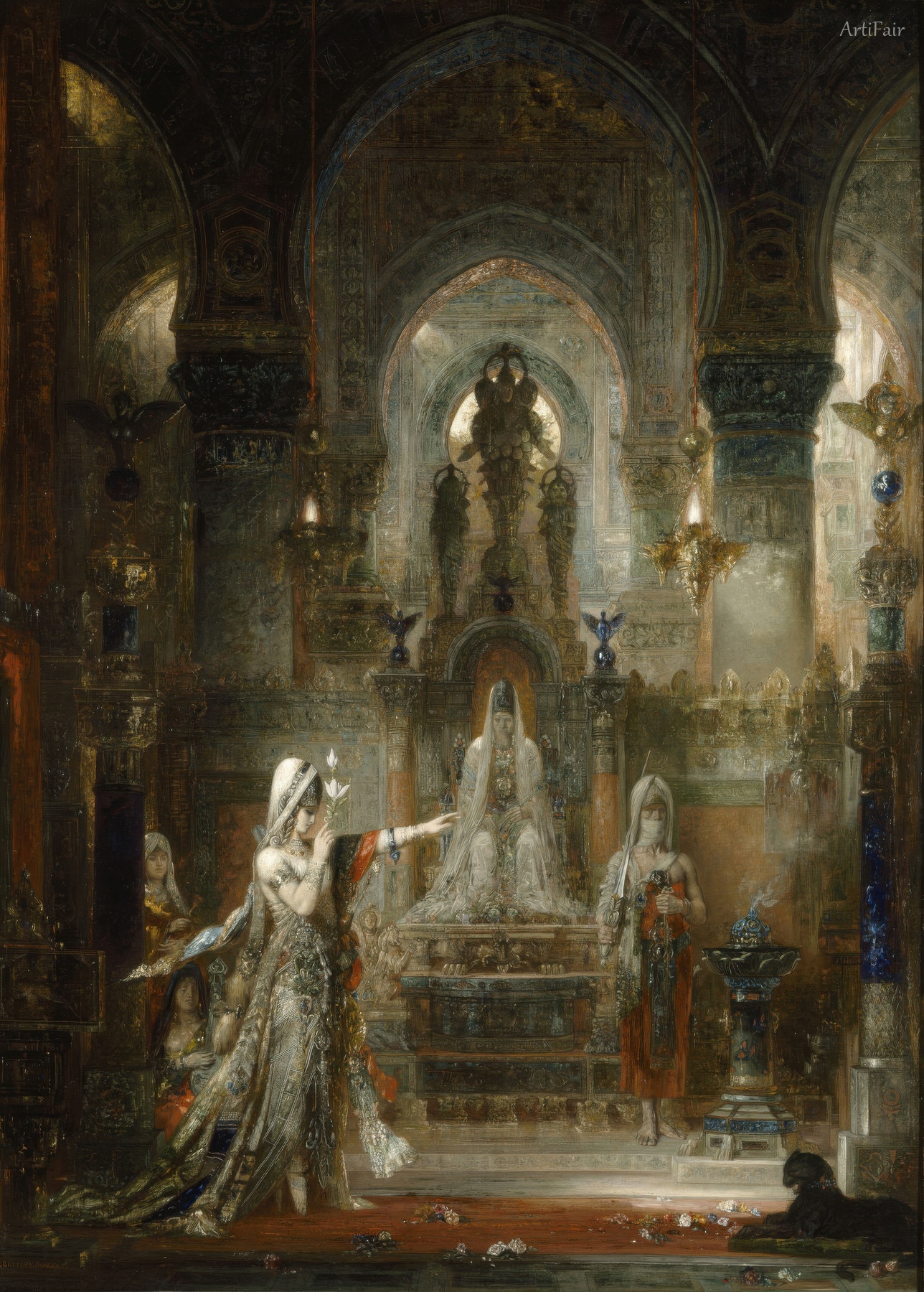
Salome Dancing before Herod (Salomé dansant devant Hérode) is an oil on canvas by Gustave Moreau, dated 1876 and measuring 143.5 × 104.3 cm, in the Hammer Museum, Los Angeles (AH.90.48).
The Gospel of Mark tells how the daughter of Herodias danced at Herod Antipas's birthday feast and, on her mother's instruction, asked for the head of John the Baptist as her reward; the Gospels do not name her, but the historian Flavius Josephus gives her name as Salome. Moreau shows the dance itself, before the execution. In a vast, dimly lit palace, Salome advances on tiptoe in profile, wearing a tall headdress, a fine white veil and a jewel-encrusted costume, a lotus flower in her right hand and her left arm extended in a stiff gesture. Rather than dancing she seems frozen in a ritual step. Herod sits enthroned at the centre facing outward, Herodias and a lute player are at the left, the executioner waits at the right, and a black panther lies at the lower right.
The architecture fuses many sources: writers have linked it to Hagia Sophia in Istanbul, the Alhambra in Granada, the Mosque–Cathedral of Córdoba and medieval cathedrals, with motifs drawn from Etruscan, Roman, Egyptian, Indian and Chinese art. The Hammer Museum dates the painting 1874–1876 and calls it arguably Moreau's most important work.
Shown at the Salon of 1876 alongside his watercolour The Apparition, it caused a sensation, and together the two works helped launch a fashion for Salome that ran into the twentieth century. In his novel À rebours (1884), Joris-Karl Huysmans has his hero Des Esseintes describe the painting at length, naming Moreau. Moreau's paintings are rare in American collections. In 2012 the Hammer devoted the exhibition A Strange Magic: Gustave Moreau's Salome to it, with about fifty related paintings, drawings and studies lent by the Musée Gustave Moreau in Paris.