
The Yellow Christ
Category:
Created:
1889
Likes:
0
Dimensions:
Download:
New users get 4 free credits. 2K costs 1 credit; 4K and Ultra HD are priced by resolution. Public domain artworks can be used commercially.
Dominant colors
Public domain download summary
This artwork is provided as a public domain image resource. The 2K file costs 1 credit for everyday creative work, while 4K and Ultra HD files are priced by resolution.
Art Appreciation
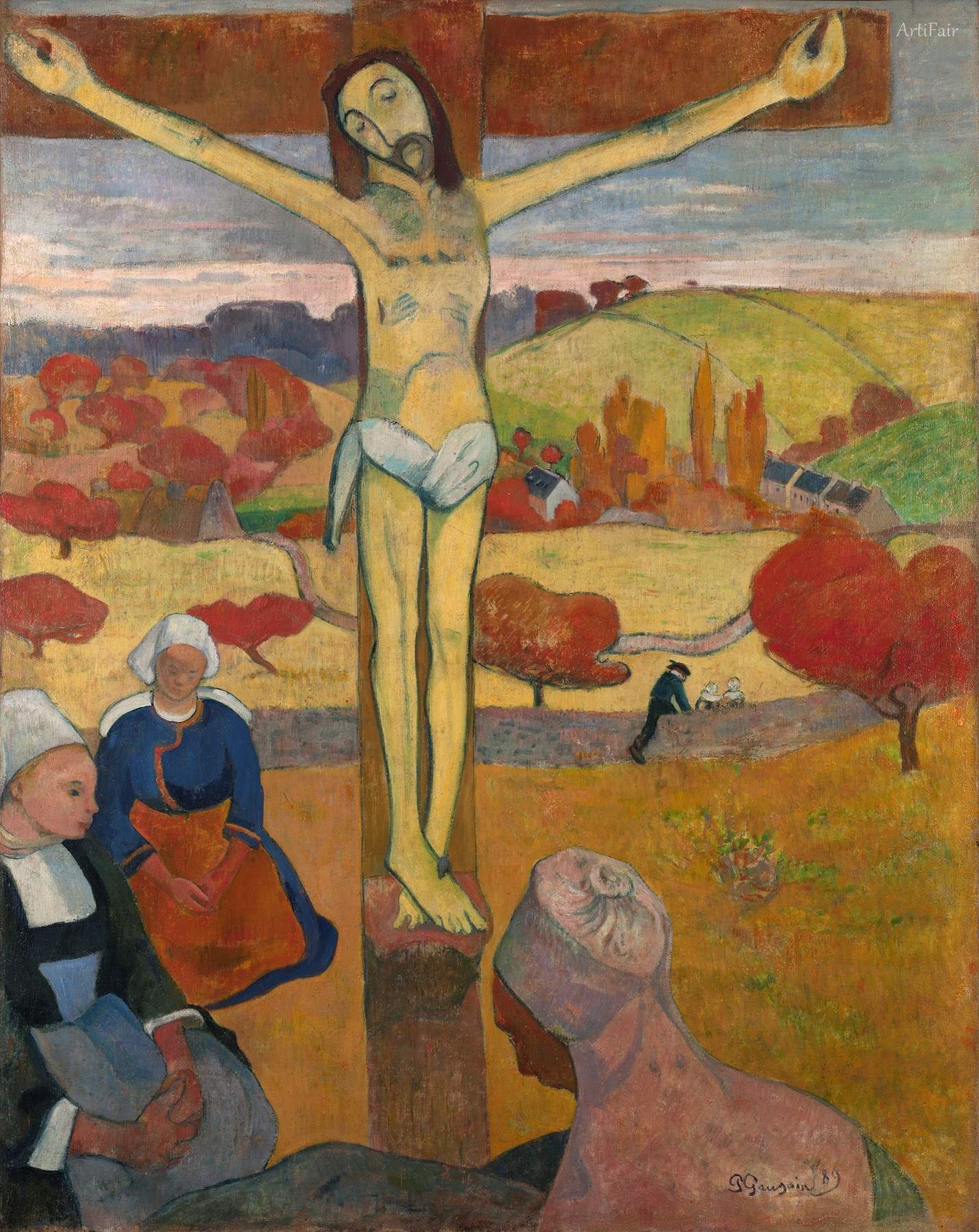
The Yellow Christ (Le Christ jaune) is an oil on canvas painted by Paul Gauguin at Pont-Aven in Brittany in the autumn of 1889; measuring 92.1 × 73.3 cm, it has been in the Albright-Knox Art Gallery, now the Buffalo AKG Art Museum, since 1946.
Gauguin first came to Pont-Aven in 1886 and returned in early 1888, leaving in October to join Vincent van Gogh in Arles for a little over two months. Back in Brittany early in 1889, he broke his stay only for a summer visit to Paris, to see the Exposition Universelle and organise the Volpini exhibition, and painted this picture soon after his return. The period produced several religious subjects, and The Yellow Christ, together with The Green Christ of the same year, is regarded as one of the key works of Symbolist painting.
The crucified figure is based on a seventeenth-century painted wooden crucifix in the Trémalo chapel near Pont-Aven. Gauguin set the crucifixion in the contemporary Breton countryside, with three peasant women in regional dress kneeling at the foot of the cross; the Buffalo museum connects the scene with the evening Angelus prayer. He said he chose the yellow to convey his feelings about the isolated life and piety of the peasants, and the autumn yellows, reds and greens of the fields and trees echo the colour of Christ's body. Flat areas of colour held within heavy dark contours, with shading kept only for the women, are typical of the cloisonnist style he was developing with his circle.
The critic Octave Mirbeau described the picture as a troubling mixture of barbaric splendour, Catholic liturgy, Hindu meditation, Gothic imagery and subtle symbolism. Gauguin placed it in the background of his Self-Portrait with the Yellow Christ of 1890. A pencil study for the composition is in the Thyssen-Bornemisza Museum in Madrid and a watercolour version in the Art Institute of Chicago. The canvas is signed and dated 'P Gauguin 89' at lower right and was bought by the Buffalo gallery with general purchase funds.