
The Death of Socrates
Category:
Created:
1787
Likes:
1
Dimensions:
Download:
New users get 4 free credits. 2K costs 1 credit; 4K and Ultra HD are priced by resolution. Public domain artworks can be used commercially.
Dominant colors
Public domain download summary
This artwork is provided as a public domain image resource. The 2K file costs 1 credit for everyday creative work, while 4K and Ultra HD files are priced by resolution.
Art Appreciation
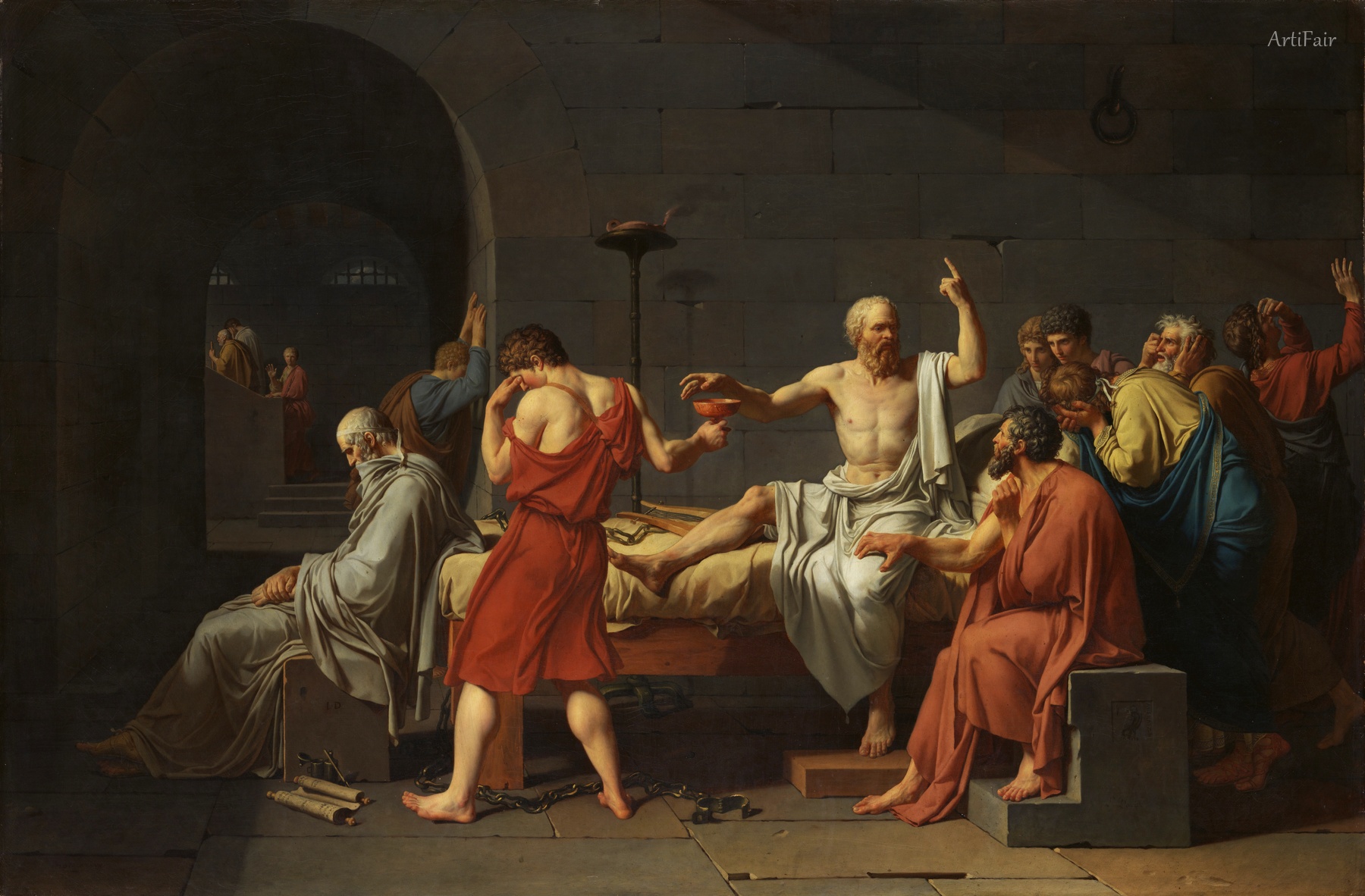
The Death of Socrates is an oil-on-canvas painting by Jacques-Louis David, dated 1787 and measuring 129.5 × 196.2 cm; it has been in the Metropolitan Museum of Art, New York, since 1931.
The picture was a private commission, given to David in 1786 by the young and wealthy Charles-Michel Trudaine de la Sablière, though David had already sketched the subject in 1782. Its source is Plato's Phaedo: convicted of corrupting the youth of Athens and introducing strange gods, Socrates is about to drink hemlock and, refusing the chance to escape, spends his last moments teaching. David took advice from the Hellenist Father Jean Adry, and the poet André Chénier, a member of Trudaine's circle, seems to have suggested the pose of the philosopher reaching for the cup while still speaking.
Socrates, in white, sits upright on the bed with one hand over the cup and the other pointing upward. Around him his followers give way to grief: the young man who hands him the poison turns his face away, Crito grips his teacher's thigh, and an aged Plato sits slumped at the foot of the bed, although Plato was in fact young and not present. Through the arch, Xanthippe looks back as she is led up the stairs. David simplified the cast of the dialogue and idealised Socrates' face and body. He signed the work twice, with his full name beneath Crito and his initials beneath Plato.
Shown at the Salon of 1787, where Pierre Peyron exhibited a rival Death of Socrates, the painting was widely praised; critics felt the comparison settled the two painters' rivalry in David's favour, and Thomas Jefferson called it the best work in the exhibition. David showed it again at the Salon of 1791. After Trudaine and his brother were guillotined in 1794 it passed through inheritance and private sales until the Met bought it in 1931 through the Wolfe Fund.