
Bathsheba
Category:
Created:
1889
Likes:
0
Dimensions:
Download:
New users get 4 free credits. 2K costs 1 credit; 4K and Ultra HD are priced by resolution. Public domain artworks can be used commercially.
Dominant colors
Public domain download summary
This artwork is provided as a public domain image resource. The 2K file costs 1 credit for everyday creative work, while 4K and Ultra HD files are priced by resolution.
Art Appreciation
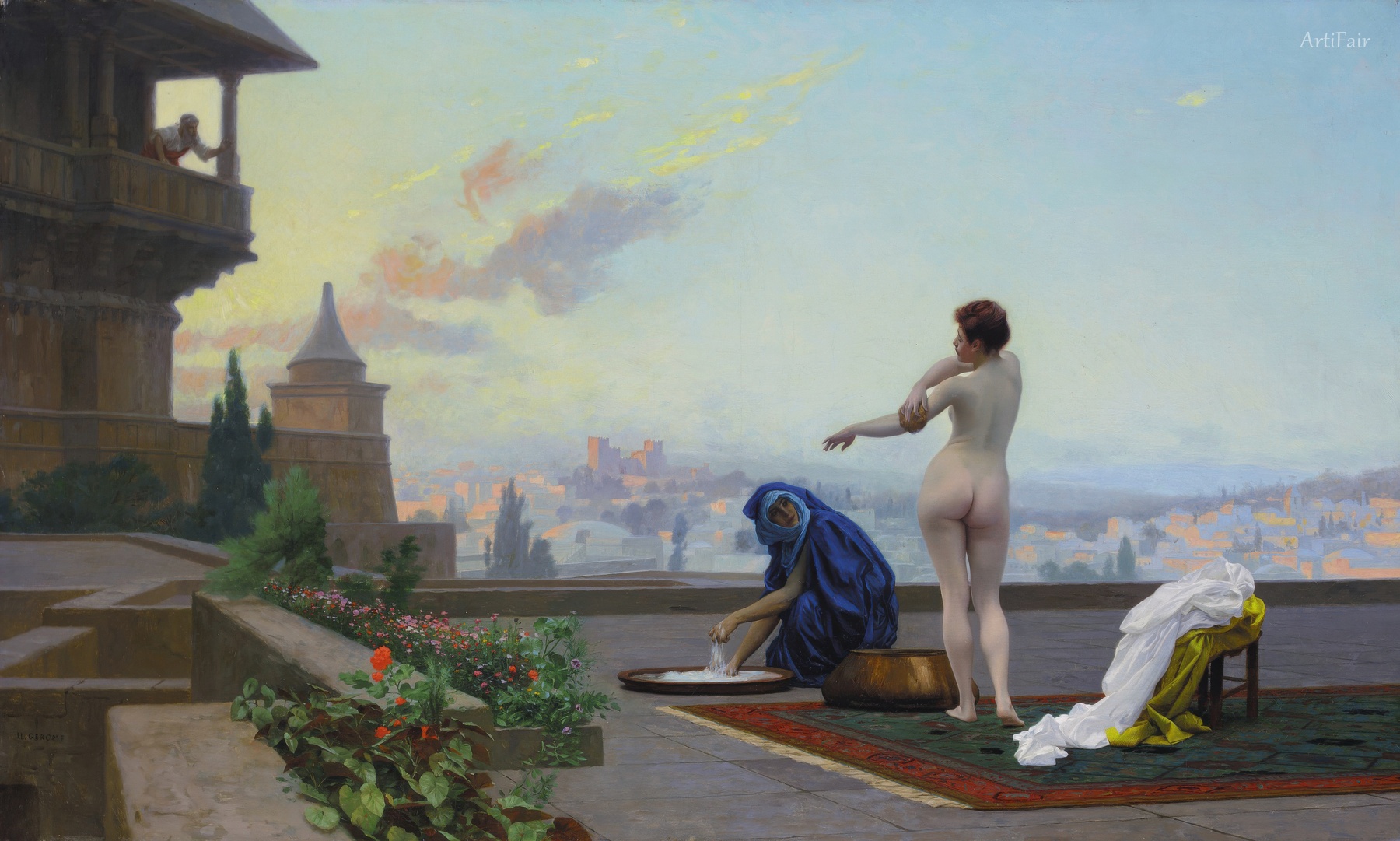
Bathsheba (Bethsabée) is an oil painting on canvas by Jean-Léon Gérôme, painted at Bougival in the summer of 1889 and now in a private collection.
The subject comes from the Second Book of Samuel: one evening King David, walking on the roof of his palace, sees a very beautiful woman bathing. She is Bathsheba, wife of Uriah the Hittite, and David's desire for her leads him to arrange Uriah's death in battle before taking her as his wife; their second son is Solomon. Gérôme shows Bathsheba standing naked on a carpet on a rooftop terrace, her back to us, washing her arm, while a servant in blue kneels beside a basin and her white and yellow clothes lie on a stool. On a balcony at the upper left a small figure of David looks down. Beyond the parapet a sunset sky spreads over an imaginary city meant as Jerusalem.
According to his biographer Fanny Field Hering, Gérôme worked on the roof of his summer studio at Bougival, screened by trees and shrubs from curious eyes, so that he could pose models in the open air and study changing atmospheric effects. Hering called the figure a marvel of plastic grace and delicate flesh tints. Sotheby's describes Bathsheba as a bather from Gérôme's many interior bath scenes moved into natural light. A preparatory oil sketch without the shrubs and flowers sold at Sotheby's New York in 1995.
The canvas, 60.5 × 100 cm, is signed J.L. GEROME at lower left. It belonged to Eugène Lyon in Brussels and later to the sculptor Antonin Mercié and to Yvonne Coty, and was sold at Sotheby's in 1990, 2005 and 2017. In 1896 Gérôme turned the figure into a sculpture; a tinted plaster version is in the Dahesh Museum of Art, New York.